Published: May 21, 2026 | Category: Essay, AI, Management & Work
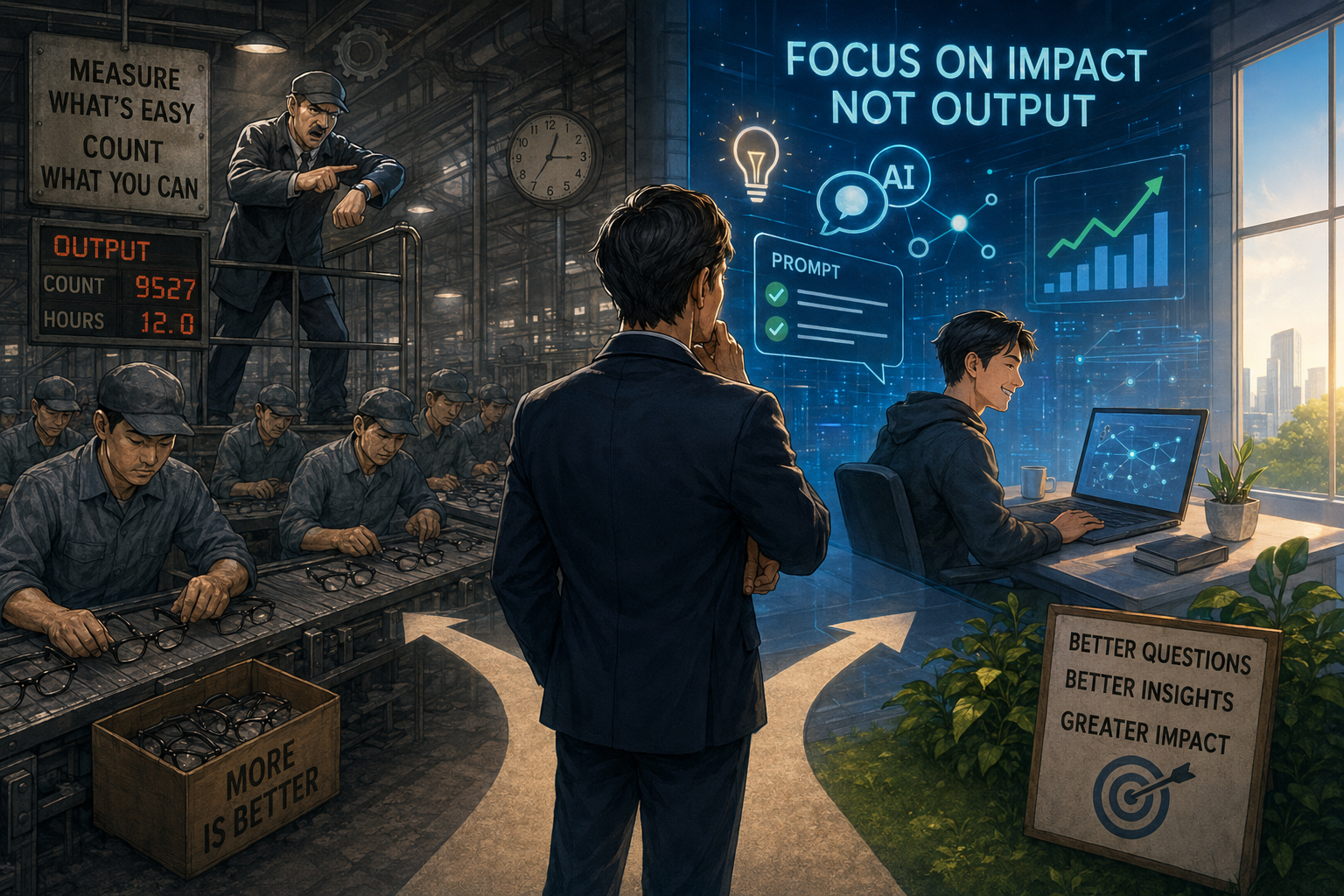
1. Opening: The Curse That Rules Every Workplace — Goodhart's Law
There's a classic iron rule in management science that managers always seem to forget — Goodhart's Law:
"When a measure becomes a target, it ceases to be a good measure."
Put plainly: when management wants to measure some abstract concept — say, "are the employees actually working hard?" — but lazily picks the most easily quantifiable data point as the evaluation criterion, the disaster begins. Because everyone's behavior immediately bends toward that single metric, and they stop caring about what actually mattered: the outcome.
The most classic Goodhart tragedy in history is the Soviet eyeglass factory. The government first evaluated factories by number of glasses produced, so factories cranked out paper-thin, instantly-shattering glasses. The government noticed and switched the metric to total weight of glasses produced — at which point the factories started producing iron-framed monstrosities so heavy no human could wear them.
You might think this kind of brain-dead management belongs to the old factories of the past. It does not. In the most cutting-edge corner of American Silicon Valley, a high-tech remake of the Eyeglass Factory Farce is now playing in full swing.
2. The Silicon Valley Spectacle: The Mad Token Incinerator
Recently, several tech outlets exposed a tragicomic new internal-management trick at Silicon Valley giants: in order to see whether employees are actually doing anything, the leadership has started pulling back-end data — and ranking employees by how many tokens (the basic unit of text in LLMs) they consume when talking to AI. Tech circles have even coined a new term: "Tokenmaxxing" — maxing out one's token count.
Meta's "Claudeonomics" leaderboard: Internally, they reportedly set up an employee leaderboard ranking everyone in the entire company by the number of tokens they burned chatting with AI. To avoid looking too far down the list, or to chase the empty glory of being a "Token Legend," employees began frantically talking past their AI assistants, dumping in absurdly long passages just to pad the count. Even more absurd, leadership publicly endorsed the logic — claiming that burning more tokens meant AI was acting as a "productivity multiplier."
Amazon's AI-agent "perpetual-motion machine": Amazon, likewise, tracked token consumption on an internal leaderboard. Sharp engineers saw the game instantly: they wrote scripts using automated agents so the AI could happily chat with itself, auto-reviewing pointless monster codebases, 24 hours a day in the background. The employees lived their lives outside; the AI inside frantically ran up the meter. The boss looked at the skyrocketing token bills and assumed everyone was "working overtime like crazy" — when in fact it was just a vast pile of digital garbage with no value at all.
This is, frankly, just the old "measure clock-in hours" or "count lines of code" management mindset wearing a shiny new coat called AI.
3. A Magical Hypothesis: What If Biomedical Informatics Adopted This KPI?
You might be thinking — this is just a Silicon Valley sideshow, none of my business. But if this "evaluate-people-by-tokens" wisdom were transplanted word for word into where I actually work — the biomedical informatics field, which wrestles every day with gene sequences, electronic medical records, and public-health big data — the picture would be too beautiful to bear.
Imagine: in a field that is supposed to be defined by rigorous, precise, logical data mining and data analysis. As soon as the boss (the professor) starts evaluating Token throughput, the entire lab's mood shifts at once:
The tragedy of gene-sequencing analysis: A truly skilled engineer might write a few precise Python scripts, using minimal tokens to perfectly clean the data and pull out the key pathogenic mutation sites. Result: because they used too few tokens, they sit at the bottom of the institution's leaderboard, get called into the boss's office, and are told they're "not working hard enough." The next day, to satisfy the KPI, everyone goes off the deep end. To analyze a short DNA segment, you first ask the AI to recite the entire Huangdi Neijing and the full NCBI literature library, then order it to explain adenine and thymine in "Shakespearean prose." By the time the gene is finally analyzed, the institution's electricity bills and token bills have already exploded.
The disaster of EMR data mining: The thing big-data clinical analysis fears most is noise. But to chase Token Productivity, everyone is forced to take their nice clean structured data and feed it to AI for a "text mega-expansion." A simple piece of feature engineering — "patient has a history of hypertension" — gets bloated by the AI into a fifty-thousand-character treatise titled An Evolutionary History of Hypertension and Human Civilization. In the back end, the AI is hitting its Token-Maxxing peak; in the front end, the servers are smoking. The model that finally emerges is full of meaningless textual noise, and the actual life-saving clinical signal is buried under it.
Of course, this is purely a thought experiment. None of this is actually happening. Fortunately. Fortunately. ~~~
4. The Core Reflection: Work Hard ≠ Work Smart
The blind spot for these high-tech bosses is that they mistake frantic Token-burning for "Working Hard." But in reality, burning Tokens like a maniac usually points to one of two things: either the employee doesn't actually know how to write a prompt and is wasting a sea of dead tokens talking past the AI, or they're having the AI churn out a flood of empty fluff text and redundant code, using volume to cover for a lack of quality.
The genuinely effective people in the workplace are usually the ones who understand "Work smarter, not harder." A true expert, with deep experience and sharp intuition, may need only three high-quality prompts to get the AI to surface the core insight and unlock huge business value. Meanwhile, the person at the top of the leaderboard burning millions of tokens a day may simply be paying the company's server electricity bill.
Blindly pursuing volume of output, instead of actual impact, only creates the labor illusion of "looking busy with high tech."
5. Conclusion: The New Workplace Motto for the AI Era
The whole point of bringing AI in was to free people from mechanical labor so they could spend their time on higher-order thinking, decision-making, and architecture. If management's thinking is still stuck at industrial-revolution piecework or hourly wages, technology will bite back hard — forcing employees to use the most advanced tools to game the system, turning technology into the digital ankle bracelet of a new era.
In the past, we said: Work smarter, not harder. In the new era of human-AI collaboration, both managers and employees should remember a brand-new workplace motto:
"Prompt smarter, not prompt harder."
(Ask better — don't just blindly run up the meter.)
Real efficiency is measured by how big a problem you solve for the company with the least, most precise effort — not by how many meaningless strings you've dumped onto the server today. Otherwise, the boss of the future will open the back end one morning to find a roomful of AI reciting War and Peace day and night — while you, long since clocked out, are off living your actual life.