Published: April 2, 2026
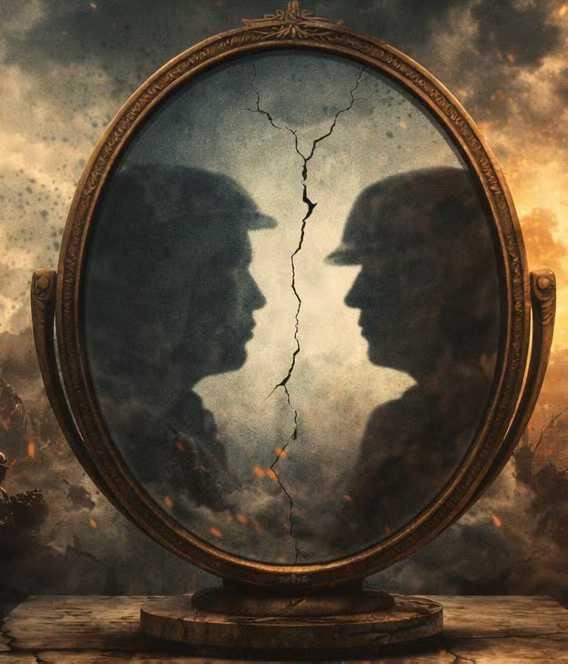
What is most worrying about this person's stance toward Iran is not simply whether he understands war, but whether he is understanding the enemy through the lens of understanding himself. On one hand, he claims the primary military objectives have been achieved and declares victory. On the other hand, he continues to deploy more troops, escalate threats, and demand support from other nations — revealing glaring contradictions within his own Iran strategy. At the same time, analysts have noted that the political operations of his second term increasingly emphasize personal loyalty, exhibiting a highly personalized style of leadership.
This leads to a problem that has recurred throughout history: mirror-imaging. That is, when a leader does not understand an adversary according to the opponent's own institutions, society, and culture, but instead projects his own experience of power onto the enemy. If someone habitually views politics as "a core figure plus a circle of loyalists," he will easily assume the other side works the same way: take down the supreme leader, decapitate the top echelon, and the entire regime will collapse along with them. But real nations often stand not on the shoulders of a few individuals, but on far deeper structures: local communities, fiscal capacity, civil-military networks, national sentiment, and even a collective consciousness that is ignited precisely by foreign invasion.
Chinese history is full of such mistakes. Before Qin conquered Chu, General Li Xin believed 200,000 troops would suffice, while the veteran General Wang Jian insisted on at least 600,000. The King of Qin first adopted the lighter, faster plan — and suffered a defeat. He ultimately had to rely on Wang Jian's massive army and a strategy of attrition. The problem was not merely a miscalculation of troop numbers; Qin had briefly treated Chu as just another opponent that could be swiftly knocked out using the same formula, underestimating Chu's geographic depth and political resilience.
The Jingkang Incident illustrates the point even more clearly: destroying the center does not mean destroying the nation. When the Jurchen Jin armies captured the capital Kaifeng and abducted the Song emperor, it appeared to be a textbook decapitation strike. Yet the Song dynasty did not vanish. Zhao Gou fled south and established the Southern Song, continuing the dynasty for over a century. This demonstrates that a regime's true lifeblood may not reside solely in its capital and its emperor — it can also live in southern revenues, local governance, and the legitimacy embedded in political tradition. The Jin armies took the capital, but they did not take all of Song.
The Ming dynasty's misjudgment of the Jurchens represents yet another form of mirror-imaging. The Jurchens had been tributaries to the Ming for a long time and were incorporated into the Ming's frontier management and command structures. This easily bred an illusion within the Ming court: since you have already been classified and administered within our institutional language, you have been truly absorbed by us. But the rise of Nurhaci later proved that what the Ming had seen was only "the Jurchens within the existing order" — they had failed to see a new capacity for internal consolidation forming within Jurchen society. Those frontier relationships that once appeared stable became, in fact, the very foundation upon which the Later Jin state was built.
In the modern era, Japan made the same mistake. After establishing the puppet state of Manchukuo in northeast China, Japan pursued a quick victory over China in 1937, evidently believing that China's central authority was weak and its regions fractured — that another heavy blow combined with puppet regimes would cause the country to collapse rapidly. But Japan misread one crucial thing: political fragmentation does not equate to the disappearance of social will. Foreign invasion can, in fact, re-weld those fractures into national resistance.
And so, the truly mature lesson of history is quite simple: Many strategic miscalculations arise not from ignorance of military affairs, but from imagining the enemy's nation, society, and people as a mirror image of one's own. Qin did this. Jin did this. Ming did this. Japan did this. And for that matter — does this person suppose that if an enemy of the United States eliminated the American president, the entire country would surrender and collapse? How is it that this particular mirror-image never seems to occur to him?