Holy Academy
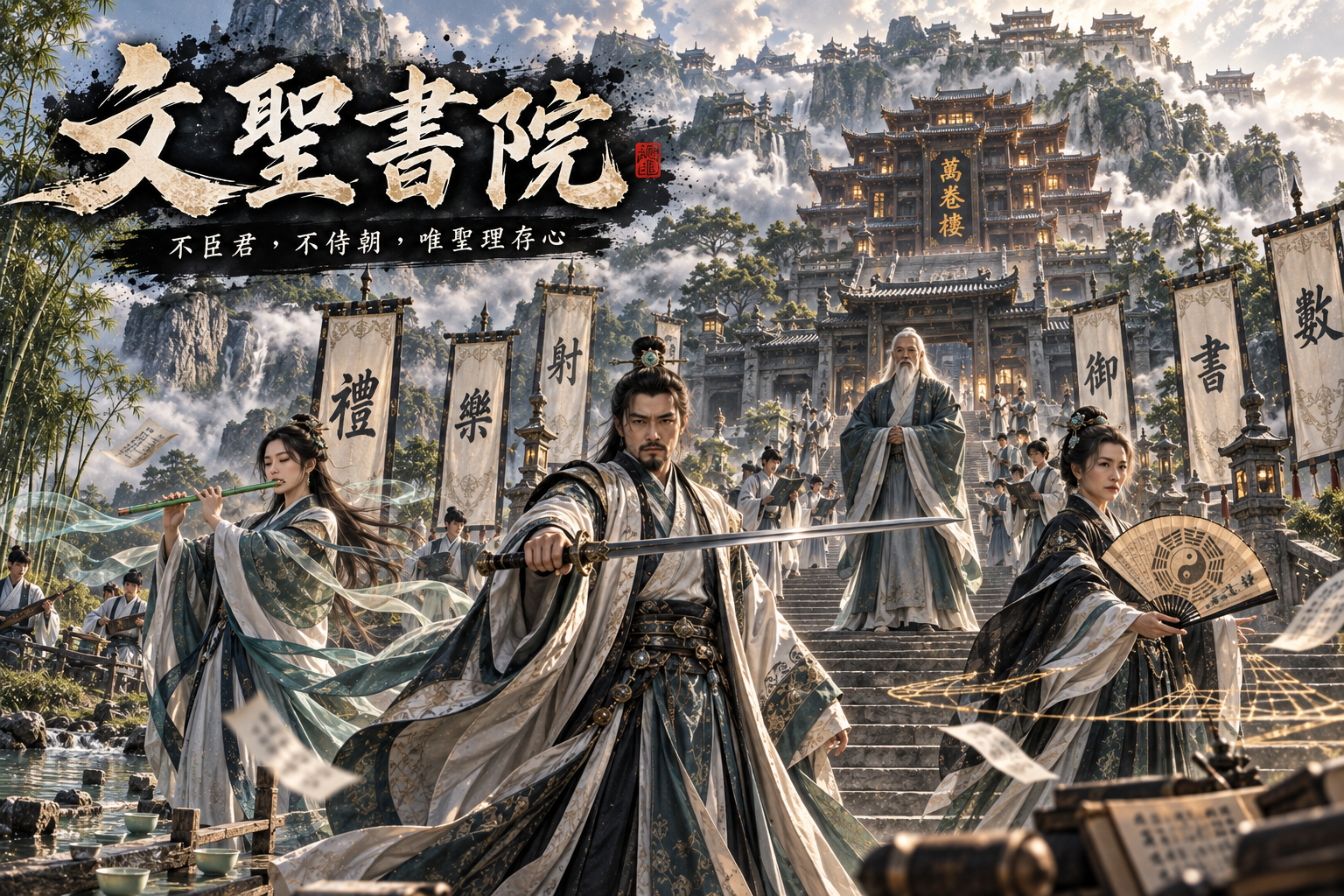
- 🔹 Also known as: the School of the Sage of Letters, Hengshan Academy, the First Academy Under Heaven
- 🔹 Creed: Serve no sovereign, attend no court — keep only the sages' truth in your heart
- 🔹 Headquarters: The Holy Academy on Wenyuan Peak, Mount Heng, in the Shuntian Dynasty
- 🔹 Nature: A school that stands above the world — the Outer College is open to all; the Inner College swears never to take office
📜 Background
The Holy Academy was founded in the final years of the old Yanwu Dynasty and is more than twelve hundred years old. Its founder, the "Great Sage Wenyuan" Sheng Xuanci, was born into a Confucian family and raised on the teachings of the Hundred Schools, mastering rites, music, and the art of war alike. Once, a single scroll of his strategy secured the Northern Frontier; once, a single plan he presented ended an internal rebellion. Yet he refused to attach himself to powerful ministers and would not accept titles or office. He resigned, went into Mount Heng, opened the mountain to students, and swore the oath "Serve no sovereign, attend no court — keep only the sages' truth in your heart." So the Holy Academy was born.
From then on the Academy stood apart from every dynasty that rose and fell. It has never claimed glory through force of arms, yet it can decide life and death by reason, calm fury with music, and turn a battle with a formation. Emperors have revered its tradition or feared its scholars; none have dared move against it. Instead, dynasty after dynasty has granted it charters and raised steles in its honor, naming it "the Fountainhead of the Way of Letters."
The Academy and the dynasties:
- A thousand years ago, the founding emperor of one dynasty, caught in usurpation and civil war, received the secret aid of strategists sent by the Academy and pacified the Central Plains;
- Five hundred years ago, a white-robed Sage of Letters drove back an army of a hundred thousand in a mountain valley with his "Formation on Paper";
- In the first years of the Shuntian Dynasty, the chief strategist is said to have been a sage hidden in the Inner College. He came down the mountain for three years, "settled the realm with nine plans," and helped the emperor unify the Central Plains. Once the empire was secure, he resigned, returned to the Inner College, and has not been seen in the world since.
So the Holy Academy stays out of court politics yet can sway the course of wars; it takes no orders from the throne yet enjoys the reverence of the people.
The Academy teaches more than Confucianism. Over a thousand years it has given shelter to the scattered learning of many schools — Mohist engineering and mechanisms, the Logicians' art of debate, the Agriculturalists' water works, the Yin-Yang School's numbers of Qimen Dunjia. These remain in the Outer College's branch colleges to this day, the most famous being the Mohist Branch College. The Academy's stance toward them has never changed: preserve them, teach them, but never found a school on them. This has saved many arts that should have been lost — and earned the Academy plenty of scorn for "burning a mountain of gold as firewood." Mo Li, who left for the Commercial Republic thirty years ago and later founded the Heavenly Craft Pavilion, was the loudest critic of all.
🏔️ Geography and Key Locations
Wenyuan Peak: Seat of the Academy's main college and one of the seventy-two peaks of Mount Heng. Its summit is flat as a terrace and wrapped in cloud all year. The Academy follows the slope in three tiers — the gate and lecture halls below, the library in the middle, the Inner College at the top, which no one may climb to unless summoned.
The Tower of Ten Thousand Scrolls: The greatest library under heaven — seven stories holding more than three hundred thousand scrolls, including many sole surviving copies long lost in their own countries. Floors one through six are open to anyone who wishes to learn, whatever their birth, nation, or sect — the most admired rule in the Academy's thousand years. Even disciples of the Blood God Sect have read here, so long as they didn't start a fight.
The Locked Scripture Loft: The seventh floor of the Tower, locked all year round, and the only place in the Academy closed to outsiders. It holds just three kinds of records: gazetteers of the northern demon tribes and old records of their portals; construction plans for the great formations and seals of past ages (including part of the building records from when Shushan's Demon-Suppressing Tower was first raised); and fragments of curses seized in past campaigns against heretical cults — which the Academy will neither burn nor return. Opening the Loft requires two seals used together, the Headmaster's and the Chancellor of the Outer College's. In a thousand years it has been opened fewer than forty times on record.
Cen Shouzhuo once said: "The Academy forbids no one to read — except one kind of book: the kind that, once read, stops anyone else from ever reading again."
The Winding Stream of Floating Cups: A man-made, winding stream on the mountain behind the Academy, its banks thick with bamboo. Twice a year, in spring and autumn, the Academy holds the "Winding Stream Gathering": disciples sit along the water, wine cups float downstream, and whoever a cup stops in front of must play music, argue a point, or draw a sword. The Academy's lightness skill, "Stream Step," comes from this.
The Hall of the Six Arts: Where the Outer College teaches — six lecture halls around a central courtyard, teaching rites, music, archery, charioteering, calligraphy, and mathematics. Scholars from across the realm, sons and daughters of civil officials, and heirs of the powerful may all sit a trial lecture to enroll. Most of the officials, strategists, and military advisers of every dynasty came from here. Many copies have been built across the Four Nations — the "Breeze Academy" in the Moonrise Empire's Tokaido, which once taught the Analects, is said to have been laid out from an old plan of the Hall of the Six Arts.
The Mohist Branch College: A separate compound halfway up the mountain, its roofs forever crowded with half-built waterwheels and crossbows. No martial arts are taught here — only engineering, water works, and machinery. Its students are not Inner College disciples; after leaving the mountain most join the Ministry of Works or the Ministry of Waterways, or head south to the Commercial Republic.
The Nameless Study: A bare room deep in the Inner College, with no plaque over its door. It is said that everyone who swears into the Inner College must spend their first night here alone, with nothing in the room but a lamp, a sword, and a scroll. What is written on that scroll, no one who comes out will ever say.
🏯 The Outer and Inner Colleges
The Academy is divided into two tiers, the "Outer College" and the "Inner College." The system is strict and the line between them is sharp.
Outer College | Raise talent for the world, help govern the realm
The Outer College is every scholar's dream. There is no entry threshold and no need to take a master. It teaches the classics, self-cultivation, law, and military texts, along with the basics of qi cultivation, swordsmanship, and brush technique. Outer College disciples may roam the jianghu, serve at court, join another sect, go into trade, or enlist — the Academy asks no questions.
That is why the foot of Wenyuan Peak is always crowded with people from every country — some truly here to learn, some here to copy books, some scouting the way, and some spies sent by one nation or another. The Academy knows, and lets them be.
Inner College | Guard the ancient Way, rescue a world in chaos
The Inner College is the heart of the Academy. Only those who pass rigorous examinations in the Outer College and show extraordinary talent, virtue, and character are ever brought in.
Whoever enters the Inner College must swear before the statue of the Great Sage Wenyuan: never to be a subject, never to hold office, never to accept title or salary.
Only after the oath are disciples taught Righteous Qi, Court Music, Trigram Fan, and the supreme art Three Odes. In ordinary times they cultivate the mind and seek the Way; only when the world falls into disorder and chaos is at hand may they come forth to steady the realm with strategy and to aid the people.
As the saying goes: "Every strategist at court came from the Outer College; when the world needs a true sage, it looks to the Inner College."
⚔️ Martial Arts Overview: One Classic, Six Arts
The Academy's martial arts are built on "One Classic, Six Arts": beneath the root text, the Comprehensive Mirror of the Six Arts, lie six disciplines — Internal Force · Sword · Brush · Fan · Music · Movement.
The philosophy is "hold the sword with rites, set the heart right with music, lay out formations with numbers" — Academy disciples are never outstanding in a duel, but as long as one is on the field, their allies fight harder and harder and their enemies can barely take a step. It is the only sect under heaven founded on "sustained strength" rather than "the power of a single blow."
Leveling a skill is cultivation: every scroll read, every piece played, every person protected makes reason clearer, qi stronger, and martial arts deeper.
Basic skills this sect requires (fan, instrument, and music are newly created for this sect):
| Basic Skill | Chinese | Category | Special Skill |
|---|---|---|---|
literacy |
讀書識字 | Knowledge | ConfucianArts |
music |
樂律 | Knowledge | CourtMusic |
force |
內功 | Internal Force | NurturingQi → RighteousQi |
sword、parry |
劍法 | Attack | GentleSword |
dagger |
短兵 | Attack | AnnalsBrush |
fan、parry |
扇法 | Attack | TrigramFan |
instrument |
樂器之法 | Attack | JadeChime |
dodge |
輕功 | Defense | StreamStep |
music is knowledge; instrument is a martial skill. Music belongs in the same category as literacy — it takes no part in attack or defense checks, grows through reading scores, listening to music, and practice, and determines "how much you understand." Instrument sits alongside sword and fan as a true weapon skill, and determines "whether you can actually hit someone with this qin."
The Academy demands both, and each holds the other back (see the Jade Chime section). This is what makes the sect so hard: disciples of other sects can go into battle after mastering one weapon, but an Academy disciple has to understand music before they can hold an instrument steady.
The supreme art ThreeOdes is not attached to any basic skill; see the end of this page.
📚 Foundation · Confucian Arts (ConfucianArts)
Type: special skill of literacy
The Academy's root classic, equivalent to Shushan's Taoist Canon or the Gessho Sect's Hongan-kyo. Everyone who enters the Academy must first master the Comprehensive Mirror of the Six Arts — "Whoever has not mastered the Six Arts may not call themselves a disciple of the Academy," says the Academy's rule.
The Six Arts are rites, music, archery, charioteering, calligraphy, and mathematics. The Academy holds that martial arts are nothing more than the Six Arts made visible in the body: rites teach when to advance and yield, music harmonizes heart and qi, calligraphy trains the wrist, mathematics reveals change. Without the Six Arts, even a disciple who learns a finishing move will never perform it fully.
The Six Arts are the root of the whole school. However deep a disciple's Six Arts go, that is how high the ceiling of every other art rises with them — sword, brush, fan, qin and flute, footwork: not one of them climbs past the Six Arts. And the depth of the Six Arts in turn depends on how well a person can read: read shallowly, and the Six Arts never root deeply; and if the Six Arts never root deeply, however hard you train your hands, they grow only so far.
There is not a single move in the Comprehensive Mirror of the Six Arts. That is deliberate — the Six Arts are the root of the school, not something to hit people with. Anyone who tries to fight with them, the Academy says, is "pulling down a roof beam to use as a club."
Unlike other sects, the Six Arts are measured subject by subject. Disciples may choose which subjects to focus on, and each subject caps a matching set of martial arts. Only "music" is not a subject of its own — the "music" the Academy speaks of is simply music itself. A disciple who does not understand music holds Jade Chime and Court Music in name only, and just makes noise with an instrument.
| Subject | Caps |
|---|---|
| Rites | Gentle Sword, parry |
| Music | Not a separate subject — it is music itself. How far Jade Chime and Court Music go, and how many pieces can be sustained at once, all depend on music |
| Archery | Hidden-weapon accuracy and flute range (the Academy uses pitch-pot in place of the bow, in the spirit of ritual archery) |
| Charioteering | How many people a formation or piece of music can cover — "charioteering" means the number one can command |
| Calligraphy | Annals Brush |
| Mathematics | Trigram Fan and the finer points of formations |
Charioteering is the key trade-off when choosing what to focus on: however high your sword and fan, if your charioteering is weak, one piece of music covers only two or three people; with deep charioteering, one piece covers the whole field. That is why the Academy's teachers always say: "What matters most is not winning — it's how many people you keep inside."
Note: literacy is a general basic skill; Shushan's Taoist Canon and Gessho's Hongan-kyo are both attached to it. Because the Outer College is open to all, it is the place in the world where literacy can be trained highest — disciples of every sect who want to deepen their learning have mostly spent a few months sitting in the Tower of Ten Thousand Scrolls.
📖 Internal Force (Outer and Inner Colleges)
The Academy's internal art is called the Collected Nurturing of Qi, in two volumes. The Outer College teaches the first, the Inner College the second. The second volume builds on the cultivation of the first — nothing needs to be retrained.
Outer College · Nurturing Qi (NurturingQi)
The introductory method of the first volume, focused on "preserving the heart and nurturing one's nature." Breathing is paired with recitation, the meaning of the words guides the qi, and the qi follows the mind; over time the meridians open and the will settles. The art is balanced and gentle, with no bias and no danger — ten years of practice will never hurt you. But it won't take you far either.
Three stages, each of which becomes an internal art of its own:
- Stage one, "Preserving the Heart" — qi sinks to the dantian and the mind is gathered in.
- Stage two, "Nurturing Qi" — qi circulates the full cycle. This qi can nourish yourself or others: it heals your own wounds, and your companions' too. It is the first way an Outer College disciple learns to help another person.
- Stage three, "Holding Resolve" — resolve fixed, qi steady.
Holding Resolve is the peak of the Outer College. Internal force has a fixed limit, and ten thousand more scrolls won't carry you past it. The Academy is blunt about this: "The first volume is for people who are going down the mountain."
Inner College · Righteous Qi (RighteousQi)
The method of the second volume, taught only to those who have sworn into the Inner College. Mencius said of qi that "it is born of accumulated righteousness, not seized by a single righteous act" — qi is not taken; it is built up one righteous deed at a time. The Academy turned that sentence directly into a martial art, and so created the strangest internal art under heaven.
This art has no cap. Internal force grows with "accumulated righteousness."
Righteousness is not accumulated by sitting in meditation but by how you act: slaying demons, protecting the people, saving others from danger, refusing bribes, breaking rather than bending — these increase it. Killing the innocent, plundering villages, currying favor with the powerful, accepting titles and salary — these reduce it. The deeper your righteousness, the higher your internal force cap, the stronger One Thread becomes, with an extra bonus against evil spirits and demons.
Three stages (from the three principles of the Great Learning), each of which becomes an internal art of its own:
- Stage one, "Illustrious Virtue" — first understand what you yourself do. One whose virtue is illustrious breathes clear qi, and wounds outside and in alike dissolve on their own — a person with nothing on their conscience cannot keep a wound.
- Stage two, "Loving the People" — virtue is not kept to oneself; qi reaches others: you can pour your own internal force into a companion. What you pour out is always more than what arrives — and the Academy does not consider that a waste.
- Stage three, "Resting in the Highest Good" — qi and heart become one. Without raising your voice or lifting a hand, you say a single sentence, and no evil thing in the room dares to move. That sentence is spoken only to evil things; it has no effect on people. This stage is the foundation of the supreme art Three Odes.
The second volume builds on the first, and the three internal arts of the first volume stay in your hands as well — whoever enters the Inner College holds six internal arts.
This is the true price, and the true reward, of the Inner College oath: accept an office from the court, and your righteousness will never grow again.
🗡️ Sword · Gentle Sword (GentleSword)
The Academy's principal sword art takes the opposite road from Shushan's swordsmanship. Shushan breaks the air with sword qi and rains stars — an aesthetic of attack. Gentle Sword follows "move later, arrive first" — the opponent moves first, I move after, but I arrive first.
This is not yielding. The sword starts only in the instant the opponent begins his move, riding his forward momentum and following the gap he opens; parry and counter are two sides of one motion. The first thing the Academy teaches about the sword is: "If you can still tell which stroke is the block and which is the counter, you haven't learned it yet."
So this sword is not about who is faster, only who sees more clearly. The more rushed the opponent and the heavier his strike, the wider his opening and the harder the counter.
Moves, in order:
- 🔹 Yield (Yield) — cup the hands and bleed off force, guiding the opponent's power aside. It isn't taking a hit — it banks your next parry in advance: for a short time afterward your parries always succeed, and your counters hit harder.
- 🔹 Balance (Balance) — the sword holds the center line, leaning neither way. In this stance attack and defense are balanced; each successful parry in a row stacks "momentum," and full momentum greatly increases the power of your next strike.
- 🔹 Stay the Blade (StayBlade) — parry and counter land at the same moment. Damage scales with the power of the opponent's original move — the fiercer his attack, the heavier your counter; against brute-force, all-out attackers this move is the most terrifying.
- 🔹 One Thread (OneThread) [Inner College] — the one sword stroke you train for a lifetime. Named for the Analects' "My Way is bound by one thread": its power is set by your accumulated righteousness, with extra bonuses against demonic paths and demons. An Academy disciple may strike this blow only once in their life, but when they do, it is the sum of everything they have ever done.
✒️ Brush · Annals Brush (AnnalsBrush)
Outer College teaching, open to everyone. The writing brush serves as a short weapon — the shaft for thrusting, the tip for striking points — taking its meaning from "praise or blame in a single word": when Confucius wrote the Spring and Autumn Annals, a single word could fix a person's merit or guilt for a thousand years.
This brush art is deliberately modest in power: most Outer College disciples will leave the mountain, and if they were taught to kill too well, the jianghu would have a few more corpses. The teachers often say: "This brush technique is to keep you alive until you reach a place where people listen to reason."
Moves, in order:
- 🔹 Dot Stroke (DotStroke) — a turn of the wrist and the brush falls in quick jabs; low damage but extremely fast, with a chance to interrupt an opponent's charged move.
- 🔹 Verdict (Verdict) — the brush comes down like a judgment and marks a character on the enemy; for several rounds their accuracy drops and their spirit falters.
- 🔹 Through the Paper (ThroughPaper) — force gathered in the tip, with great penetration that ignores part of the target's armor.
- 🔹 The Great Verdict (GrandVerdict) [Outer College peak] — the last move an Outer College disciple can ever learn, taught only to those who reach the rank of "Erudite." The brush pronounces sentence, and its power depends on the opponent's evil deeds: the more blood on their hands, the fouler their name, the thicker their demonic aura, the harsher this stroke; against good people it barely stings.
One Thread weighs yourself; the Great Verdict weighs others — only together do these two moves make up everything the Academy believes about the "brush" and the "sword." Outer College disciples can never learn Three Odes, but the Great Verdict is what the Academy gives them instead: you don't have to take the oath to write a stroke on the world's behalf.
Note: Judge's Pen and Annals Brush share a source but went separate ways, and share the same short-weapon foundation. The Academy acknowledges the former came from an old Outer College art; it no longer teaches it, but does not forbid anyone from learning it.
🪭 Fan · Trigram Fan (TrigramFan)
One of the Academy's signature arts, taught in the Inner College: an Instructor chooses either this or Court Music; an Elder is taught both. It belongs to the Exotic Weapons (ExoticWeapons) and exists nowhere else in the world.
A fan opens into a shield, closes into a baton, and unfolds into a map. The Academy paints the numbers of the Eight Gates of Qimen on the fan's face, drawing on the art of "mathematics" to fold Qimen Dunjia into a hand-sized fan. Its wielder puts disrupting the order of the battlefield ahead of doing harm.
Core mechanic · Open and Close (FanStance): the fan has two stances and can switch at any time —
- Fan open · defensive: the fan face catches the wind, blocking hidden weapons, dispersing poison mist, and reducing damage in an area — protecting yourself and others.
- Fan closed · offensive: the ribs act as a short baton, striking pressure points and sealing meridians; extremely fast, aimed at casters and anyone charging a move.
Moves, in order:
- 🔹 Gale Sweep (GaleSweep) [open] — one sweep of the fan scatters poison smoke, knocks down hidden weapons, drives off miasma, and shields allies in an area.
- 🔹 Rib Strike (RibStrike) [closed] — the ribs strike vital points in quick succession, sealing the meridians; whoever is hit can't use a move for several breaths.
- 🔹 Eight Gates (EightGates) [open and closed together] — unique to the Academy. Standing in the middle of the field with fan in hand, you lay the Eight Gates of Qimen over the entire room: those in the Gate of Rest recover their breath, those in the Gate of Harm move sluggishly, those in the Gate of Death lose much of their accuracy, and those in the Gate of Opening can break away. Once the formation is set it affects everyone on the field, friend and foe alike — so whoever lays it must first work out which gate they are standing in. How many people it can cover depends on the Six Arts subject of "charioteering." It is the only "room-wide" sustained formation in the world.
🎼 Instrument · Jade Chime (JadeChime)
Taught from the Inner College's first rank, "Heart-Seeker." One of this sect's main attack skills, alongside Gentle Sword and Trigram Fan. Once a disciple has sworn the oath, the first things placed in their hands are a qin and a flute.
The name comes from Mencius: "He who gathers the great completion is like the sound of bronze and the resonance of jade" — bronze to begin, jade to end. This art is not about swinging a qin or flute like a club. It uses sound as a weapon: one pluck, one breath, and a blade of sound cuts through the air, striking from a distance.
The difference between a single note and a full piece is the key to this art:
- A single note is an attack — Jade Chime, an ordinary action in a combat round: fast, repeatable, reaching across the distance.
- A full piece is a domain — Court Music, which must be channeled over time and changes the whole field (see the next section).
As the Academy puts it: "One note wounds a person; one piece changes the battle."
Two instruments, two roles:
- Flute — sound straight and sharp: long range, fast, precise on a single target, aimed at an opponent's opening moves and charged moves.
- Qin — sound broad and deep: it can reach several people, but is slower to start.
Moves, in order:
- 🔹 Cloud Pierce (CloudPierce) [flute] — a note that rises straight through the clouds: a long-range single-target blade of sound, extremely fast, with a high chance to interrupt the opponent's opening move.
- 🔹 Silk Tear (SilkTear) [qin] — one stroke across all seven strings, the sound like tearing silk: it can hit several people.
- 🔹 Rhythm (Rhythm) [both] — beating time on the instrument for a multi-hit suppressing combo; once it lands, your next piece gains resistance to interruption while channeling. The key link for switching from attacking to playing in group fights.
- 🔹 Rest (Rest) [both] — cut the sound and ride the momentum to break free and open distance. This is the most important move before starting a piece — with someone tangled up with you, no piece can begin.
Fatal weakness: an instrument is, in the end, not a close-quarters weapon. Range is everything to Jade Chime; once someone closes in, no sound comes out, and a qin or flute in hand is nearly as good as empty hands. So when an Academy disciple is pressed close, the right move is to switch to the sword — Gentle Sword isn't there to win, it's there to hold on until you can open distance again.
How it and Music hold each other in check (the core of this sect's design):
- 🔹 Playing a piece requires holding a flute or qin —
musicis knowledge; however deeply you understand it, with no instrument in hand you can't play a single note. - 🔹 Whether a piece survives being hit while channeling is decided by
instrument— only a steady grip keeps the piece going. - 🔹 In the other direction, Jade Chime's sound effects (sealing meridians, breaking stealth, intimidation) are decided by
music— without an understanding of music, what comes out is just noise and does little damage.
One side is learning, the other is skill in the hands; lack either, and the other is only half as good. As the Academy often says: "An instrument without music is a club; music without an instrument is nothing."
Instruments to come: for now the Academy teaches only the qin and the flute; the xiao, pipa, bianzhong, and others are still being organized by Music Master Xiao Yumian, and may be added in the future.
🎵 Music · Court Music (CourtMusic)
One of the Academy's signature arts, taught in the Inner College (an Instructor chooses either this or Trigram Fan; an Elder is taught both). It is attached to the knowledge skill music and takes no part in attack or defense checks itself — it doesn't hit anyone; it changes the whole field. The only sect under heaven that brings music into martial arts.
The Academy considers "music" the most vital of the Six Arts — rites set people apart, music brings them together. Blades divide people; melody unites them. So Court Music does not harm the body but moves the heart and qi: allies who hear it find their blood and qi flowing freely and their spirits soaring like a rainbow; enemies who hear it lose their composure and no longer know whether to advance or retreat.
Playing a piece requires the matching instrument in hand (flute or qin), and handling the instrument belongs to Jade Chime (instrument), a separate art. Pieces follow two paths: flute pieces are sharp and focused, able to pierce one person; qin pieces are broad and lingering, able to fill a room.
Core mechanic · Channeling (Channel): playing a piece is not a single action but an ongoing state that occupies you. Once the piece begins, you stand outside the fight with your whole self in the music —
- 🔹 You cannot attack: while channeling you can't use moves — Jade Chime, sword, and fan all stop.
- 🔹 You can dodge: movement works as normal, and it is a player's only lifeline. Stream Step is the true protective charm of the Academy's musicians — which is exactly why this footwork is capped by
music: whoever can't keep the beat can't finish a piece. - 🔹 Being hit ends the piece: not being interrupted — being hit. Dodge it and nothing happens; take one hit and all your work is lost, your internal force wasted.
- 🔹 You must keep your distance from enemies: you can't start a piece while someone is tangled up with you — first break free with "Rest," let an ally block for you, or slow the enemy with Eight Gates.
The finer your music, the more pieces you can sustain at once; the finer your "charioteering," the more people a piece covers; the finer your instrument, the less likely a hit is to break the piece.
So the Academy's position in group fights is very clear: the musician stands at the very back, and the swordsman stands in front of them. This is also why Gentle Sword trains defense rather than attack — a swordsman's task was never to kill the enemy, but to let the person behind them finish the piece.
Repertoire: Court Music has six pieces, three for flute and three for qin. Each one can be learned only after a deed has been done — a piece is not taught, it is earned. When Music Master Xiao Yumian takes a student, she never asks whether you can play; she asks what you have done.
- 🔹 Stone-Splitting Note (StoneNote) [flute] — a note that pierces the clouds and splits stone: a single-target sound wave that strikes directly, and its shockwave breaks stealth — enemies who sneak, use illusions, or hide have nowhere to go.
The deed: books vanish from the Tower of Ten Thousand Scrolls night after night. The thief is inside the Tower, yet no one can find him — a single note from the flute must force him into the open. - 🔹 Soul Shake (SoulShake) [flute] — the sound reaches the soul: it falls hardest on demons and evil spirits, and those hit lose their morale and shrink back in fear.
The deed: in a village at the foot of the mountain, someone weeps every night — a lingering ghost that will not leave. The Academy performs no rites and chants no sutras; it plays a single piece and talks the ghost round. - 🔹 Three Variations on the Plum Blossom (PlumBlossom) [flute] — the plum blooms three times, each variation higher than the last, unbowed by the cold. The Academy's flute pieces were once only Stone-Splitting Note and Soul Shake, both short and sharp; for a flutist who has come this far, this is the first long piece of their own. It walks the road a flute should walk — guarding, not killing.
The deed: behind Wenyuan Peak stands a nameless grave. Every year when the snow falls, its keeper plays "Plum Blossom" three times through. He has grown old, and can no longer finish the third. - 🔹 Farewell at Yangguan (Farewell) [qin] — the first refrain says farewell, the second asks you to stay, the third never ends. Continuously restores allies' health and internal force on the field; the longer the piece, the stronger the effect.
The deed: see an old lecturer, retiring, off the mountain on his journey west. The Academy's rule is "see them off until you can no longer see them" — all the way to the pass, where you play the three refrains through to the end. - 🔹 Guangling Melody (Guangling) [qin] — the lost masterpiece of antiquity, fierce and stirring. The whole party's attack and accuracy rise with the music; the core piece of the Academy's group fights.
The deed: the piece has long been lost. As far as the Academy knows, only three fragments of the score survive, each scattered somewhere out in the world — gather all three, and only then can it be learned whole. - 🔹 Ambush from Ten Sides (Ambush) [qin] — the sound of slaughter, enemies on every side. Lowers the accuracy, dodge, and morale of every enemy together. (This piece was written for the pipa; the Academy plays it on the qin for now. Once the pipa has been organized, it will return to its rightful instrument.)
The deed: walk into an Eight Gates formation laid by Lu Qingluan, Elder of the Mystic Gates, and play the whole piece through inside it.
🍃 Movement · Stream Step (StreamStep)
The Academy's lightness skill, born of the Winding Stream Gathering on the mountain behind. Wine cups drift downstream, now slow, now quick, now left, now right, yet never overturn — this footwork learns from that: not to be fast, only never to be predicted.
This step follows the beat, not the path. At the Winding Stream Gathering, where a cup stops depends on the rhythm of the water; the footwork is the same — whoever doesn't understand music will never land on that beat. So Stream Step's level is capped by both dodge and music, which is what most sets the Academy's lightness skill apart from other sects': a person who doesn't understand music, however solid their lightness foundation, can never take this footwork past the first stage.
It is taught in both the Outer and Inner Colleges — the Academy's only art with no divide between them. As they say at the Academy: "The way you walk is the Academy's gift to you; you're welcome to take it down the mountain."
Three stages:
- Stage one, "Floating Cups" — the steps turn with the flow and slip aside from blows, moving freely through cramped rooms and winding alleys.
- Stage two, "Winding Stream" — movement flows without a break, following no fixed pattern, so enemies can hardly predict where you'll land.
- Stage three, "Orchid Pavilion" — you can keep moving while playing music or laying formations without breaking the piece. Requires both
musicandinstrumentat great mastery. This is the stage that matters most to Academy disciples — without it, Court Music can never be finished on a real battlefield.
🌌 Supreme Art · Three Odes (ThreeOdes)
Type: a finishing move, not a skill — it does not occupy any basic skill's special slot.
The Book of Songs has six principles, three of which — Airs, Odes, and Hymns — are its three forms. The Academy took the name and combined the three arts of fan, qin, and sword into a single technique — the same Three Odes produces whichever chapter matches the weapon in your hand. The three chapters are independent: they need no set order and don't have to be played in succession.
Core rule: pour out all your internal force at once; the strength of the effect is determined by how much internal force is spent.
| Chapter | Held | What internal force becomes |
|---|---|---|
| Chapter One · Airs (Airs) | Fan | The formation's area, strength, and duration |
| Chapter Two · Odes (Odes) | Qin | The size and duration of the buff |
| Chapter Three · Hymns (Hymns) | Sword | The damage of the counter |
The Six Arts subject of "charioteering" also decides how many people the Airs and Odes chapters can cover.
So Righteous Qi doesn't add damage directly — righteousness raises your internal force cap, and your internal force cap decides how much you can pour out. That is how the saying "this sword's might equals the sum of everything you have ever done" actually works in the mechanics.
Chapter Three · Hymns: Holding Stance and Counter
Hymns cannot be struck actively. When used, you enter a holding stance:
- 🔹 You cannot attack and cannot leave where you stand. Once the sword is leveled, you are a gate.
- 🔹 While holding the stance your internal force keeps recovering, faster than usual — the stiller the person, the fuller the qi. The longer you stand, the heavier this stroke.
- 🔹 Being attacked triggers it — it does not interrupt it. Fist, blade, hidden weapon, or spell — the moment someone strikes first, the sword falls.
- 🔹 When triggered, a check is rolled (based on Gentle Sword, parry, and the Six Arts subject of "rites"; the faster the opponent, the harder to catch): catch it and you cut them down, pouring out all your internal force; miss it and the blow lands on you as normal, the stance breaks, and your internal force is poured out all the same.
The counter is simply not to strike. If the opponent turns and walks away, the stance catches no one, but nothing is lost — the internal force isn't poured out and the stance holds. The one holding it can only watch them go.
This is exactly what the Academy wants: Hymns isn't for winning, it's for blocking. It doesn't promise you can kill anyone; it promises no one gets down this road — unless they're willing to gamble on that roll.
Against people there is a way out; against demons there is none. Demons are savage and know no fear, lunging at anyone they see — when Academy disciples go north to fight, Hymns is often the hardest stretch of the entire defensive line.
Requirements
- 🔹 Inner College of the Holy Academy, sworn before the statue of the Great Sage Wenyuan
- 🔹 Sect rank ten, "Grand Confucian"
- 🔹 Great mastery in all six studies: ConfucianArts, RighteousQi, GentleSword, TrigramFan, JadeChime, CourtMusic
- 🔹 Gentle Sword's "One Thread" unlocked
- 🔹 Stream Step's third stage, "Orchid Pavilion," achieved
Cost: all internal force poured out at once; for a while afterward you are as good as crippled and need a long rest to recover. In twelve hundred years only seven people have performed it to the standard — not because they were unwilling to use it, but because the bar is so high almost no one ever reaches it. The seventh is Gu Xingzhi, whom the jianghu calls the Warden of the Blade, who completed it on the stone steps of the mountain gate twelve years ago, at the age of twenty-eight.
"Airs to stir it, Odes to set it right, Hymns to bring it to completion. When the world is not at peace, with this I bring it peace." — Annals of the Academy · Supreme Arts
🔱 The Academy's Four Formations
The last line of the Academy's martial creed is "lay out formations with numbers." Beyond Eight Gates, the Academy has four formations: two are led by a fan-bearer standing at the center, and anyone under heaven may join them; the other two can be formed only by Academy disciples.
The two fan formations ignore sect for the same reason the Outer College is open to all. Cen Shouzhuo says the books sit right there, and whoever reads them owns what they learn; Lu Qingluan puts it more briefly: "The formation is laid out. Whoever steps in is part of it."
All four took shape within the last few decades. Each has its own story, told after its entry.
| Formation | Size | Requirements | Effect |
|---|---|---|---|
| Gathering of Worthies (Worthies) | 3–6 (including the formation master) | Formation master holds a Trigram Fan (closed) at the center; members may be of any sect | Members strike harder and move faster |
| The Tripod (Tripod) | 4 (including the formation master) | Formation master holds a Trigram Fan (open) at the center; members may be of any sect | The whole formation holds firm, master included |
| Grand Ensemble (GrandEnsemble) | 3–6 | All Holy Academy, all holding a qin or flute | Both attack and defense rise |
| Never Alone (NeverAlone) | 2 | Both Holy Academy, both holding swords and using Gentle Sword | Rock-steady defense, restrained attacks; counters not reduced |
General rules
- 🔹 A person can be in only one formation at a time.
- 🔹 All four formations affect only their members; enemies are untouched. Eight Gates affects friend and foe alike and remains the only "room-wide" formation in the world.
- 🔹 A fan formation keeps its master occupied (BUSY): no attacking, only dodging. Unlike channeling, though — a piece of music ends the moment you are hit, but a formation does not; it breaks only if the formation master is knocked unconscious or leaves the room. As the Academy puts it: "A piece is a single breath. A formation is a place to stand."
- 🔹 Both fan formations come from the Trigram Fan: fan closed, it drives people forward (Gathering of Worthies); fan open, it keeps people safe (The Tripod). One fan can hold only one formation at a time. Trigram Fan is taught only in the Inner College, so a fan formation's master must be at least rank 8, "Instructor."
🪭 Gathering of Worthies (Worthies)
Source: the Preface to the Orchid Pavilion Poems — "All the worthies have gathered; young and old alike are here." The gathering at the Orchid Pavilion never asked where a guest came from; whoever arrived had a seat. The third stage of the Academy's lightness skill Stream Step, "Orchid Pavilion," takes its name from the same source.
The formation master stands at the center with the fan closed and, by the numbers of the Eight Gates, places each companion in an auspicious gate. The master cannot make a single move — their whole self is given to the formation — but everyone else in it strikes harder and moves faster than usual.
- 🔹 Formation master: holds a Trigram Fan, which must be closed (offensive); Inner College Instructor or above.
- 🔹 Members: any sect.
- 🔹 Size: 3–6, including the formation master. The upper limit is set by the master's Six Arts "charioteering" — a shallow grasp of charioteering can carry only three people; a deep one can fill all six places.
- 🔹 Effect: every member strikes harder and moves faster.
- 🔹 Formation master's state: occupied — cannot attack, can only dodge.
- 🔹 Breaks when: the formation master is knocked unconscious or leaves the room.
📖 "Left for Whoever Comes"
Lu Qingluan and Shushan's Xuanjizi, Lu Guanqi, debated formations by letter for three years — more than a hundred letters back and forth. In the autumn of the third year, Lu Guanqi's letter held a single line: "However finely you calculate your Eight Gates, only one person stands in your formation. A formation of one is not a formation."
Lu Qingluan did not argue. She drew a diagram and sent it: herself at the center with her fan, every other gate left empty, and beside them a line in small script — "Left for whoever comes."
That winter, demons rose in the north. Lu Qingluan, who so rarely came down the mountain, went north.
The people standing beside her that day were three strangers to one another: a Shushan swordsman, a Demon Suppression Bureau veteran, and a young monk of Wuxiang Temple. The demon host pressed out of the fog, and the Bureau veteran spat: "The Academy never takes our orders."
Lu Qingluan snapped her fan shut. "Then today you take mine. Stand in the Gate of Opening."
She could not make a single move herself; all she could do was dodge. Three times a demon's claw grazed her temple, and her feet never shifted an inch. She only called the gates, one after another: "Swordsman, one step left — the Gate of Life. Monk, don't fall back." The three had never fought side by side, yet every step landed where she had calculated it, and each of them struck faster and harder than ever before. The Shushan swordsman said afterward that for the first time, he saw someone from the Academy fight without spending half the battle tuning up a song first.
When the fighting was done, the veteran asked her: "How did you know we'd listen?"
Lu Qingluan said: "I didn't. That's why the gates were left empty."
A month later, a letter from Shushan reached Mount Heng. It held a single line: "The formation is not in the fan; it is in the people. I concede."
🏺 The Tripod (Tripod)
Source: the Book of Changes, hexagram Ding, the Cauldron — "Fire over wood: the Cauldron. The gentleman, by keeping his position correct, makes his mandate firm." A ding cauldron is one body on three legs: the formation master is the body, the three members are the legs — four people in all. The Cauldron hexagram is about "keeping one's position correct": when everyone holds their own place, the formation stands as steady as a ding. And the ding is a ritual vessel, fitting for an Academy that "holds the sword with rites."
When the world says "standing like the three legs of a ding," it means three rivals at a standoff. When the Academy says it, it means three people holding up one cauldron together.
- 🔹 Formation master: holds a Trigram Fan, which must be open (defensive); Inner College Instructor or above.
- 🔹 Members: any sect.
- 🔹 Size: exactly four, including the formation master — no more, no fewer.
- 🔹 Effect: all four hold firm, the formation master included.
- 🔹 Formation master's state: occupied — cannot attack, can only dodge.
- 🔹 Breaks when: the formation master is knocked unconscious or leaves the room.
📖 "A Cauldron Has Three Legs"
While the Jingbei Accord was being negotiated, the representatives of the Four Nations sat deadlocked on either side of the round table for two full months. Beside the table stood a small desk, where a Shuntian scholar kept the record for all four nations. He never spoke, and no one ever asked his name.
On the last night of the second month, assassins came through the windows. The first blade cut down the Shuntian envoy's guard; the lamps went over, and the hall fell into chaos. The three remaining guards each came from one of the other three nations, and their first reaction was to draw on one another — each was sure the assassins had been sent by someone else.
The scholar stood up and opened his fan. "You're standing in the wrong places," he said, not loudly. "East, west, north — each of you hold a leg. I'll take the center."
No one knew who he was, and no one had time to ask. The three each stepped back until they stood back to back, facing outward — three legs of a cauldron. An assassin's blade struck the fan's face and glanced away; it turned on a guard and was turned aside again. The three did not have to trust each other. They only had to hold the gate under their own feet.
The scholar never made a single move. He only slipped between the three, calling out positions. Within the time it takes an incense stick to burn, the assassins withdrew, and the representatives of the Four Nations crawled out from under the table.
The next day's agenda held several new compromise clauses, written in a neat, unsigned hand. The first sentence of the first clause read: "A cauldron has three legs; lose one, and it topples."
That day, all four nations signed. Some said later that the scholar was Han Yue, the Master Strategist of Mount Heng. He never admitted it.
🎶 Grand Ensemble (GrandEnsemble)
Source: Mencius — "He who gathers all into a great whole is like the bronze bell and the jade chime." Jade Chime takes its name from this very line. What Mencius was describing was an ensemble: the bronze bell sounds the opening, the jade chime sounds the close, and everything between is the whole orchestra.
The only one of the four that raises both attack and defense. What a musician fears most is being closed in on — range is everything to Jade Chime. In an ordinary group fight a swordsman has to stand in front of the musicians; Grand Ensemble needs no one there. Whoever in the formation is being closed in on, the others' notes arrive first and hold the attacker off.
- 🔹 Members: all must be Holy Academy disciples, and all must hold a qin or flute. Jade Chime is taught only in the Inner College, so in practice this is an Inner College formation.
- 🔹 Size: 3–6.
- 🔹 Effect: every member's attack and defense both rise, and each attacks with Jade Chime as usual.
- 🔹 For now the Academy teaches only the qin and the flute, so the formation has only those two voices. The xiao, pipa, and bianzhong that Music Master Xiao Yumian is still organizing may one day join it.
📖 "Never Again Just One Flute"
After the battle at Jingbei Port, Xiao Yumian coughed blood for three days. When she woke on the fourth, the first thing she said was: "Next time, there shouldn't be just one flute."
Back on Mount Heng, she chose six musicians from the Inner College — four qin players and two flutists. For the first month the back mountain was as noisy as a market every day: each of the six wanted to be heard, the qin strings were plucked harder and harder, the flutes climbed higher and higher, until no one could hear anyone else. The youngest flutist, Wen Ruozhu, played until her lips bled, and the other five still drowned her out completely.
Xiao Yumian listened for a whole month without saying a word. On the first day of the second month, she opened Mencius to that page and set it down in the middle of the six: "The bronze bell to begin, the jade chime to end. Do you know what is in between?"
No one answered.
"Everyone else," she said. "An ensemble isn't six people playing loudly together. It's each of you leaving room for the others."
They practiced for three more months. On the day of the test, Xiao Yumian struck herself: one note from her green jade flute pierced the clouds, aimed straight at Wen Ruozhu, the weakest of the six. Before it arrived, five other notes got there first — two qins pressed down on it from left and right, and the other flute cut across it. She changed direction and struck again, and again it was cut off. When an incense stick had burned down, she lowered her flute.
"One flute can only drive people back," she said. "It takes an ensemble to hold a city."
At the door she added one more line: "Once the pipa is ready, the formation will be complete."
⚔️ Never Alone (NeverAlone)
Source: the Analects, "Li Ren" — "Virtue is never alone; it is sure to have neighbors."
The smallest of the four formations, and the easiest to learn. Two people stand back to back, each using Gentle Sword to cover the other's openings — not guarding themselves, but guarding each other. Gentle Sword already moves second and arrives first; with two side by side, whichever direction an opponent comes from, one sword is there first.
- 🔹 Members: two, both Holy Academy disciples, both must hold a sword and use Gentle Sword as their sword art.
- 🔹 Threshold: Gentle Sword is taught from Outer College rank 4, "Inner Chamber," so this is the formation Outer College disciples can form too.
- 🔹 Effect: a rock-steady defense, with attacks held somewhat in check.
- 🔹 Counters are not reduced: only the attacks you initiate are held in check; counterattacks after a parry (such as Stay the Blade) lose nothing at all. The harder an opponent strikes, the harder the counter — this formation is a wall that hits back.
📖 "Sure to Have Neighbors"
Two disciples in the Outer College had just risen to Inner Chamber: Zhong Lie struck too fast, and Song Chi struck too slow. They had trained in the same hall for half a year, couldn't stand each other, and had spent that half year arguing.
One day the First Sword, Jian Bisheng, wandered into the sword hall, listened to them argue for a while, and yawned: "We should spar sometime — no, let's spar today. But we'll change the rules: neither of you may block a blade aimed at yourself. You may only block the ones aimed at the other."
On the first day, each of them took a dozen hits. By the tenth day, Zhong Lie had worked out that Song Chi's sword was "slow" because it was waiting for the opponent to move first; and Song Chi had worked out that Zhong Lie's sword was "fast" because it always landed exactly where Song Chi couldn't get to in time.
That autumn, the two were sent to escort a cart of books down the mountain and ran into highwaymen on the mountain road — seven of them, every one more seasoned than the two disciples. Alone, neither would have lasted ten moves. They stood back to back, neither thinking about winning, each thinking only about blocking the next blade aimed at the other.
The seven surrounded them and fought for the better part of an hour, and not one of them got through. The two hardly hurt anyone either — only the two who struck hardest had their blows sent straight back to them by Stay the Blade. As the sky darkened, the highwaymen retreated, cursing.
When they reported back on the mountain, Jian Bisheng, for once, didn't smile: "Do you know why I had you learn this? Twelve years ago, Gu Xingzhi stood alone on the mountain-gate steps for an entire night, and afterward he couldn't get up for three days. The Academy will never again let one person stand alone all night."
He patted them both on the shoulder. "Virtue is never alone; it is sure to have neighbors. Go get something to eat."
"One person holding the gate is courage; many holding it together is rites." — Annals of the Academy · Formations
📋 One Classic, Six Arts at a Glance
| Category | Art | English | Outer/Inner | Role |
|---|---|---|---|---|
| Root Classic | Confucian Arts | ConfucianArts | From Outer | Six subjects cap every art of the sect |
| Internal Force (I) | Nurturing Qi | NurturingQi | Outer | Three stages, three internal arts; Nurturing Qi heals others; steady, hard cap |
| Internal Force (II) | Righteous Qi | RighteousQi | Inner | Three principles, three internal arts; internal force grows with righteousness, no cap |
| Sword | Gentle Sword | GentleSword | From Outer | Move later, arrive first; parry is the counter |
| Brush | Annals Brush | AnnalsBrush | Outer | Short-weapon basics, modest power |
| Fan | Trigram Fan | TrigramFan | Inner (Instructor: choose one; Elder: both) | Open/close stances, room-wide formation |
| Instrument | Jade Chime | JadeChime | Inner (from Heart-Seeker) | Sound as a weapon, ranged single-note attacks |
| Music | Court Music | CourtMusic | Inner (Instructor: choose one; Elder: both) | Channeling occupies you and breaks when hit; each of the six pieces must first be earned by a deed |
| Movement | Stream Step | StreamStep | From Outer | Capped by both dodge and music |
| Supreme Art | Three Odes | ThreeOdes | Inner | Pours out all internal force, power set by amount; chapter chosen by weapon |
| Outer Peak | The Great Verdict | GrandVerdict | Outer | Power depends on the opponent's evil deeds |
| Formation | Gathering of Worthies | Worthies | Master: Inner; members: any sect | Fan-bearer occupied at the center; 3–6 (cap set by charioteering); members strike harder and move faster |
| Formation | The Tripod | Tripod | Master: Inner; members: any sect | Fan-bearer occupied at the center; exactly four; the formation holds firm |
| Formation | Grand Ensemble | GrandEnsemble | Inner | Academy musicians in concert, 3–6; attack and defense both rise |
| Formation | Never Alone | NeverAlone | Outer and up | Two back to back; rock-steady defense, counters not reduced |
🏅 Sect Ranks (Mastery of the Six Arts × Virtue and Righteousness, Ten Ranks)
The Academy ranks its people not by who can beat whom, but by two things only: first, mastery of the Six Arts — that is learning; second, virtue and accumulated righteousness — that is character. However deep your learning, if your virtue falls short the Academy won't let you teach; however great your virtue, if your learning is lacking the Academy won't let you leave the mountain. Advance in both, and rank follows.
Six Outer College Ranks
- 🔹 1 · Novice — newly arrived on the mountain, learning to read and recite, yet to choose a subject.
- 🔹 2 · Scripture Bearer — can hold one classic and has mastered one subject; may attend lectures in the Hall of the Six Arts.
- 🔹 3 · Hall Entrant — has entered two of the Six Arts; taught Nurturing Qi and Annals Brush.
- 🔹 4 · Inner Chamber — a full Outer College disciple; taught Gentle Sword and Stream Step.
- 🔹 5 · Adept of the Arts — has mastered four of the Six Arts; the best of the Outer College, may teach in a master's place.
- 🔹 6 · Erudite — the peak of the Outer College; may lecture independently and take Outer College students. Most of the realm's strategists and military advisers stop at this rank.
Four Inner College Ranks (the oath must be sworn first)
- 🔹 7 · Heart-Seeker — sworn into the Inner College and spends a night in the Nameless Study; begins learning the second volume, Righteous Qi, and Jade Chime.
- 🔹 8 · Instructor — excels in one art; taught one of Court Music or Trigram Fan, by choice, and may teach Inner College learning.
- 🔹 9 · Elder — deep in all Six Arts and rich in righteousness; taught both Court Music and Trigram Fan; runs a hall and is a pillar of the Academy.
- 🔹 10 · Grand Confucian — at the summit of both learning and virtue; only then may one study the supreme art Three Odes. In twelve hundred years, only a few dozen have reached this rank; only seven could play all three chapters.
Headmaster, Chancellor of the Outer College, Music Master, First Sword, and Elder of the Mystic Gates are all offices, appointed separately and unrelated to rank — Cen Shouzhuo holds the office of Chancellor of the Outer College but is only an Erudite by rank. As he puts it himself: "I'm a teacher. What would I want a rank that high for?"
📜 Key Figures
📖 Headmaster | Master Wensheng, Su Wendao
The forty-seventh Headmaster of the Academy, nearly eighty, with white hair and a long beard, always in the same old blue robe. The world calls him "the Living Confucius." It is said he can recite thirty percent of the scrolls in the Tower of Ten Thousand Scrolls, and name offhand which scroll and which page any line comes from.
Su Wendao entered the Inner College at twenty and has kept the oath for sixty years. In that time the Shuntian Dynasty sent envoys three times to invite him to serve as Imperial Preceptor, and three times he refused. When the third envoy asked why, he only said: "If this old man went, there would be no one left on Mount Heng to teach." His cultivation is unfathomable, yet he has not raised a hand in forty years. Some say he mastered Three Odes long ago; others say he no longer even wears a sword.
🎵 Music Master | Xiao Yumian
Music Master of the Inner College and head of the Court Music lineage, around thirty-five, with cool, clear features, always carrying a green jade flute. She is the most gifted musician the Academy has seen in a hundred years; at sixteen she could sustain three pieces at once without a break.
Seven years ago she went north to Jingbei Port with the relief army and played Soul Shake on the North Gate for four hours straight, forcing back an entire vanguard of demon soldiers marching south — and coughed blood for three days afterward. Since that battle, every liaison office the Four Nations keep at Jingbei Port knows that "Mount Heng has a flute." Her famous words: "Blades can only make people fall silent; music can make them listen."
🪭 Elder of the Mystic Gates | Fu Xuanzi, Lu Qingluan
Elder of the Mystic Gates in the Inner College, around fifty, a master of Dunjia and formations who never lets her fan out of her hand. She can lay an Eight Gates formation on any terrain within the time it takes an incense stick to burn. It is said that even Shushan's Xuanjizi, Lu Guanqi, debated formations with her by letter for three years before conceding.
Lu Qingluan rarely comes down the mountain, but whenever a great formation somewhere under heaven needs breaking, someone usually climbs Mount Heng with rich gifts to beg her to draw a diagram. She never accepts gifts — only books.
🗡️ First Sword | Jian Bisheng, the "First Confucian"
First Sword of the Inner College and head of the Gentle Sword lineage, now nearing sixty. The jianghu honors him as the "First Confucian" — a title he never uses himself.
He carries no sword, only an ordinary writing brush. In his early twenties he went down the mountain alone and, with that brush, took on three demonic sects and cut down seventeen masters; the jianghu has called him the "Sword-Brush Saint" ever since. He strikes fast and judges the measure even faster: when Han Tu, "Bloody Hand" of the Blood God Sect, wounded an Academy student outside the gate, a single stroke left one small hole in each of his palms — "I'm in a good mood today. I don't feel like killing anyone."
Day to day he is all blue robes and lazy smiles, usually offering to "spar sometime"; only one thing takes the smile off his face — someone laying hands on the Academy's own at its gate. That episode is told in Prequel: The Friendship between Chen Hui and Liu Wenzhou.
🛡️ Inner College Swordsman | Gu Xingzhi, "the Warden of the Blade"
A swordsman of the Inner College, around forty, taciturn, carrying a sword with no scabbard — the only one of his generation universally acknowledged to have "achieved One Thread."
Twelve years ago an elder of the Blood God Sect climbed Wenyuan Peak by night, after the Demon-Suppressing Tower's building records in the Locked Scripture Loft. Gu Xingzhi stood alone on the mountain-gate steps with his sword leveled, and all night not a single blow was exchanged; near dawn the man finally struck, one stroke fell, and Gu Xingzhi could not stand for three days afterward. "Warden of the Blade" is not an Academy office but the name the jianghu gave him — after that night, that is what people called him.
Afterward someone asked how long he would have stood there if the man had never struck. He said: "Until he left." The whole night is told in The Warden of the Blade.
🎓 Chancellor of the Outer College | Cen Shouzhuo
Head of the Outer College, in charge of the Hall of the Six Arts and the Tower of Ten Thousand Scrolls, around sixty, round, plump, and good-natured, smiling at everyone. His own martial arts are ordinary, yet he is one of the most important people in the Academy — over thirty years, more than half the strategists, military advisers, and aides under heaven have sat in his lectures.
Cen Shouzhuo never asks where his students come from, nor cares what they do once they leave the mountain. When people accuse him of teaching the Academy's learning to demonic sects and enemy nations, he just laughs: "The books sit right there, and whoever reads them owns what they learn. If I picked who to teach, this wouldn't be called an academy anymore — it would be called a government office."
But the second seal of the Locked Scripture Loft is in his hands, and in forty years he has not used it once.
🏛️ Master Strategist Han Yue
A strategist of the Inner College, around forty-five, specializing in military strategy and war-gaming, and one of the most renowned military advisers of his age — yet he has never accepted any nation's commission. He comes down the mountain only when the world is in great chaos, returns as soon as the matter is done, and takes not a single coin.
When the Jingbei Accord was being negotiated, the representatives of the Four Nations deadlocked at the round table for two months; it is said that several of the compromise clauses that finally got every nation to sign were written by a Shuntian scholar who refused to leave his name.
📜 Relations with Other Factions
Shuntian Dynasty: A subtle and long-standing relationship. The court has honored the Academy's tradition in every generation, granting charters and raising steles — and has been wary of it in every generation too, for a sect that accepts no office, obeys no edict, and can still sway the course of wars is a threat in itself. A great many court officials came from the Outer College, which is both the Academy's influence and its greatest protection: move against the Academy, and you move against the teachers of half the court.
Demon Suppression Bureau: Tense. The Bureau is part of the imperial establishment, and the Inner College oath forbids holding office, so Inner College disciples may not join the Bureau and do not take its orders. Yet when demons ravage the Northern Frontier, the Academy has never been absent — its people simply refuse to wear the Bureau's badge. There is plenty of grumbling inside the Bureau about it: "They're there when there's fighting to do, and gone when it's time to hand out credit — which only makes us look greedy."
Shushan Sect: Mutual respect without closeness. Both are orthodox sects of Shuntian, but Shushan slays demons with sword and thunder while the Academy steadies the people with rites and music — their paths could hardly be more different. Shushan disciples joke in private that the Academy "has to play half a song before it can start a fight," while Academy disciples say Shushan "has no second idea besides chopping down." Yet on the battlefields of the Northern Frontier, Shushan's swords and the Academy's qins work together better than anyone. The letters on formations between Xuanjizi Lu Guanqi and Fu Xuanzi Lu Qingluan remain a bridge between the two sects to this day.
There is one more thing Shushan has never been quite comfortable with: several volumes of the Demon-Suppressing Tower's original building records sit in the Locked Scripture Loft. Shushan has sent people to retrieve them several times, and the Academy has never returned them, with only one reason given — "A way of building should never exist in just one copy."
Wuxiang Temple: Friendly. Both seek to "transform people," and Buddhist chanting and the Academy's music share much in principle. Once every ten years the two hold a "Debate of Sound and Meaning," monks chanting Sanskrit hymns and scholars playing court music — debating without quarreling, as has long been the custom.
Heavenly Craft Pavilion: Same roots, different roads — rivals and friends at once. Pavilion Master Mo Li studied mechanism arts at the Academy's Mohist Branch College in his youth, then left for the Commercial Republic to set up his own house, dissatisfied that the Academy was "too conservative." To this day some Academy scholars still exchange letters and diagrams with the Pavilion; but the Academy believes the Pavilion has abandoned the Mohist principle of "non-aggression," while the Pavilion mocks the Academy for standing still.
What shows the difference most clearly is their two libraries: in the Pavilion's Heavenly Craft Library, the Forbidden Archive can be entered only with the Pavilion Master's personal approval, and nothing else is ever lent out; in the Academy's Tower of Ten Thousand Scrolls, six floors are open to anyone, and only the seventh is locked. Mo Li once said: "They lock one floor because they fear the whole world; I lock one vault because I fear fools." When Cen Shouzhuo heard it, he only replied: "Then what we lock up is exactly the opposite."
Faceless Theater Troupe: Quiet dealings. Most of the Troupe's Art Faction musicians, if you trace it back, learned by stealing from the Academy's Outer College — old Oscar himself once spent an entire winter sitting in the Tower of Ten Thousand Scrolls. The Academy has never pursued the matter, but the Inner College has always kept its distance from the Troupe: "They play music to make people believe what's false; we play music to make people remember what's true."
Kagemoon: No formal relations. The Judge's Pen lineage came from an old Outer College art, which Kagemoon refined into a technique made purely for taking lives; the Academy has never said a word about it. Someone in the Inner College once argued for reclaiming the art, and Su Wendao stopped them with a single sentence: "The brush is dead; people are alive. Is it the brush you want back, or the people?"
Blood God Sect: The Academy's most painful relationship. The Blood God Sect excels at infiltration, and in every generation some of its people have sat in the Tower of Ten Thousand Scrolls for a year or more — texts on meridians, on the nature of medicines, on seals and great formations, which the Academy never forbade anyone to read. They read them one scroll after another and carried them back to the Crimson Blood Grotto, turning them into methods of blood-drinking and soul-refining. The Academy even suspects that the Sect's current deputy leader, the Blood-Fiend Child — "once a disciple of a respected orthodox sect" — was once on the roll call in the Hall of the Six Arts.
Demon Tribes: Pure hostility. The Academy regards demons as beings who understand no human speech and accept no rites or music — the only existence "with whom there is no reasoning." A great many Inner College disciples have gone north to fight, Xiao Yumian's stand at Jingbei Port chief among them. And the collection of demon gazetteers and old portal records in the Locked Scripture Loft is the Academy's quietest, yet weightiest, trump card in the north.