Wuxiang Temple (Formless Temple)
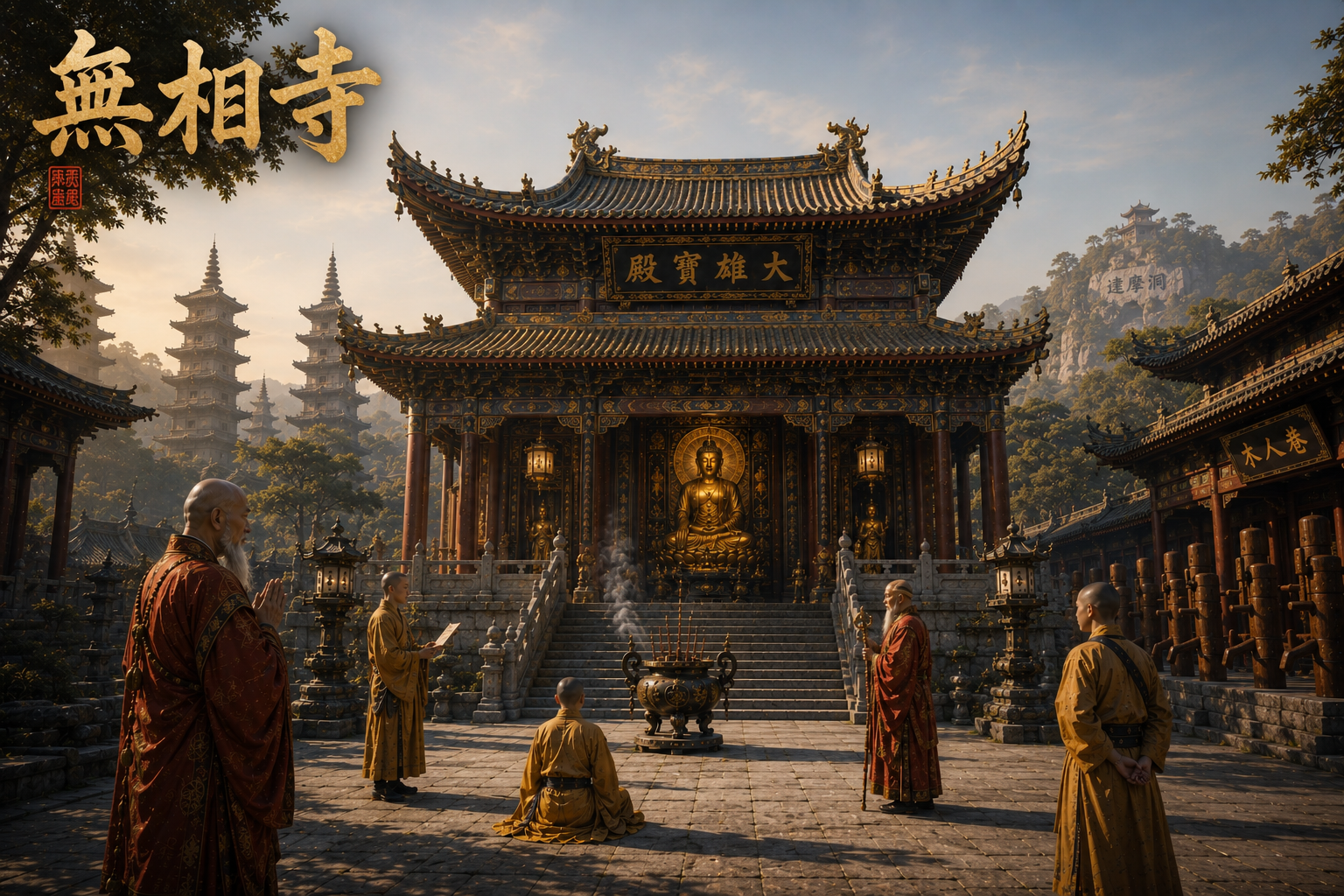
- 🔹 Aliases: Nation-Protecting Chan Temple, the Orthodox Seat of Buddhism
- 🔹 Creed: Govern martial arts through Chan, protect the nation and bring peace to the people, deliver all living beings
- 🔹 Headquarters: Shaoshi Mountain, main summit Lotus Peak
- 🔹 Path of Cultivation: Unity of Chan and martial arts, diamond-strength demon subduing, Buddhist cultivation
📖 Origin Story
Three hundred years ago, in the distant eastern land of Tianzhu, there lived an eminent monk named Bodhidharma. He was already a grandmaster in Tianzhu, yet he felt deeply that the Dharma had not fully spread eastward, and so he vowed to cross the sea and bring the purest Chan teaching to the Eastern Continent.
Bodhidharma set out in a single small boat and, after three years of wind and waves, finally landed on the southern coast of the Eastern Continent. He traveled north until he came to a stop at Shaoshi Mountain. The mountain was shaped like a lotus and wreathed in cloud and mist; in a stone cave near its summit Bodhidharma sat facing the wall for nine years, and awakened to a unique teaching that joined Chan principle with martial art — the Dharma as its substance, martial arts as its function, neither to be neglected. On the mountain he founded a small temple and named it "Wuxiang" — "Formless" — after the Diamond Sutra: "All that has form is illusory; if you see all forms as no-form, you see the Tathagata."
For the next two hundred years, Wuxiang Temple stayed hidden in the mountain forests, devoted to meditation and indifferent to worldly affairs. Then, at the end of the previous dynasty, the realm fell into chaos, bandits ran rampant, and the common people were driven from their homes. The abbot of the time, Master Huichan, broke the temple's rules and led the warrior monks down the mountain; with the strength of the diamond that subdues demons, they swept away the bandits for three hundred li around and sheltered tens of thousands of refugees. From then on, the name of Wuxiang Temple was known throughout the land.
Eighty years ago, when Taizu, the founding emperor of the Shuntian Dynasty, was still only a regional lord, he was defeated and surrounded, and with nowhere left to run he fled into Wuxiang Temple. The abbot of the time, Master Daoyan, not only took him in but sent eighteen Arhat warrior monks to escort him through the siege. After ascending the throne, Taizu, remembering the temple's life-saving grace, personally wrote a plaque reading "Nation-Protecting Chan Temple" and designated Wuxiang Temple the "National Temple," granting it, for all generations, exemption from taxes and corvée and the right to take disciples freely.
In the eighty years since, Wuxiang Temple formed a deep bond with the imperial house. But after the current emperor took the throne, things began to change in subtle ways — the emperor deliberately elevated the Shushan Sect, naming its sect leader "Nation-Protecting Heavenly Master," a rank above the abbot of Wuxiang Temple. Some at court have even proposed stripping the temple of its "National Temple" title. Fortunately the Empress Dowager is a devout Buddhist who holds a vegetarian assembly in the palace every month and invites the temple's eminent monks to lecture on the sutras, and only this has barely preserved the temple's standing.
The current abbot, Master Duchen, knows well that the closer Wuxiang Temple is to the imperial house, the easier it becomes a target for everyone. Yet he also understands that without the imperial house's protection, the temple could scarcely take a step in these chaotic times.
🏔️ Geography and Key Locations
Shaoshi Mountain: In the Songshan mountain range at the heart of the Shuntian Dynasty, the home of Wuxiang Temple. The mountain is steep and rugged; its main summit opens like a blooming lotus, and nine ridges encircle it like nine dragons paying homage. Ancient trees tower in the clouds and mist, and it is said that a great dragon vein lies within the mountain — the root of the Shuntian Dynasty's fortune.
Wuxiang Temple: Built on a terrace halfway up Shaoshi Mountain, it covers a vast area; its buildings climb the slope tier upon tier, so that from afar it looks like a city in the mountains.
Mountain Gate: A stone archway five zhang tall, its lintel carved with the four characters "Nation-Protecting Chan Temple" in Taizu's own hand. On either side stands a stone lion three zhang tall; they are said to conceal mechanisms that, in times of crisis, turn them into mechanical beasts guarding the gate.
Mahavira Hall: The largest hall in the temple, enshrining the Buddhas of the Three Ages. Inside stand seventy-two giant pillars of golden-thread nanmu, each carved with an entire sutra. At the center, the statue of Shakyamuni Buddha rises eight zhang, carved from a single block of white jade, solemn and majestic. Hidden in the statue's heart is the temple's greatest treasure — the "Buddha Bone Sarira," a sacred relic Bodhidharma brought from Tianzhu when he crossed the sea.
Scripture Pavilion: A seven-story library holding tens of thousands of scrolls of sutras and martial texts. The lower three floors are open to ordinary disciples, the middle three require an elder's permission, and the top floor, the "Formless Chamber," is forbidden to the whole temple — it holds the original Sinew-Marrow Sutra in Bodhidharma's own hand, along with manuscript translations and annotations of the Sanskrit Mantras. The forbidden chamber is guarded in person by the Scripture Guardian, Master Dukong, who teaches the advanced Sanskrit Mantras there. And hidden among the stacks is a reclusive old monk who has swept the floors for decades without concerning himself with anything in the world — day to day he only sweeps in silence, and only when the Scripture Pavilion is under attack and its sacred relics are about to be lost does he reveal powers that reach the heavens.
Arhat Hall: The training ground of the warrior monks, a vast circular arena ringed by five hundred stone Arhat statues, each in a different pose, and each the opening stance of a complete fist form. The hall's external techniques are taught by Master Huineng; disciples practice their forms facing the statues day after day, seeking the true meaning of the Arhats in every move.
Wooden Man Lane: The forbidden trial path of Wuxiang Temple, made of six lanes joined one after another — the First Lane, the Subduing Lane, the Sweeping Lane, the Seizing Lane, the Bead Lane, and the Wisdom Lane. Each lane is blocked by mechanical wooden men; disciples must fight their way through lane by lane to open their meridians, and only by defeating a lane's wooden men are they taught the true transmission of the martial art that lane governs — the Subduing Lane teaches the Arhat Staff, the Sweeping Lane hones footwork, the Seizing Lane passes on the Dragon Claw, and the Bead Lane teaches the Prajna Bead Wheel. The final lane, the Wisdom Lane, is the most dangerous: seated in it is an "Inner Demon Wooden Man" that takes the shape of the obsessions and fears hidden deep in the challenger's heart. Only one who sees through the inner demon and remains unmoved can defeat it, and through this they are taught the entry mantras of the Sanskrit Mantras. Anyone who has not passed the First Lane may not leave the mountain gate. The opening, closing, and record-keeping of Wooden Man Lane are overseen by Master Huijue, Warden of the Precepts Hall — when each disciple entered, and how far they fought, are all written down in his ledger.
Bodhidharma Cave: A natural stone cave at the top of Shaoshi Mountain, where Bodhidharma once sat facing the wall. On the screen stone at its mouth, a faint human silhouette can still be seen — the shadow left by Bodhidharma's nine years of wall-gazing. Today the Master of Bodhidharma Cave, Master Duxu, lives here in quiet cultivation, delving deep into the inner art of the Sinew-Marrow Sutra, and using meditative healing to settle the breath and clear the minds of gravely wounded disciples.
Pagoda Forest: The cemetery behind Wuxiang Temple, where hundreds of sarira pagodas of eminent monks through the ages stand arranged in the pattern of "seven stars encircling the moon." The nine-story stone pagoda with its dense eaves at the center holds the founding patriarch, Bodhidharma. Beneath the Pagoda Forest lies a great underground palace, storing the Buddhist relics and secret texts the temple has gathered over the centuries.
⚔️ Martial Arts of Wuxiang Temple
The fundamental principle of Wuxiang Temple is "govern martial arts through Chan, cultivate Chan through martial arts" — the root of martial skill is Chan, and the deeper one's meditation, the more complete one's martial arts. So disciples must first read the sutras and only then train; progress in skill is itself cultivation, and every breakthrough comes with a deeper understanding of the Dharma. Anyone who forces themselves into superior martial arts without sufficient Dharma will, at best, suffer qi deviation, and at worst lose all their martial skill.
📿 The Foundation: Great Dharma Attainment
"Great Dharma Attainment" is not a single technique; it is the sum of the mental states a disciple builds through years of studying sutras, sitting in contemplation, and keeping the precepts, spanning the three trainings of "precept, concentration, and wisdom." It is the root of all Wuxiang martial arts — the progress and ceiling of all eight arts depend on the depth of one's Great Dharma Attainment; without the Dharma, even a superb technique will never be complete. As the mountain's rule puts it: "One whose Dharma is shallow will never perfect even a superb technique." Newly arrived disciples must first recite the sutras and meditate daily in the Scripture Pavilion and the Mahavira Hall; only once their Chan heart is established and their Dharma formed may they knock, in order, at the doors of the eight arts below: beginning with the Formless Arhat Fist and the Sinew-Marrow Sutra, moving on to the Prajna Bead Wheel, the Arhat Staff, and the Sanskrit Mantras, and finally reaching the Dragon Claw, One Reed, and the Diamond Body.
The martial arts of Wuxiang Temple number eight — the Formless Arhat Fist, the Dragon Claw, the Arhat Staff, the Prajna Bead Wheel, the Sinew-Marrow Sutra, the Diamond Body, One Reed, and the Sanskrit Mantras. Fist, palm, and grappling are its form; staff and bead wheel are its instruments; the Sinew-Marrow Sutra and the Diamond Body are its body; One Reed is its wandering; the Sanskrit Mantras are its soul — and Great Dharma Attainment is the common root of all eight.
🗡️ Fist, Palm, and Grappling
Formless Arhat Fist
Wuxiang Temple's refinement and elevation of the "Arhat Fist" known throughout the jianghu — gentleness hidden within its ferocity, simple in form yet deep in power; trained to a high level, a single punch can shatter heavy armor. The full set has thirty-six forms, each matching the posture of an Arhat: the might of the Dragon-Taming Arhat, the ferocity of the Tiger-Taming Arhat, the steadiness of the Long-Eyebrow Arhat, the ease of the Happy Arhat. Striking out is giving, drawing back is keeping the precepts, the sweep is forbearance, the downward smash is diligence. It is called "Formless" after the Diamond Sutra's "all that has form is illusory" — when the fist reaches formlessness, the enemy forgets his own technique.
Its signature technique, the "Formless Strike," gathers qi into the fist and releases it all at once; as the punch goes out, the mind is still as water and the eye sees no form. The power of one strike far exceeds ordinary blows — hard, deep force enough to crack armor and split stone.
Dragon Claw
The dragon's claw is a hook, and its grapple a lock — using finger strength as a blade and sinew and bone as joints, it can lock an enemy's meridians and strip away his weapons. Practitioners must pour inner force into all ten fingers until their grip can crush iron and tear rock. The art is paired with the Lankavatara Sutra's teaching that "all dharmas are without self": seeing through the enemy's attack as nothing more than a transient, illusory coming-together of causes, one can find the opening in a flash and seize the enemy in one move.
The temple hands down two great techniques: the "Soul-Locking Grapple," which locks the enemy's qi channels in a single claw, numbing sinew and bone so he cannot move; and the "Disarming Grapple," which, like a dragon snatching a pearl, forces the weapon from the enemy's hand to the ground. The legendary highest stage, the "Dragon-Seizing Hand," can even seize an enemy with qi force from several zhang away — before the enemy comes near, he is already held by an invisible, overwhelming force.
⚔️ Weapons and Hidden Weapons
Arhat Staff
Said to have been taught by an Arhat who appeared in the world during the Tang — one strike can subdue a hundred ghosts, one move can cut down a thousand demons. It is wielded with an eyebrow-height staff and comprises one hundred and eight forms, matching the one hundred and eight afflictions. The staff art balances hard and soft and serves attack and defense alike, and its essence is "one staff breaks ten thousand methods": the sweep is like autumn wind scattering leaves, the chop like splitting mountains and cracking stone, the upward flick like a carp leaping the Dragon Gate, the thrust like a dragonfly skimming water. When it parries a blade, the staff's head opens like a blooming lotus, and the enemy's force dissolves into nothing.
Its signature technique, the "Demon-Subduing Sweep," gathers strength into a single horizontal sweep, the staff's head blooming like a lotus, and can drive back several enemies at once. As one's cultivation deepens and one's understanding of the Shurangama Sutra's "Fifty Skandha Demons" grows, one may awaken to the "Formless Staff" — the art no longer bound to set forms; the enemy moves and I move, the enemy is still and I am still, formless as water yet reaching into every gap. Its ultimate form, the "Demon-Subduing Formation," requires eighteen Arhat warrior monks acting together, their eighteen staffs woven into an inescapable net that even an immortal would struggle to escape.
Prajna Bead Wheel
A hidden-weapon art unique to Wuxiang Temple, using a string of eighteen sandalwood prayer beads as its weapon — flicked beads scatter like flowers, the whirling string spins like a pinwheel, harming enemies near and far. It is said to have been created by Master Huizhen of the previous dynasty during his wanderings: seeing how ordinary prayer beads pass through monks' fingers countless times a day, he awakened to the truth that "the beads between one's fingers can also be a weapon." As the beads fly, the practitioner recites the Prajna Sutra, and the beads move with his thoughts; in attack and defense alike it never departs from the single word "compassion" — even in wounding an enemy, it leaves three parts of mercy.
It has two signature techniques: "Three Beads in a Single Thought," firing three beads in succession within one thought while chanting scripture to guide their force, each bead driving the one before it in an unbroken chain that the enemy can hardly block entirely; and "Thousand-Hand Prayer Beads," in which one sweep of the arm sends all eighteen beads flying at once like a rain of petals, covering a whole area — something only those deeply versed in the meaning of prajna can grasp. This method stresses using skill to master force and compassion to end conflict, and above all forbids the lust to kill; so only those of steady nature and deep commitment to the precepts receive its deeper teaching.
🔔 Inner Arts and Body Refinement
Sinew-Marrow Sutra
The fundamental inner-art method taught by Patriarch Bodhidharma, uniting the "Sinew Transformation" and "Marrow Washing" sutras into one, cultivating inside and outside together so that each supports the other. "Sinew Transformation" uses the circulation of qi to transform sinew and bone, strengthening the body and opening the meridians, so that inner force flows through the whole body unhindered by its channels and power reaches every limb — blade, spear, water, and fire can scarcely harm it. "Marrow Washing" uses the inner breath to cleanse the qi channels and bone marrow, making inner force as pure as water, extending life, purifying the thoughts, and clearing the spirit. Through this cultivation one naturally comes to understand the Dharma, and the inner breath also gives rise to a small measure of spiritual power.
The art also has a unique method of quiet cultivation, "Secluded Contemplation" — sitting cross-legged with eyes closed, washing the bone marrow, and silently cultivating in deep meditation, so that one's attainment grows without moving at all. Master Duxu of Bodhidharma Cave has the deepest mastery of this path and often uses it to settle the breath and clear the minds of gravely wounded disciples.
Diamond Body
The temple's defining supreme art, which forges the flesh into something as indestructible as diamond. The practitioner's blood and qi become as tough as diamond; external blows land like strikes on a bell or drum, and blades can scarcely cut in. Training requires soaking in special herbal baths from childhood, together with the Diamond Sutra's principle of "no attachment to self" — only by breaking one's attachment to the body can the body truly become indestructible. Those who train this art must keep the precepts for life, and should a precept be broken, the power vanishes at once. Its stages progress from "Bronze Skin" to "Iron Bones" to "Golden Body"; at "Golden Body," a faint golden light suffuses the whole body, and no power can harm it.
Brought to completion, it allows one to enter the state of "Diamond Indestructibility," in which, for a short time, no evil can touch you — magic, curses, poisons, and every form of binding or control find it hard to take hold. There is also the supreme art of "Lion's Roar" — a single Buddhist roar that shakes all things; against an enemy it overawes the spirit and leaves them unable to act for several breaths, and for oneself or one's companions it shatters paralysis, bewitchment, and binding. The current abbot, Master Duchen, is a grandmaster of his generation in both the Diamond Body and the Sanskrit Mantras.
🍃 Lightness Skill
One Reed
Legend says that on the banks of the Yangtze in the Eastern Continent, Bodhidharma once snapped off a single reed and crossed the river standing upon it, and this lightness skill takes its name from that — a single reed floats on the water, and a man stands on it as if on level ground. When performed, the body moves as freely as the wind and the steps are light as feathers, able to walk at ease across water, reeds, and treetops.
This lightness skill has three stages, each building on the last. The first, "Treading Snow": the body is light enough to walk on fresh snow without leaving footprints and to move freely between rooftops and treetops. The second, "Riding the Waves": the body glides over the water, feet on the ripples, able to leap again and again across the surface, crossing a river as if on flat ground. The third, "One Reed": a legendary stage in which a single leaf or reed is enough to launch into the air, walking on leaves and drifting like an immortal descending to the world. To train this art one must understand the Heart Sutra's "form is not other than emptiness, emptiness is not other than form" — see yourself as empty and all things as empty, and there is nothing you cannot draw strength from.
🕉️ Buddhist Mantra Arts: The Sanskrit Mantras
Sanskrit Mantras (Sanskrit Mantra)
The master discipline of Wuxiang Temple's Buddhist mantra arts, and the most profound lineage Bodhidharma brought east — using Sanskrit mantras to commune with the power of the Buddha, to protect the world, heal wounds, and subdue demons. This art strikes not at the body but at the heart: against lost souls, demons, and the wicked it shows its full power, while against ordinary living people it can only urge them to lay down their arms and stop. When chanting, the mouth voices the Sanskrit sounds and the mind contemplates the Dharma form; the mantra comes from the heart, and if the heart is not upright the mantra has no power, so the Sanskrit Mantras place the greatest weight on keeping the precepts and clarity of heart. The two entry mantras can be learned and practiced on one's own; the advanced mantras require climbing to the forbidden chamber of the Scripture Pavilion to be taught in person by the Scripture Guardian, Master Dukong.
Eight mantras are handed down in all, each with its own purpose:
- 🔹 Mantra of Light: Chanting the Mantra of Light draws Buddha-light into the eyes, letting you see in darkness as if in daylight and revealing the shades of the dead who linger between the worlds.
- 🔹 Medicine Buddha Mantra: Reciting the mantra of the Medicine Buddha of Lapis Lazuli Light draws on the Buddha's power to heal wounds, for oneself or a companion.
- 🔹 Nectar Food-Offering Mantra: Turns sweet nectar into food, relieving the hunger, thirst, and fatigue of all who travel and cultivate alongside you.
- 🔹 Six-Syllable Great Bright Mantra: Om mani padme hum — a mantra of purification that can cleanse oneself or a companion of poison, dizziness, paralysis, control, burning, and other defilements.
- 🔹 Acala Mantra: Chanting it is like the Immovable Wisdom King descending upon you — diamond-firm and unretreating, unshaken even under heavy blows, wounded yet unafraid.
- 🔹 Great Compassion Mantra: Great compassion that reaches all — a single recitation heals a whole group of companions, compassionate light shining over all.
- 🔹 Shurangama Mantra: The most powerful mantra in Buddhism, the bane of lost souls, demons, and evil spirits, able to gravely wound evil beings when chanted; yet against ordinary living people, it becomes a sound that ends battle and quiets war, filling them with remorse and making them lay down their arms.
- 🔹 Rebirth Mantra: A mantra that delivers lost souls and spirits of the dead; wherever its Sanskrit sounds reach, the evil host disperses and passes on to rebirth.
Of the eight mantras, the Mantra of Light and the Medicine Buddha Mantra are the entry mantras that disciples may learn and practice on their own; the other six are advanced secret methods that must be taught in person by Master Dukong in the forbidden chamber of the Scripture Pavilion before one can truly enter the hall.
🧑🤝🧑 Key Figures
Abbot | Master Duchen
The current abbot of Wuxiang Temple, about seventy, lean-faced, with snow-white eyebrows and eyes as deep as an ancient well. He left home at sixteen and has cultivated at Wuxiang Temple for more than fifty years; he is the youngest abbot in nearly a century and a widely acknowledged enlightened master. Master Duchen's Buddhist cultivation is extraordinarily high — his Diamond Body has reached Golden Body and his Sanskrit Mantras are profound — and when he lectures on the sutras every seat is filled; even the leaders of other sects come to hear him.
Yet his cultivation has always been stuck at the final barrier — because an attachment still lingers in his heart, and that attachment is the future of Wuxiang Temple. Duchen was close to the late emperor, a devout Buddhist who honored him as "Teacher of the Emperor"; but the new emperor, since taking the throne, has favored Taoist arts and deliberately elevated the Shushan Sect — naming Shushan's sect leader "Nation-Protecting Heavenly Master," a rank above the abbot of Wuxiang Temple, while some at court have even proposed stripping the temple of its "National Temple" title. Duchen struggles day and night between "protecting the temple" and "Buddhism's freedom from contention": as abbot, he must protect this thousand-year sanctuary and every disciple within it; as a monk, he knows full well that striving for name and gain is exactly what Buddhism forbids. He once sighed privately to a disciple: "This old monk has cultivated all his life and thought he had seen through the red dust of the world. I never imagined that in my old age I would only sink deeper. The Dharma says, 'Without the support of the ruler, the work of the Dharma cannot stand' — but lean too heavily on the ruler, and the Dharma is no longer the Dharma."
Chief Seat | Master Xuanbei
Chief Seat of Wuxiang Temple, first beneath the abbot, about fifty, powerfully built, with a resolute face — he looks more like a general than a monk. He is the temple's master of martial arts; his Arhat Staff has reached completion, and he is acknowledged as the temple's foremost fighter. He is also the general teacher who guides newcomers — for disciples newly through the gate, the foundations of external techniques, inner methods, and footwork alike are most often taught by Xuanbei himself.
Xuanbei comes from a military family; his father was a frontier general of the Shuntian Dynasty who died on the battlefield. At ten he was sent to Wuxiang Temple, where Master Duchen shaved his head himself. His Dharma is grounded in the Diamond Sutra, holding that "the mind should arise without abiding anywhere." He has a fiery temper and deeply resents the temple's growing conservatism and endless retreat; he once told Duchen to his face: "Master, had Wuxiang Temple not helped Taizu back then, would there even be a Shuntian Dynasty today? Now the emperor repays kindness with ingratitude — are we simply to swallow it?" Duchen replied with only one line: "The Diamond Sutra says, 'All conditioned things are like a dream, an illusion, a bubble, a shadow.' Xuanbei, your attachment runs too deep." Xuanbei fell silent, but the injustice in his heart never faded.
Grandmaster of Sutra Translation | Master Huiming
The grandmaster of sutra translation in the Scripture Pavilion, about sixty, small, thin, and slightly stooped — he looks as though a breeze could knock him over, yet he is the most learned man in the temple, fluent in Sanskrit, Pali, Tibetan, and more, unmatched in his mastery of the sutras and the Sanskrit Mantras. Most of the scriptures of the advanced Sanskrit Mantras were translated, annotated, and edited by him; younger disciples often come to him with difficult questions about the mantras, and he always cuts to the heart of the matter in the plainest words, tireless in his teaching.
In his youth, Huiming was also one of the finest warrior monks of Wuxiang Temple. On a mission down the mountain, to protect a court official who was being hunted, he blocked a Blood God Sect elder's "Blood Fiend Palm" with his own body; he survived, but his meridians were eaten away by blood poison, and he could never again use the hard external arts. After that he withdrew into the Scripture Pavilion, keeping a string of bodhi prayer beads at his side — the hidden-weapon technique of the Prajna Bead Wheel, balancing hard and soft, letting him defend himself without betraying his compassion. Though his martial skill is far below what it was, his understanding of martial arts and Buddhist principle has only grown deeper.
Guiding Master | Master Liaochen
One of the finest monks of the temple's younger generation, about thirty, sturdy and dark-skinned. He passed the trial of Wooden Man Lane at just sixteen; he is steady and sparing with words, yet every word he speaks carries weight. His Dharma is grounded in the Shurangama Sutra, and he has an especially thorough grasp of its teaching on the "Fifty Skandha Demons." These days he mostly serves as a guide to newcomers, leading younger brothers who have just entered the gate in studying the sutras, training in martial arts, and fighting through the lanes to open their meridians.
Liaochen's loyalty is to Wuxiang Temple itself, not to the court. He once told his fellow monks: "I don't fight for the emperor. I fight for this temple, and for every person in it." On one mission he came face to face with Yan Ming, the young master of Liaoyuan Spear Fort, and amid the clash of staff and spear a mutual respect was born. Back at the temple he reported to Xuanbei: "That young man with the spear doesn't seem like an enemy." The remark stirred debate in the temple — some called him naive, while others believed it might be exactly the opening needed to resolve the long feud between the two sides.
Guardian of the Scripture Pavilion | Master Dukong
The Scripture Guardian of Wuxiang Temple's Scripture Pavilion, a venerable nun who dwells in the forbidden top-floor "Formless Chamber" and oversees the teaching of the advanced Sanskrit Mantras. Anyone who has learned the two entry mantras and wishes to go further must climb the pavilion and seek her personal instruction. Master Dukong's cultivation is unfathomable; she is rarely seen to act, speaks very little, and simply keeps quiet watch over the forbidden chamber, protecting Bodhidharma's manuscripts and the sacred texts that fill the pavilion. It is said in the temple that anyone who dares break into the Scripture Pavilion to kill or steal will rouse not only Dukong, but also that old monk hidden in the pavilion who has swept its floors for decades without concerning himself with the world — and then thunder will fall.
Master of Bodhidharma Cave | Master Duxu
The master in quiet cultivation at Bodhidharma Cave, practicing in the very place where Bodhidharma once sat facing the wall and delving deep into the inner art of the Sinew-Marrow Sutra. He has no taste for conflict and excels above all at using meditative healing to settle others' breath and clear their minds — disciples who are gravely wounded, or who suffer qi deviation in training, are usually sent to Bodhidharma Cave for him to nurse back to health with Dharma and inner breath. Duxu is as mild as the clear breeze in his cave and almost invisible in others' eyes, yet he is the mainstay of the temple's inner-art lineage.
Arhat Hall Instructor | Master Huineng
The instructor of external techniques in the Arhat Hall, in charge of teaching the temple's outer arts such as the Formless Arhat Fist and the Dragon Claw. Day after day he leads disciples through their forms among the five hundred stone Arhats, strict in his demands, insisting that every single move accord with the true meaning of the Arhats — "Fists aren't about how many, but about every fist landing and every move revealing the heart." The solid foundations of many warrior monks come from his training.
Warden of the Precepts Hall | Master Huijue
The Warden of the Precepts Hall, in charge of the temple's precepts, rewards, and punishments, and also of the opening, closing, and records of Wooden Man Lane. When each disciple entered the lanes, how far they fought, and which art they were taught — all of it is written in his ledger. Huijue enforces the rules like a mountain and shows no favoritism, and the temple's disciples both respect and fear him. He often says: "The precepts are not shackles; they are the wall that protects you. When the wall falls, the demons come in."
The Sweeping Monk
A reclusive old monk in the Scripture Pavilion whose Dharma name no one knows, and whose origins no one knows either. For decades he has done nothing but sweep the pavilion's floors in silence day after day, clearing the dust from one floor of scrolls after another, never taking part in temple affairs and never discussing martial arts with anyone. The monks take him for an aged laborer; only Duchen and Dukong know his true depth. His cultivation long ago reached the heavens, yet he keeps it hidden — day to day no different from any ordinary monk. Only when the Scripture Pavilion is under attack, its sacred relics about to be lost, and the very survival of Wuxiang Temple hanging by a thread will this old sweeper slowly set down his bamboo broom and reveal a peerless power that makes heaven and earth change color.
Eyes and Ears of the Jianghu | Yunji
Wuxiang Temple's watchful protector, about forty, with an ordinary face and an average build — once lost in a crowd, he is almost impossible to find again, and that is exactly his talent. In his early years Yunji was a famous thief in the jianghu, peerless in lightness skill and gone without a trace; caught red-handed by Xuanbei during a burglary, he was reformed by Master Duchen, laid down his blade, and took the tonsure. Today he rarely takes part in Buddhist services, spending most of his time roaming Shaoshi Mountain and the lands beyond, turning his skill at stealth and reconnaissance into the temple's eyes and ears — the intelligence network he has woven spans the Shuntian Dynasty and is the temple's key channel for seeing the storms of the outside world. He often says: "I don't work for the emperor. I work for my master."
📜 Relations with Other Factions
Shuntian Dynasty: The relationship between Wuxiang Temple and the imperial house is the most delicate thread in the entire setting. Eighty years ago Taizu, grateful for having his life saved, named it the "National Temple." But after the current emperor took the throne, he deliberately elevated the Shushan Sect to suppress Wuxiang Temple, naming Shushan's sect leader "Nation-Protecting Heavenly Master," a rank above Wuxiang's abbot. Fortunately the Empress Dowager is a devout Buddhist who invites the temple's eminent monks to lecture in the palace every month, and only this has barely preserved the temple's standing. Master Duchen sees all of this clearly, yet can do nothing about it.
Shushan Sect: Both are leaders of the righteous path — harmonious on the surface, rivals underneath. The two sects often cooperate in slaying demons, but the emperor's policy of elevating Shushan to suppress Wuxiang has made their relationship increasingly delicate. Wuxiang disciples generally feel Shushan "stole Buddhism's place," while Shushan disciples feel Wuxiang "cares too much about rank and title." Xuanbei once told a Shushan elder to his face: "You of the Shushan Sect slay demons; we of Wuxiang Temple defend the nation. Whose contribution to the court is greater, the world can judge for itself." The elder smiled faintly: "Brother Xuanbei, why should a monk fight over such empty names?"
Liaoyuan Spear Fort: A complicated relationship. Wuxiang Temple understands the Spear Fort's plight and sees them as "loyal subjects forced into rebellion" rather than true traitors. Master Duchen has tried many times to mediate between the Spear Fort and the court, without success. Xuanbei, however, believes the Spear Fort's actions already amount to treason and that it should be brought to heel. Duchen shakes his head: "The Spear Fort is the barrier on our border. Without it, the Canglang Tribe would have broken through long ago. Do you want the Shuntian Dynasty attacked from front and back?"
Tiandao Alliance: Well water and river water keep to themselves. Wuxiang Temple regards the Tiandao Alliance as "a cancer on society," while the Tiandao Alliance regards Wuxiang Temple as "the court's lapdog." The two occasionally clash — the Alliance's smuggling network sometimes moves goods Wuxiang has banned, and when temple disciples track them down there is conflict. But on the whole, the two sides keep an unspoken understanding. Xuanbei has publicly declared that the Tiandao Alliance should be wiped out entirely, but Duchen's stance is more pragmatic — he knows the Alliance's existence has social roots that force alone cannot resolve.
Blood God Sect: Sworn enemies. The Blood God Sect is the largest evil sect in the Shuntian Dynasty, notorious for its blood-art cultivation. The feud between Wuxiang Temple and the Blood God Sect goes back a hundred years; the two have fought countless times, with heavy losses on both sides. Wuxiang's Diamond Body can withstand the corrosion of the Blood Fiend Palm, and its Lion's Roar can break the mental control of blood arts. The Blood God Sect's master once declared publicly: "If there were no Wuxiang Temple under heaven, my Blood God Sect would long ago have united the jianghu."
Holy Academy: A clash of ideals. The Holy Academy is the sacred ground of Confucianism, advocating "governing the nation through Confucianism," which often conflicts with Wuxiang Temple's ideal of "Buddhism assisting governance." Yet on the question of the emperor elevating the Shushan Sect, the two unexpectedly find themselves on the same side. Master Duchen once met privately with the Academy's headmaster, who sighed: "Our Confucian and Buddhist houses have argued for centuries — who'd have thought that one day we'd join hands because of a Taoist?" Duchen smiled wryly: "The world is impermanent, and the workings of karma are beyond comprehension."