影月派 Kagemoon Sect
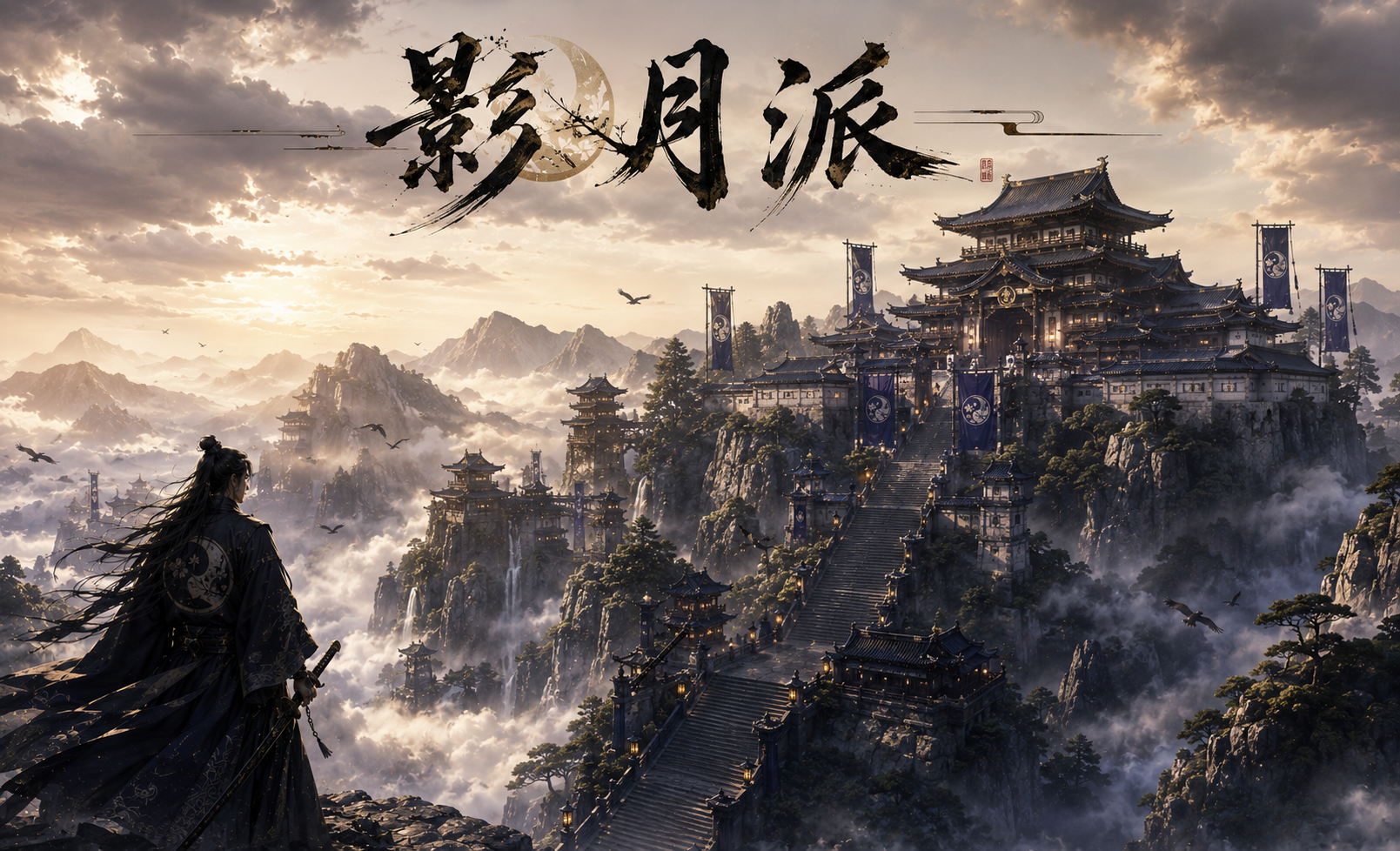
- 🔹 Aliases: Kagemoon Sword School, the Iaijutsu Gate, Moonblade Hall
- 🔹 Creed: Overcome the enemy with utmost speed, prove the Way through the blade, end war through war
- 🔹 Headquarters: Kagemoon Mountain City, in the Moonrise Empire's home islands
- 🔹 Path of Cultivation: Iaijutsu, swordsmanship, military strategy
📜 Background
The Kagemoon Sect is one of the most renowned blade schools of the Moonrise Empire. Over a century it has produced countless distinguished swordsmen; its martial system centers on "iaijutsu," the art of the draw, and prizes the way of winning in an instant, demanding "speed, ferocity, and precision." Though "blade and sword" are spoken of together in the Moonrise Empire, the Kagemoon Sect at its core holds to "cutting the enemy down in an instant" — the samurai way of battlefield slaughter and military strategy.
Legend says the sect's founding patriarch, Getsuei Mumei, was a reclusive swordsman in an age of warring states. In a desperate battle of one against fifty, he cut down the enemy's officers within three breaths, and his name became known throughout the land. He founded the Kagemoon Sect on his lightning-fast swordsmanship and allied with the emperor of the day, becoming the imperial house's own sword school; from then on its standing was exalted, and every sect leader since has served as both swordsman and strategist, cultivating statecraft and the martial way alike.
The Kagemoon Sect's headquarters is "Kagemoon Mountain City" in the Moonrise Empire's home islands. The city has been contested ground since ancient times, wreathed in cloud and mist all year round, easy to defend and hard to take. The whole mountain city is itself one great battle formation — at once a sacred place of training and a labyrinth of blade formations, where every disciple must "break the formation with the blade and prove the Way with the body."
Yet beneath the glory, undercurrents stir.
In the era of the fifth sect leader, Tsukikage Kūzō, the sect maintained the "Shadow Assassination Group," the forerunner of the Kaga Clan, whose duty was to carry out assassinations and espionage for the imperial house. But Tsukikage Kūzō held that "a swordsman should meet the enemy on the righteous path; skulking assassination disgraces our school of the blade." He resolutely abolished the Shadow Assassination Group, sparking the "Iaijutsu Rebellion." Most of the group's disciples were expelled from the sect, withdrew to Shadow Valley, and founded the Kaga Clan, swearing to seize the orthodox succession of the blade. Ever since, the Kaga and the Kagemoon have been like fire and water, and assassination and counter-assassination, espionage and counter-espionage, have never ceased. Kagemoon swordsmen regard the "Way of the Broken Blade" followed by the Kaga Clan as heretical and despicable, and within the sect there is even the saying: "Craftsmen who work beneath the flame are not worthy to cross blades with us."
By the time of the sixth and seventh sect leaders, the Kagemoon Sect had gradually come under the control of the Shogunate and for a time allied with the regional daimyo, taking on an ever more political character. The sect split as a result: the Loyalist faction insisted the sect must forever serve the emperor and accept his rewards and appointments, while the Free Swordsmen held that a swordsman should honor the "heart of the Way" above all, and that imperial power should not constrain the will to train and to fight.
The current eighth sect leader, Temba Jiro, astonished the empire with his iaijutsu as a young man. His creation, the "Swallow Reversal," is hailed as a technique without answer — fast to the extreme, able to cut the enemy down before their blade has even begun to rise from its sheath. Though he accepted the emperor's appointment, he has repeatedly refused orders to march to war, declaring that "the blade of the Kagemoon is driven by no one else," and he stands opposed to the Loyalist faction without open conflict.
Yet the most legendary thing about the Kagemoon Sect is the Shadow Painting Scroll, which has lain hidden in the sect since its founding. This ancient book is said to record the blade forms and tactics of every sect leader since Getsuei Mumei, and it is the sect's highest secret canon. In recent times, rumor has it that the Free Swordsmen want to use the book to rebuild the Kagemoon Sect's purpose, break free of the shackles of imperial power, and found a separate "Kagemoon Freedom Hall" — which could trigger a new round of internal strife.
Beyond this, the Kagemoon Sect's unbroken survival through troubled times is owed not only to the swordsmanship of its leaders but also to several secret places within the sect. Throughout the jianghu, legends circulate about the Kagemoon Sect's three sacred sites, inspiring awe.
The first is "Moon Mirror Lake." It lies in the deepest part of Kagemoon Mountain City, its water still as a mirror all year round, reflecting the sky by day and the moon by night. Legend says the founder of the Reflection Moon Art gazed at the moon at this lake and awakened to the Way. On every full-moon night, afterimages of the blade forms of every past sect leader appear on the lake's surface — known as the "Moonshadow Echo," the supreme place for disciples to grasp the meaning of the blade. But not everyone can see the moonshadow in the lake; only those whose hearts are as still as water can glimpse the true meaning of the way of the blade in the shimmering light.
The second is the "Sword Tomb." It is where the blades of fallen Kagemoon swordsmen through the ages are buried. Countless famous blades lie buried within it; their blade-spirit never dissipates, and over time they have become sentient. Every midnight, the faint clash of steel can still be heard in the Sword Tomb — countless blade intents dueling one another beneath the moon, never resting for an instant. The jianghu says that deep in the Sword Tomb lies a legendary blade called "Tsukikagemaru," forged by the patriarch Getsuei Mumei in his later years; on every night of a lunar eclipse, moonlight like cracks appears on the blade, and it is hailed as "the Soul of the Kagemoon."
The third is "Shadow Valley." It lies deep in the back mountains of Kagemoon Mountain City and never sees the sun. The valley was once the training ground of the Shadow Assassination Group, and fell into ruin after the Kaga Clan broke away. The valley is dense with hidden mechanisms and secret formations, and the remains of old assassination training can be seen everywhere. Rumor has it that the valley still hides fragments of secret arts the Shadow Assassination Group could not take with them, called the Chapter of Shadow Concealment, recording the Kagemoon Sect's most ancient methods of stealth and assassination. But the valley is now a forbidden zone; the sect's rules strictly prohibit entry, and violators are expelled.
There are also rumors that Moon Mirror Lake, the Sword Tomb, and Shadow Valley together quietly form the Kagemoon Sect's most essential system of inheritance — one for awakening to the Way, one for carrying on the will, and one for forbidden arts — allowing the sect both to pass down the essence of its swordsmanship and to hold its internal undercurrents in check. But most of these secret places exist only in legend, and outsiders have no way of knowing the truth.
📖 Inheritance and Forbidden Arts
- 📖 Shadow Painting Scroll: Passed down only to the sect leader and a handful of senior disciples. It records generations of iaijutsu, battle methods, stratagems, and real duels, and is said to "record real combat," restoring the afterimages of the battlefield — the supreme martial canon every Kagemoon disciple dreams of.
- 🌙 Kagemoon Sword Trial: A great assembly of the sect held once every ten years to select its future core. The winner is permitted to study fragments of the Shadow Painting Scroll and the true forms of the battle formations — the only threshold for rising to senior ranks. Winners' names are carved on the "Trial Stele" before the Sword Tomb, for later disciples to revere.
- 🌕 The Legend of the Moonblade Eye: Legend says that those who truly understand the Kagemoon way of the blade and bring the Reflection Moon Art to perfection will have silver moon patterns flash in their eyes in battle, symbolizing "blade intent at utmost speed, killing intent without form." Everyone who sees these patterns is struck with terror, for the moment the Moonblade Eye lights up is proof that the enemy's death has arrived.
⚔️ Martial Arts of the Kagemoon
Kagemoon martial arts rest on two great pillars, "swordsmanship" and "strategy," supported by "inner methods" and "footwork." Disciples train under the "Fangshu" system — raising martial skills is itself cultivation, and every breakthrough unlocks new abilities and techniques.
🗡️ Martial Arts · The Way of the Blade
Kagemoon Blade
The Kagemoon Sect's foundational blade art, handed down by the patriarch Getsuei Mumei, which emphasizes "watching for the gap and cutting in the instant" — the root of every Kagemoon blade practitioner. Its blade force relies not on strength but on "momentum" and "gaps," seeking to seize the faintest opening in the moment before the enemy attacks, one cut falling like the moon descending into a long river. Practitioners must first quiet their minds and watch the shadows for a hundred days, until blade and body are one, body and mind are one, and mind and shadow are one, before they can glimpse its path. Kagemoon swordsmanship does not seek to make every move lethal; it seeks one cut that is certain to kill.
When the blade art is trained to a certain level, killing intent can be turned into blade qi that wounds enemies several zhang away. Advanced practitioners can condense moonlight-like blade qi into substance; one swing passes soundlessly, leaving only afterimages like the moon and blade marks like frost.
- 🔹 Iaijutsu: The Single Killing Draw (Moonflash Draw)
The Kagemoon Sect's iaijutsu does not simply chase speed; it seeks "the blade already drawn before the enemy's intent has stirred." The practitioner must, in a moment of a mind still as water, see the faintest opening in the enemy's defense and cut through it with a single moonlight-like blade shadow. When a true master draws, the enemy does not even hear the blade sing — they simply fall after a flash of moonlight. - 🔹 Moonshadow Flurry
The most representative combination technique of Kagemoon swordsmanship. The blade's force is like moonlight scattering on water — seemingly broken, yet every glint of light and shadow hides a killing blow. The practitioner uses a continuous stream of afterimages to confuse the enemy's judgment, so they cannot tell which cut is real and which is false. - 🔹 Silent Nightblade
The Kagemoon Sect's assassination-style blade art. It does not seek dazzling blade light, but draws in killing intent, footsteps, and breath entirely. The enemy hears no footsteps and sees no blade shadow, feeling only a chill in the darkness. By the time they see the flash of the blade, the one who drew it has already cut and returned the blade to its sheath. - 🔹 Flowing Shadow Stepkill
The Kagemoon Sect's killing move that unites footwork and cutting. The practitioner does not clash head-on with the enemy, but slips into the blind spot with a moonshadow-like glide. The enemy thinks they have dodged the blade, only to find the shadow already stepping behind them — and the next instant, the blade falls from behind and to the side. - 🔹 Swallow Reversal
Legend says a Kagemoon swordsman awakened to this technique while watching a sea swallow skim the water. A swallow seems to fly straight ahead, yet it can double back and turn over the instant it nears the surface. The Swallow Reversal is the same: the first cut forces the enemy to defend, and the second doubles back against the grain, cutting in from an angle the enemy never expects.
🧠 Inner Method
Reflection Moon Art
The Kagemoon Sect's core inner art. It is not a direct attack skill but an inner art that sharpens observation, reaction, state of mind, and resistance to curses. Its fundamental idea comes from Moon Mirror Lake — the true moon is not in the sky but in the water. The moon in the sky is out of reach, but the moon in the water changes with the wind, the waves, and the heart. Those who train this method must make their minds like water, able both to reflect the enemy's killing intent and to dissolve interference from outside.
This method holds that "when the mind does not move, the shadow reveals itself." When the enemy attacks, the practitioner does not chase the blade with the eyes but watches the shadow with the mind; rather than colliding with force, they flow aside with it, reflect it back, and cut in return. The Kagemoon masters' ability to perform iaijutsu, the Swallow Reversal, and the Silent Nightblade all rests on this method.
- 🔹 Moonblade Eye
The Reflection Moon Art's technique for reading the enemy. The practitioner sinks the breath into the dantian so that their vision is like the moon reflected in a cold pool, able to see the signs of an attack in the enemy's shoulders, wrists, feet, and breath before it comes. When the Moonblade Eye opens, the enemy's openings surface as clearly as cracks across the water. - 🔹 Still Moon Mind
The Kagemoon Sect's secret method for resisting illusions, curses, and mental interference. In an instant the practitioner draws in all five senses so the lake of the mind stays without a ripple. Spells are like wind and curses like rain, but so long as the moon in the heart does not shatter, no outside evil can be reflected within it.
💨 Lightness Skill · Footwork
Moonshadow Glide
The Kagemoon Sect's foundational movement art, and one every disciple must learn. This footwork allows no jumping, no stamping, and no sound; the soles must move as if walking on thin ice, gliding close to the ground and turning from the waist and hips, so that the body shifts like a shadow beneath the moon. The Kagemoon Sect holds that true evasion is not fleeing the blade but making the enemy's blade fall "where you were a moment ago." The Moonshadow Glide was born for exactly this.
The Moonshadow Glide has three stages. The first, "Hugging the Ground": the body moves slightly, like a shadow following its form, able to glide beneath the enemy's blade. The second, "Turning": in the midst of turning and shifting, one can change position instantly, leaving the enemy unable to follow. The third, "Shadow Return," a legendary realm: after successfully evading a melee attack, one immediately moves to the enemy's flank, so the next blade attack gains extra damage and accuracy — turning evasion itself into the start of a counterattack.
Senior disciples can link the Moonshadow Glide into the Flowing Shadow Stepkill, the Swallow Reversal, and the Silent Nightblade, making evasion the beginning of the attack.
📜 Strategy · Tactical Knowledge
Shadow Art Strategy
Shadow Art Strategy is battlefield knowledge every Kagemoon disciple must learn. Though the Kagemoon Sect is famed for its swordsmanship, what truly lets it stand firm in troubled times is not individual courage but precise command of the battlefield's rhythm, the distance between friend and foe, ambush positions, and lines of retreat.
Legend says the Kagemoon Sect's first strategist once watched an army marching under the moon: the figures' shadows constantly changed shape with firelight, moonlight, water, and terrain. The shadows the enemy saw were not necessarily real people; the gap the enemy thought they saw might be exactly where an ambush waited. So he created Shadow Art Strategy, teaching disciples to see the battlefield as an unfinished ink painting — the blade is the brush, the shadow is the ink, and the enemy's fear is the empty space.
Shadow Art Strategy has four precepts:
- 🔹 Swift as Wind: Marches and raids must be so fast the enemy has no time to form ranks.
- 🔹 Hidden as Forest: When lying in wait, the whole unit is like shadows in a forest, silent and without a trace.
- 🔹 Fierce as Fire: Once they strike, it is like fire sweeping a wild plain, giving the enemy no chance to breathe.
- 🔹 Steady as Mountain: Facing counterattacks and curses, the mind stays calm and the formation does not break.
So Kagemoon disciples must learn Shadow Art Strategy before they learn the blade. No special performance skill may go beyond the bounds of the way of the blade laid down in Shadow Art Strategy — strategy is the soul, swordsmanship the body, and neither can be missing.
👥 Key Figures
- 🗡️ Temba Jiro: The eighth sect leader, whose iaijutsu has reached its peak; creator of the "Swallow Reversal," he serves as both swordsman and strategist. Outwardly loyal to the imperial house, inwardly he harbors a will for freedom, and he stands opposed to the Loyalist faction while keeping his own counsel.
- 🗡️ Tsukihime: A prodigy swordswoman of the Kagemoon Sect, known as the "Blade Beneath the Moon." Temba Jiro's younger sister, she excels at the Swallow Reversal and the twin-blade style, and her blade speed surpasses even her brother's. Gentle outside and steel within, she holds her loyalty to the emperor in reserve, and rumor has it she has been in secret contact with the Reform Blade Alliance.
- 🗡️ Kuroba Soji: A Kagemoon elder and leader of the Loyalist faction, who advocates complete loyalty to the Shogunate and the emperor. He has watched Temba Jiro's every move for years, and bears a personal grudge against the Kaga Clan.
- 🗡️ Getsuei Mumei: The founding patriarch, a legendary figure known as the "undefeated in a hundred battles" iaijutsu sword demon, whose posthumous work, the Shadow Painting Scroll, is ranked as the sect's supreme canon.
- 🗡️ Tachibana Michiko: The Kagemoon Sect's chief instructor, first beneath the sect leader. Born a commoner, she rose from servant to instructor through astonishing perseverance. She never takes part in factional struggles, answering only to the inheritance of the way of the blade, and disciples call her the "Iron Moon Demon." She once refused a surname bestowed by the imperial house, and most past winners of the Sword Trial have come from under her tutelage.
- 🗡️ Kirishima Sōgon: An elder of the previous generation, now retired to guard the Sword Tomb. He was the last captain of the "Shadow Assassination Group" and lived through the sect's upheaval in the previous generation. He chose to obey the sect leader, but his heart is complicated. Temba Jiro has asked him three times to come out of retirement, and he has politely declined each time. Tsukihime occasionally seeks his advice on ancient assassination footwork.
- 🗡️ Yukimura Sayo: The youngest female senior swordswoman, only nineteen. Born to a poor farming family, she defeated three seniors with the Moonshadow Flurry at the Sword Trial. Quiet and sparing with words, she has profound mastery of the Moonblade Eye. Temba Jiro calls her "the Kagemoon's second blade of the future." She sometimes speaks quietly with Kirishima Sōgon at the Sword Tomb.
📜 Relations with Other Factions
- 🔹 👑 Emperor · Shogunate: Loyal on the surface, but divided within. The Loyalist faction, holding appointments from them, backs the emperor firmly, while the Free Swordsmen oppose involvement in court politics. Since the sixth sect leader, the Kagemoon Sect has gradually come under the Shogunate's control, and this contradiction remains unresolved to this day.
- 🔹 🔥 Kaga Clan (Broken Blade Sect): An irreconcilable blood feud, like fire and water. The Kaga Clan was founded by disciples of the Shadow Assassination Group who were expelled from the sect; they follow the "Way of the Broken Blade," the exact opposite of the Kagemoon's, and regard the short blade as "the true heir of the blade." Assassination and counter-assassination, espionage and counter-espionage between the two have never ceased.
- 🔹 ⚔️ Reform Blade Alliance: Tsukihime is suspected of secret dealings with it, and some Free Swordsmen disciples sympathize with the ideals of reform. The Alliance advocates reforming the Shogunate's system and expanding samurai autonomy; should the Kagemoon Sect's internal contradictions intensify, the Reform Blade Alliance is very likely to intervene.
- 🔹 💰 Wealth Sect: A distant relationship, with occasional trade. The Kagemoon Sect needs money to keep the mountain city running and its soldiers equipped, while the Wealth Sect values the Kagemoon Sect's military strength and standing in the jianghu. Yet Shen Cuodao, master of the Wealth Sect's Silver Pavilion, seems to have a strange connection to the Kagemoon Sect — something that invites curiosity.