Fantasy World Short Stories
The Warden of the Blade
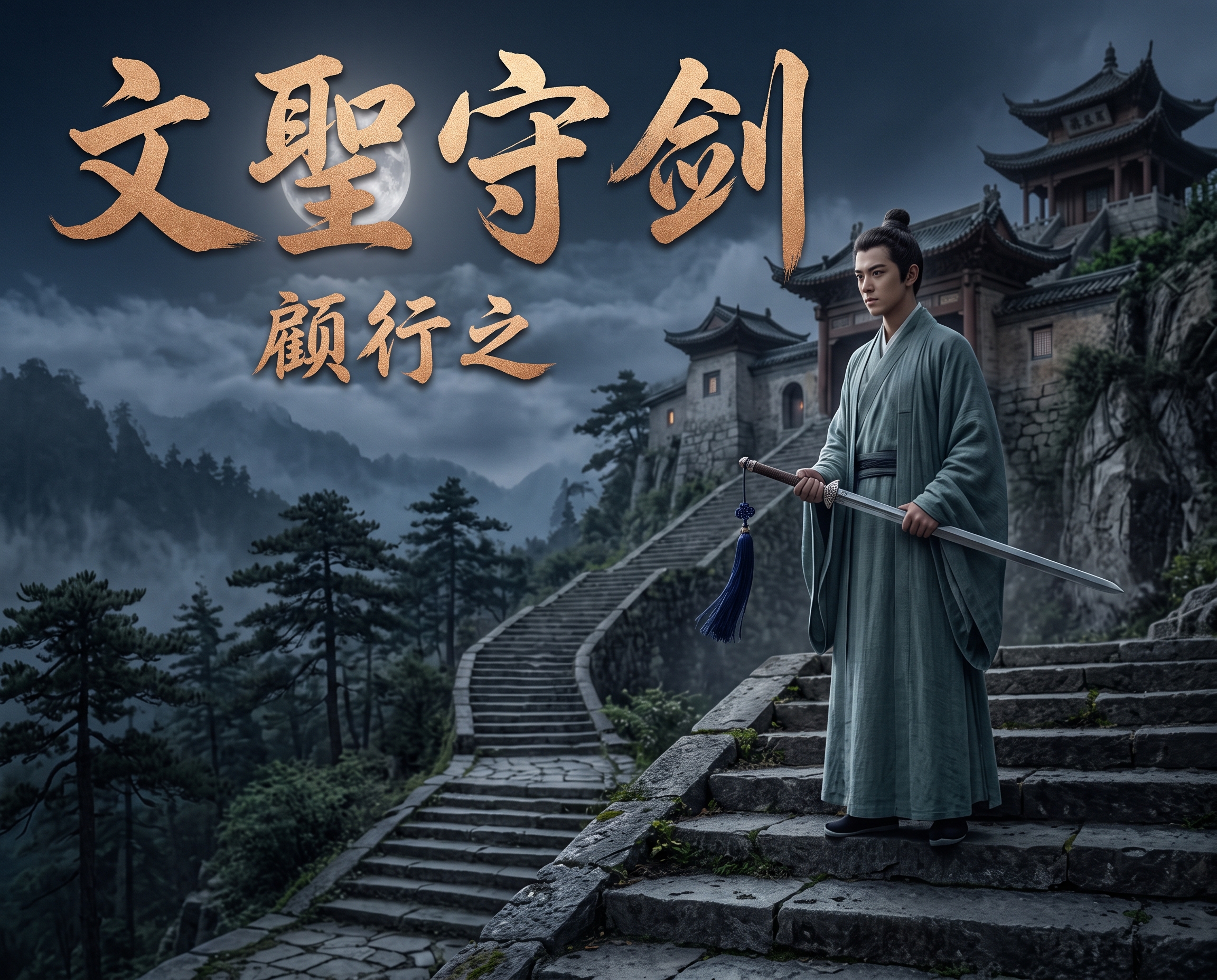
I. Fourteen
That autumn, Gu Xingzhi was fourteen.
He came from the south. Where exactly, the Academy's register recorded as: "Southern border of the Shuntian Dynasty, Linjiang Prefecture. No father, no mother. Supported by his clan." He carried a very old cloth bundle holding two changes of clothes, a copy of the Analects he had written out halfway, and an inkstone worn very thin.
The Outer College entrance examination was held in the great courtyard in front of the Hall of the Six Arts. That year one hundred and seventy-three applied; thirty would be taken.
The first test was "Calligraphy," a written paper. The topic: "A gentleman is not a vessel."
When the topic was posted, a murmur went around the courtyard. It wasn't a hard question, but it was not easy to answer well. Most wrote that "a gentleman should be broadly accomplished, not confined to a single talent or skill." That was the standard answer, and the safe one.
Gu Xingzhi wrote something different.
He wrote: "A vessel is a thing others make use of. A gentleman is not a vessel — not because he cannot be one, but because he will not let himself be used."
Pei Wenyuan was an instructor in the Outer College then, and he was grading the papers. When he came to this one, he paused. The handwriting wasn't pretty, but it was steady. He read it twice, then turned back to see the name. Gu Xingzhi.
The second test was "Mathematics." The third, "Rites." The fourth, "Music" — not playing the qin, but identifying pitch and temperament by ear. The fifth was "Archery," the sixth "Charioteering."
Gu Xingzhi placed first overall.
But that was not why Pei Wenyuan remembered him. After the examinations, the other candidates milled about the courtyard talking — some elated, some miserable. Gu Xingzhi sat on the stone steps in a corner, took out his half-copied Analects, and went on copying.
Pei Wenyuan walked over and asked him, "You're not happy?"
Gu Xingzhi looked up, glanced at him, and said, "I'm happy."
"It doesn't show."
"It doesn't show. I'm still happy."
Pei Wenyuan laughed. "What's your name?"
"Gu Xingzhi."
"Xingzhi — written how?"
"Xingzhi. The xingzhi in xingzhi youxiao. 'Proven by putting it into practice.'"
Pei Wenyuan nodded. Later he wrote a single line in the register: This one can be taught.
What he didn't write was that he had found the boy far too quiet that day. A fourteen-year-old who had just placed first, sitting in a corner copying a book.
That wasn't composure. It was having nothing he wanted.
II. Fast
Gu Xingzhi studied in the Hall of the Six Arts for six years.
The Hall's curriculum was rites, music, archery, charioteering, calligraphy, and mathematics. Every subject had a monthly examination, and after each one came the rankings. In six years, Gu Xingzhi's name never once dropped out of the top three.
And he was absurdly fast.
In rites, the Quli chapter of the Book of Rites, which took others a year, took him a month. When the teacher asked a question, he stood, answered, and sat down — not one word more.
In archery, the first time he drew a bow, nine of ten arrows hit. The archery teacher, Master Zhong, was an old soldier with a hot temper. He looked at Gu Xingzhi's arrows, frowned, and said, "Where are you aiming?"
Gu Xingzhi said, "I don't aim."
"Then how do you hit?"
"My hands know."
Master Zhong later told Pei Wenyuan: "There's something uncanny about that boy. When he shoots, there's no arrow in his mind at all. He just stands there, and the arrow is gone."
In charioteering, he drove a chariot around the grounds for the first time. The course had twelve wooden posts; one lap meant twenty-four turns. On his first lap, Gu Xingzhi touched none of them. His second lap was faster than the first. On his third lap, he slowed down.
The charioteering teacher asked him why he'd slowed down.
He said, "Speed is useless. When there are people in the chariot, speed means jolting. Jolt them, and they can't keep their seats."
In calligraphy, his characters weren't pretty, but they were never wrong. In mathematics, he calculated faster than the teacher. In music, he could hear differences in pitch that no one else could.
Once Pei Wenyuan called him to his study and asked, "You're good at all six arts. Which one do you like?"
Gu Xingzhi thought for a moment and said, "They're all the same."
"There isn't one you couldn't bear to give up?"
Gu Xingzhi thought again, and shook his head.
Pei Wenyuan's heart sank.
III. The Sword
The year Gu Xingzhi turned sixteen, the Hall of the Six Arts added a sword class.
It wasn't one of the Six Arts; the Outer College had added it on its own, once every ten days, teaching basic Gentle Sword. The Academy didn't forbid its students from learning martial arts — but outside the Inner College, nothing they learned counted as real swordsmanship.
The teacher was a senior brother sent down from the Inner College. In the first lesson, he didn't yet teach any of Gentle Sword's moves — Yield, Balance, Stay the Blade — only its foundation. It was very simple: a single straight thrust.
When Gu Xingzhi took hold of the sword, the senior brother gave him a look.
"Your hand is steady."
"Mm."
"But you're gripping too hard."
Gu Xingzhi loosened his grip. The senior brother showed him a few thrusts, then left him to practice on his own.
That day, all the other students practiced thrusting, and the courtyard was full of the whoosh of swords. Gu Xingzhi stood in a corner and didn't move. He held the sword strangely — neither raised nor lowered, but leveled across his body. He didn't thrust. He only stood.
The senior brother came over and asked, "Why aren't you practicing?"
Gu Xingzhi said, "I am practicing."
"How are you practicing by standing there?"
"I'm thinking: if I thrust this, what if the other man doesn't block?"
The senior brother was taken aback. "If he doesn't block, you hit."
"And if he does block?"
"Then you change your move after he blocks."
Gu Xingzhi nodded, and leveled the sword across his body again.
From that day on, Gu Xingzhi trained with the sword differently from everyone else. Others trained to "thrust." He trained to "not thrust." The more others trained, the faster they got. The more he trained, the slower he got.
The year he turned seventeen, the Hall's sword class came to an end. The senior brother had everyone fight one bout. Gu Xingzhi won, and won slowly. Every stroke he made was so slow his opponents thought he was letting them off. But the moment an opponent moved, his sword was already there.
The senior brother later told Pei Wenyuan, "I can't teach him."
"Why not?"
"Because what he's learning isn't what I teach."
IV. Airs, Odes, Hymns
The year Gu Xingzhi turned twenty, he finished the Outer College.
Those who finish the Outer College may choose to leave, or choose to sit for the Inner College. The Inner College examination is held once every three years, and it tests not martial skill but character. Gu Xingzhi sat for it.
The chief examiner that year was Su Wendao. Su Wendao was the Headmaster of the Academy, just past sixty that year.
The examination was held in front of the Nameless Study in the Inner College. Su Wendao asked three questions. Gu Xingzhi answered two.
The first question: "The Academy serves no sovereign and attends no court. If an emperor threatened the lives of ten thousand people and ordered you down the mountain to take office — would you go?"
"No."
"Why not?"
"If he threatens ten thousand lives and I go to take office, he gets what he wants. If I don't go, it's the ten thousand he's threatening, not me. I'm a disciple of the Academy, not his bargaining chip."
The second question: "What if everything you learn in this life is never of any use?"
"Then I'll stand."
Su Wendao didn't ask the third question. He stood up, walked over to Gu Xingzhi, looked at him for a long time, and said, "Go spend a night in the Nameless Study."
The Nameless Study is a bare room deep in the Inner College. In it there is only a lamp, a sword, and a scroll. Everyone who swears into the Inner College must spend their first night there alone. What is written on the scroll, no one who comes out will ever say.
Gu Xingzhi spent the night inside. When he came out the next day, he said nothing.
Later someone asked him what he had done that night. He said, "Sat."
"Sat all night?"
"Sat all night."
"What was written on the scroll?"
Gu Xingzhi looked at the man, turned, and walked away.
It was only after entering the Inner College that Gu Xingzhi first heard the words "Three Odes."
The Three Odes is the Academy's supreme art. It is not among the Six Arts, nor above them. It is another road.
By the Academy's rules, the Three Odes is taught only to the tenth rank, "Grand Confucian" — those at the summit of both learning and virtue. Inner College disciples may listen in the lecture hall, but may not practice it. Gu Xingzhi had only just entered the Inner College; he was of the seventh rank, "Heart-Seeker."
In the Inner College lecture hall, the teacher of the Three Odes was a very thin old man named Master Xie. What he said in his first lesson, Gu Xingzhi would remember all his life.
Master Xie said: "The Six Arts are learning. The Three Odes is how you stand in the world. Master the Six Arts, and you can be a good scholar. Master the Three Odes, and you can be a man who stands there."
"The Three Odes has three chapters."
"Chapter one: Airs."
Master Xie took out a fan. It was a very ordinary paper fan, nothing painted on its face.
"The Airs chapter commands a formation with the fan. Open the fan, and the formation rises; close it, and the formation withdraws. As wide as the fan opens, that much room heaven and earth give way. As still as the heart of the one holding it, that long the formation holds."
"Chapter two: Odes."
Master Xie set down the fan and brought out a qin. Its body was very old; its strings were new.
"The Odes chapter uses the qin to strengthen others. When the music rises, your companions' qi swells like spring water spilling over a bank; when the music falls, the water recedes. How far the qin can carry people depends on how far the player himself has gone."
"Chapter three: Hymns."
Master Xie pushed the qin aside. He didn't pick up a sword; he simply held out his hand in the shape of a man holding one.
"The Hymns chapter counterattacks with the sword."
The lecture hall was very quiet.
"The Hymns chapter has only one secret: hold the sword and do not move. Once the sword is held up, it falls only when someone strikes first. If no one strikes, it waits forever."
Gu Xingzhi raised his hand.
Master Xie looked at him. "Ask."
"The Hymns counterattack — it waits for the other man to strike first?"
"Yes."
"What if the other man doesn't move?"
Master Xie was silent a moment.
"Then you keep holding it."
"Until when?"
"Until he moves — or until you can't hold it anymore."
Gu Xingzhi lowered his hand.
After the lesson that day, Master Xie called him back.
"You know the rule?"
"I know. Listening is allowed. Practicing isn't."
Master Xie let that pass without a word.
"Which chapter do you want to learn?"
Gu Xingzhi thought about it and said, "I'll learn Airs first, then Odes, and Hymns last."
Master Xie laughed. "Everyone else wants to go straight to Hymns."
"Why?"
"Because Airs is the fan, and Odes is the qin — only Hymns is the sword. Everyone who studies the sword wants to learn Hymns."
Gu Xingzhi said, "I've never learned the fan or the qin. You have to know how to stand before you can know how to wait."
Master Xie looked at him for a long time, then nodded.
With that nod, he broke a rule the Academy had kept for a thousand years.
V. Slow
Gu Xingzhi learned the Airs chapter in three months.
The fan in his hand looked as though it had always belonged there. He opened it, and the formation rose. It wasn't large, but it was steady. Master Xie said, "You learn fast."
Gu Xingzhi learned the Odes chapter in half a year.
The qin didn't come as naturally to him as the fan, but his playing was precise. When his fellow disciples practiced the sword, he played beside them, and their swords rose a notch. Master Xie said, "You learn this fast too."
Then he began to learn the Hymns chapter.
He learned it for seven years.
The Hymns chapter is not a move. It is "holding."
The first lesson Master Xie gave him was to stand in the courtyard holding the sword, not moving.
"Stand until when?"
"Until someone moves first."
Gu Xingzhi stood for two hours. Master Xie left. He stood another two hours. The sun went down, and he was still standing.
That night, Master Xie came back to check on him. He was still standing.
Master Xie asked him, "Tired?"
"Tired."
"Why don't you put it down?"
"Because no one has moved first."
Master Xie laughed. "No one's fighting you. Standing here, you're fighting yourself."
Gu Xingzhi said, "Then I can put it down even less."
The first year, he could hold the sword for the time it takes a stick of incense to burn.
The second year, for an hour.
That was also the year Master Xie died. Gu Xingzhi was twenty-two.
Master Xie died very quietly. He was lecturing in the hall, stopped halfway through, and sat down. His students thought he was resting. He sat there a while, and never got up again.
Gu Xingzhi put away his qin for him. It was the very old qin with the new strings. He carried it back to his own room and set it on the table.
After Master Xie died, no one left in the Inner College could teach the Hymns chapter. Su Wendao came to the courtyard now and then to watch him. He never corrected his swordwork — only stood to one side watching for a while, asked a question or two, and left.
The rest of the time, Gu Xingzhi stood alone. When his legs started to shake, he carried Master Xie's qin out under the eaves and played a piece from the Odes chapter for himself. When the music ended, he stood up again.
The third year, he could hold the sword for two hours.
By the fifth year, he could stand holding it for an entire night.
Anyone can stand. The hard part is not moving. When a man stands, his hands want to move, his feet want to move, his heart wants to move. The longer he stands, the stronger the urge. Once the urge rises, the sword falls. Once the sword falls, the stance is wasted.
What Gu Xingzhi trained was "not moving."
Two more years passed, and one winter Su Wendao came again. Gu Xingzhi was twenty-seven that year.
Su Wendao asked him, "What are you waiting for?"
Gu Xingzhi said, "For the other man to strike first."
"And if he doesn't?"
"Then I keep waiting."
Su Wendao looked at him for a long time.
"Do you know what the hardest part of the Hymns chapter is?"
"What?"
"It isn't the waiting," Su Wendao said. "It's still being able to stand when the wait never ends."
The Hymns chapter had come as far as the courtyard could take it. However long he stood, if no one struck first, the sword could never fall — and a sword that never falls is not a completed chapter.
VI. The Visitor
The following autumn, the Academy received a secret report.
Blood God Sect people had been active in the north of the Shuntian Dynasty, their target unknown.
Su Wendao called the Inner College disciples together to confer. Gu Xingzhi sat in the lowest seat and didn't say a word from start to finish.
When the meeting ended, Su Wendao kept him back.
"If someone comes, you stand at the mountain gate."
Gu Xingzhi nodded.
Su Wendao added, "That night, no one else from the Academy will step outside the mountain gate."
Gu Xingzhi nodded again.
He didn't ask why it would be only him. With more people there, whoever came would retreat — and whoever retreats comes back.
He knew exactly what was in the Locked Scripture Loft. Gazetteers of the northern demon tribes, construction plans for the great formations of past ages, the building records from when Shushan's Demon-Suppressing Tower was first raised. The Blood God Sect wanted these things — the Tower's building records most of all.
The Blood Heavenly Sovereign had long been looking for a way to release what was sealed in the Demon-Suppressing Tower — the demonic masters Shushan had imprisoned there a century ago. If the Blood God Sect got the Tower's construction plans, it could find the weak points in the seal.
The Academy forbids no one to read. Floors one through six of the Tower of Ten Thousand Scrolls are open to anyone who wants to borrow a book. Even disciples of the Blood God Sect have read there, so long as they didn't start a fight.
But the Locked Scripture Loft is the seventh floor, and it stays locked all year round. Opening it takes two seals used together, the Headmaster's and the Chancellor of the Outer College's. In a thousand years it has been opened fewer than forty times on record.
Cen Shouzhuo had once said: "The Academy forbids no one to read — except one kind of book: the kind that, once read, stops anyone else from ever reading again."
Gu Xingzhi remembered those words.
The Blood God Sect sent an elder.
He was called the Old Blood-Fiend. His real name was Han Sha. No one in the sect used it; they just called him "Old Sha."
He was more than a hundred years old. He did not practice the Blood Demon Great Method, but the Blood Fiend Palm and talisman curses. He didn't like fighting head-on. He preferred blood pacts, talismans, and long, slow torment to break his opponents.
A century ago, when the sect's Grand Elder, the Slaughtering Blood Patriarch, was imprisoned by the Shushan Sect, power within the sect was reshuffled. A great many people died in that reshuffle. The Old Blood-Fiend was one of the few who survived.
What kept him alive wasn't strength. It was his ability to wait.
When others fought, he waited. When others grabbed, he waited. He waited until the fighters were dead and the grabbers were dead, and he was still alive. Then everything they'd wanted was his.
All his life he lived by one saying: Killing is easy. Waiting is hard.
The Slaughtering Blood Patriarch had said it. The Old Blood-Fiend had heard him say it once, when he was young. The Patriarch had been sitting at the very top of the Crimson Blood Grotto with his eyes closed, the blood-qi around him so thick it seemed almost solid. The Patriarch said, "Killing is easy. Waiting is hard."
He hadn't understood it then. Slowly, over the years, he came to.
In the whole Blood God Sect, no one could match his patience.
So this time, it was he who came.
The front of Wenyuan Peak was patrolled at night by Academy disciples in rotation; the back was sheer cliff. The cliff only climbed as far as the pine forest halfway up. Above that, the summit was ringed by precipices on all four sides. The Tower of Ten Thousand Scrolls and the Locked Scripture Loft stood on the summit. The only way up was the single flight of three hundred and sixty-four stone steps on the front of the mountain, and at the top of the steps stood the mountain gate.
The night he climbed the mountain, the moonlight was beautiful.
On autumn nights on Wenyuan Peak, the mist runs thin, and the moonlight lay on the stone steps like a layer of frost. The Old Blood-Fiend came up the cliff at the back, slipped past the patrols at the foot of the mountain, came out through the pine forest halfway up, and set foot on the steps.
He wore dark gray night clothes. He hadn't brought the Blood-Fiend Magic Banner, nor the Blood-Prison Divine Blade. He brought only his two palms and a few blood-seal talismans.
He didn't want to kill anyone. Killing would alert the Academy. What he wanted were a few volumes of building records from the Locked Scripture Loft. Once he had them, he would leave.
He climbed the steps. Pines lined both sides, and the moonlight came through the branches in broken pieces. He moved very lightly, almost without a sound.
At around the three hundred and fortieth step, he stopped.
At the top of the steps, before the mountain gate, stood a man.
VII. The Leveled Sword
Gu Xingzhi stood on the topmost step before the mountain gate, his sword leveled across the way.
He wasn't wearing the formal robes of the Inner College, only a blue robe washed nearly white. The scabbardless sword lay level before him, its blade catching the moonlight, cold as a frozen stream.
He simply stood.
The Old Blood-Fiend looked at him and didn't move.
He recognized the man. An Inner College swordsman of the Academy — Gu Xingzhi. The Blood God Sect kept records on the Academy's masters, and Gu Xingzhi's name was among them. The record read: "About thirty. Taciturn. Carries a scabbardless sword. Strength unknown. Suspected to be among the Inner College's top swordsmen."
Strength unknown.
The Old Blood-Fiend did not like those two words. He was used to knowing his opponents inside and out — used to knowing, before any fight, what moves they used, where their weaknesses lay, and when they would leave an opening.
But Gu Xingzhi's record said nothing. No moves, no fights, no weaknesses.
He only stood there with his sword leveled.
The Old Blood-Fiend watched him for a long time.
He had heard of the Hymns chapter. A counterattacking sword: once it is held up, it waits for the other man to strike first. There was another rumor too — that while the swordsman stands there motionless, his internal force keeps rising, and the longer he stands, the heavier that stroke becomes.
But that was rumor. No one had ever seen the Hymns counterattack with their own eyes. In a thousand years only six people in the Academy had completed the Hymns chapter. Five had died unnatural deaths, and one had vanished without a trace. Whether the man before him was the seventh, no one knew.
Rumors aren't necessarily true, the Old Blood-Fiend thought.
He took a step forward.
Gu Xingzhi's sword stayed level. It didn't advance, didn't retreat.
The Old Blood-Fiend took another step. He was only twenty paces from Gu Xingzhi now. He could see the sword clearly. There were extremely fine lines on the blade, as if words had been carved into it, too faint to make out in the moonlight.
He noticed how Gu Xingzhi held the sword. His right hand gripped toward the back of the hilt; his left hung at his side, not resting on the blade.
Not quite an attack. Not quite a guard.
It was waiting.
The Old Blood-Fiend stopped.
He could see it: the sword was waiting for him to strike first. As long as he didn't, it would stay leveled there.
He thought it over, then backed away.
Gu Xingzhi didn't follow. The sword stayed level.
The Old Blood-Fiend backed off three steps and stopped. He was thinking.
Below the steps was the road; above them was the Tower. This man stood in between. To get past, he would have to go past him. The steps were only so wide, and the leveled sword sealed off exactly their full width.
He tried to slip past along the side. To the left of the steps was the pine forest; to the right, the cliff face. He shifted and darted left.
Gu Xingzhi's sword simply turned, still level, its point toward him.
He darted right. The sword stayed level.
He returned to where he'd been.
The steps were very quiet. There was only the rustle of wind through the pines.
VIII. Gathering
Gu Xingzhi stood there doing nothing at all.
His breathing was slow — so slow you could hardly tell he was breathing. But his qi was gathering.
How heavy the Hymns stroke is depends on how long its holder has stood. The longer he stands, the deeper the qi gathers, like a mountain spring below the steps filling an unseen pool one drop at a time. Only when the pool is full does the sword fall.
The Old Blood-Fiend didn't know any of this.
He only felt that the man before him was growing heavier and heavier, as if the whole weight of Wenyuan Peak were settling, bit by bit, onto that sword.
At first, Gu Xingzhi stood there like a pine.
Later, he stood there like a mountain.
The moonlight fell on him, and the blade grew brighter and brighter, as if it were drinking in all the moonlight.
A bead of sweat broke out at the Old Blood-Fiend's temple.
He began to calculate.
With his skill, if he forced his way through, could he get past before Gu Xingzhi's sword came out? Twenty paces — at his speed, he could close in within three strides.
But after closing in? The sword lay level across the way; closing in meant running onto its edge. He needed an opening. Gu Xingzhi's stance had none.
At least none he could see.
He calculated something else.
A man had been standing at the mountain gate this long; the Academy had to know by now. Yet no one came. Not a single lamp lit behind the gate, not a single footstep.
He couldn't make sense of it. If the Academy wanted to take him, it should have sent ten men; if it feared him, it should have roused everyone in the Locked Scripture Loft. The Academy had done nothing — only put one man here.
But dawn always comes. At dawn the morning bell would ring, the Academy's disciples would rise, and then it would be a crowd coming.
He knew he couldn't wait until dawn.
Nor did he want to strike first.
He practiced the Blood Fiend Palm. When he began a Blood Fiend Palm strike, his right shoulder dropped slightly — a habit decades in the making. If Gu Xingzhi knew about that habit — and he very likely did — the sword would come in through the opening at his right shoulder.
He could leave. If he left, Gu Xingzhi wouldn't follow. He could simply come back another time.
That's what he told himself.
But his feet didn't move back down the steps.
He found himself another reason: if he came back another time, this man would be standing here again — and would be here even earlier.
IX. The Long Night
That night, nothing happened on Wenyuan Peak.
The moonlight moved from east to west. The shadows of the pines crept across the steps and back again. Gu Xingzhi stood on the topmost step, motionless. The Old Blood-Fiend stood twenty paces below, motionless.
Between the two men lay some twenty steps, and a leveled sword.
Wind rose from the valley, carrying the smell of pine resin. The lights of the Tower of Ten Thousand Scrolls on the summit had long since gone out; only the stone lanterns at the mountain gate were still lit, and their light was very dim.
The Old Blood-Fiend had counted his own heartbeats. From the climb until now, six hours had passed. His heart had beaten about fifteen thousand times. He didn't know Gu Xingzhi's heartbeat, but he guessed it was very slow — so slow it could hardly be felt.
Gu Xingzhi's qi was still rising.
At first it was faint, like a stream. Then it grew more and more obvious, like a river. By the end, he could no longer judge how high the man's presence had risen.
He knew only this: every moment he spent made that sword heavier.
He had counted the steps. Three hundred and sixty-four. He stood at around the three hundred and fortieth; Gu Xingzhi stood on the very top.
He had tried advancing to fifteen paces, and the sword didn't move. At ten paces, the sword stayed level. At eight paces, he stopped.
Because he could feel the point of the sword aimed at the space between his brows. Gu Xingzhi's hand hadn't moved, yet the point seemed to have found him on its own.
He fell back to twenty paces.
He tried once more. This time he circled around the side, to the edge of the pines left of the steps, meaning to slip through the trees. Gu Xingzhi didn't follow; he only tilted the sword a little. The point was still on him.
He circled halfway round, and the sword turned halfway round with him.
He returned to where he'd been.
Time crept by.
The Old Blood-Fiend's mind began to wander.
He remembered the first man he killed in the Blood God Sect, when he was young. An ordinary farmer. He tormented him slowly with a blood pact for three days, and savored every moment of it.
Now he stood here facing a man who was doing nothing at all, and it felt worse than being tortured.
He thought of the Slaughtering Blood Patriarch again. That Grand Elder of a century ago had reportedly slaughtered ten thousand people in a city single-handedly to refine a Blood Fiend Formation, and was in the end imprisoned by the Shushan Sect.
The Patriarch had said, "Killing is easy. Waiting is hard."
He hadn't understood it then. Now he understood a little.
But what the Patriarch hadn't said was that waiting has its limits too.
X. Before Dawn
The sky began to pale.
On the ridge to the east, the clouds took on a thin line of the faintest gray-white. Birds in the pines began to sing — a few scattered notes at first, then a whole chorus.
Before long, beyond the sound of the stream and the birds, the morning bell of the lecture halls would ring.
The Old Blood-Fiend knew he couldn't wait any longer.
Once the morning bell rang, the Academy's people would come. By then, he wouldn't even have the chance to retreat.
He had to strike.
He knew Gu Xingzhi was waiting for him to strike, and that the sword was waiting for the opening his first move would leave.
He had no other choice.
He drew a deep breath. Blood-fiend qi circulated through his body, and his palms glowed a dark red. His right shoulder would drop as he began; he tried holding it up, but then the force of the palm would go off line.
He could only accept the opening.
He stepped forward.
Gu Xingzhi still didn't move.
He took another step. He was only ten paces from Gu Xingzhi now.
He stopped and looked at the sword. The moonlight had faded, and the light on the blade had faded with it. But he could see the words carved into it — very fine, as if cut in with something, one point at a time.
He couldn't make out what they said.
He no longer wanted to.
He moved.
He struck with the Blood Fiend Palm at full force. Both palms, trailing dark red force, drove at Gu Xingzhi's chest. His opening move was fast — so fast he almost believed he hadn't left an opening.
But Gu Xingzhi's sword had already moved.
That stroke was very fast.
So fast the Old Blood-Fiend saw only a streak of white light.
The streak of white was brighter than the moon. It went in at his right shoulder and out below his left ribs. He felt no pain — only a chill in his chest, and then his whole body went light.
He looked down and found the steps getting farther and farther away.
So he was falling.
The last thing he saw before his consciousness scattered was Gu Xingzhi going down on his knees.
In the distance, the morning bell rang.
XI. Three Days
Gu Xingzhi knelt on the stone steps.
All the qi he had gathered through the night poured out in the instant the sword fell.
The sword fell; the man died.
Then his body was empty.
His meridians felt like a riverbed sucked dry, cracking open inch by inch. He knelt on the steps, hands braced against the ground, his forehead pressed to the cold stone.
He wanted to stand; his legs wouldn't obey. He wanted to breathe; every breath felt like dragging air in from somewhere very far away.
The Academy's people came. Someone held him up, someone went to look at the body, someone went to report to the Headmaster. He couldn't make out what they were saying.
He remembered only that someone lifted him and carried him back to the Inner College.
Later, a single entry was made in the Academy's register: Hymns chapter — completed.
In the Academy's thousand years, only seven people have ever completed the third chapter. Gu Xingzhi was the seventh, and the youngest. He was twenty-eight that year.
The six before him had all been Grand Confucians when they completed it. Gu Xingzhi was not.
He lay in bed for three days.
For those three days he couldn't speak, and even raising a hand was an effort. He only lay there, looking at the ceiling. His room in the Inner College was very simple: a bed, a table, a lamp. Outside the window was bamboo that rustled when the wind blew.
On the table sat the qin. The one Master Xie had left behind.
As he lay there, he thought of the six names in the Academy's register. Five dead by unnatural deaths, one vanished without a trace.
After that one stroke, he couldn't lift a single finger. If there had been two men standing below the steps that night, the second would only have had to walk up.
The Hymns chapter lets a man hold back one person, one time. After that single stroke, he is empty. Whatever comes next depends on others.
He thought the five before him had probably all died that way.
On the evening of the third day, he sat up.
Cen Shouzhuo came to see him. Cen Shouzhuo was Chancellor of the Outer College, and one of the few people in the Academy Gu Xingzhi could exchange more than a few words with. He sat down by the table and didn't ask how he was feeling. He knew Gu Xingzhi didn't care for questions like that.
What he asked was something else: "That night — what were you guarding?"
Gu Xingzhi leaned against the head of the bed, looking out the window. The bamboo leaves turned in the wind.
"The mountain gate."
"And behind the mountain gate?"
"Behind the mountain gate is the Locked Scripture Loft. In the Locked Scripture Loft are books. Books are for people to read, not for people to take by force."
Cen Shouzhuo nodded. After a while, he asked again: "The Headmaster allowed no one to step outside the mountain gate that night. You knew?"
"I knew."
"If he had turned and gone back down the mountain, what would you have done?"
"Kept my guard."
"And if he had forced his way up?"
"Kept my guard."
"You couldn't have stopped him."
"I couldn't have," Gu Xingzhi said. "If he'd gone back down the mountain, I couldn't have kept up. That whole night of standing would have been for nothing."
"Then why guard at all?"
Gu Xingzhi looked out the window for a long time before he said, "Mencius said: 'If, on looking inward, I find myself upright, then though there be thousands and tens of thousands, I will go forward.' I don't go forward. I hold. His coming is his business. My holding is mine."
Cen Shouzhuo was silent for a while. Then he asked, "Why didn't he leave?"
Gu Xingzhi said, "He couldn't get past it."
"What do you mean, he couldn't get past it?"
"The Great Learning says: 'Only when you know where to stop can you be settled,'" Gu Xingzhi said. "He didn't know where to stop. He waited for others to fight, waited for others to grab, waited for others to die — waited more than a hundred years. There was nothing he couldn't get past, except the words 'I can't get past this.' He had never once got past those."
Cen Shouzhuo nodded, rose, and left.
That night, a lamp was lit in the Outer College's register room.
Pei Wenyuan had grown old, and his eyes were failing. He had heard what happened at the mountain gate. Alone, he went through the admission registers from fourteen years before, searching a long while before he found the page.
Southern border of the Shuntian Dynasty, Linjiang Prefecture. No father, no mother. Supported by his clan.
Beside it, in his own hand: This one can be taught.
He thought of that autumn, and the boy copying a book in the corner of the stone steps before the Hall of the Six Arts.
He took up his brush and wrote a line: A scholar must be broad of mind and firm of will, for his burden is heavy and his road is long.
The brush stopped on the paper.
There were two more lines after it; he had recited them all his life. He takes humaneness as his burden — is that not heavy? Only with death does it end — is that not long?
Ink dripped from the tip of the brush and spread into a small blot on the paper.
(End)
Thank you for reading this far.
This site has no ads and no paywall — if what you found here meant something, ☕ buying me a coffee is the best encouragement to keep writing.