Fantasy World Short Stories
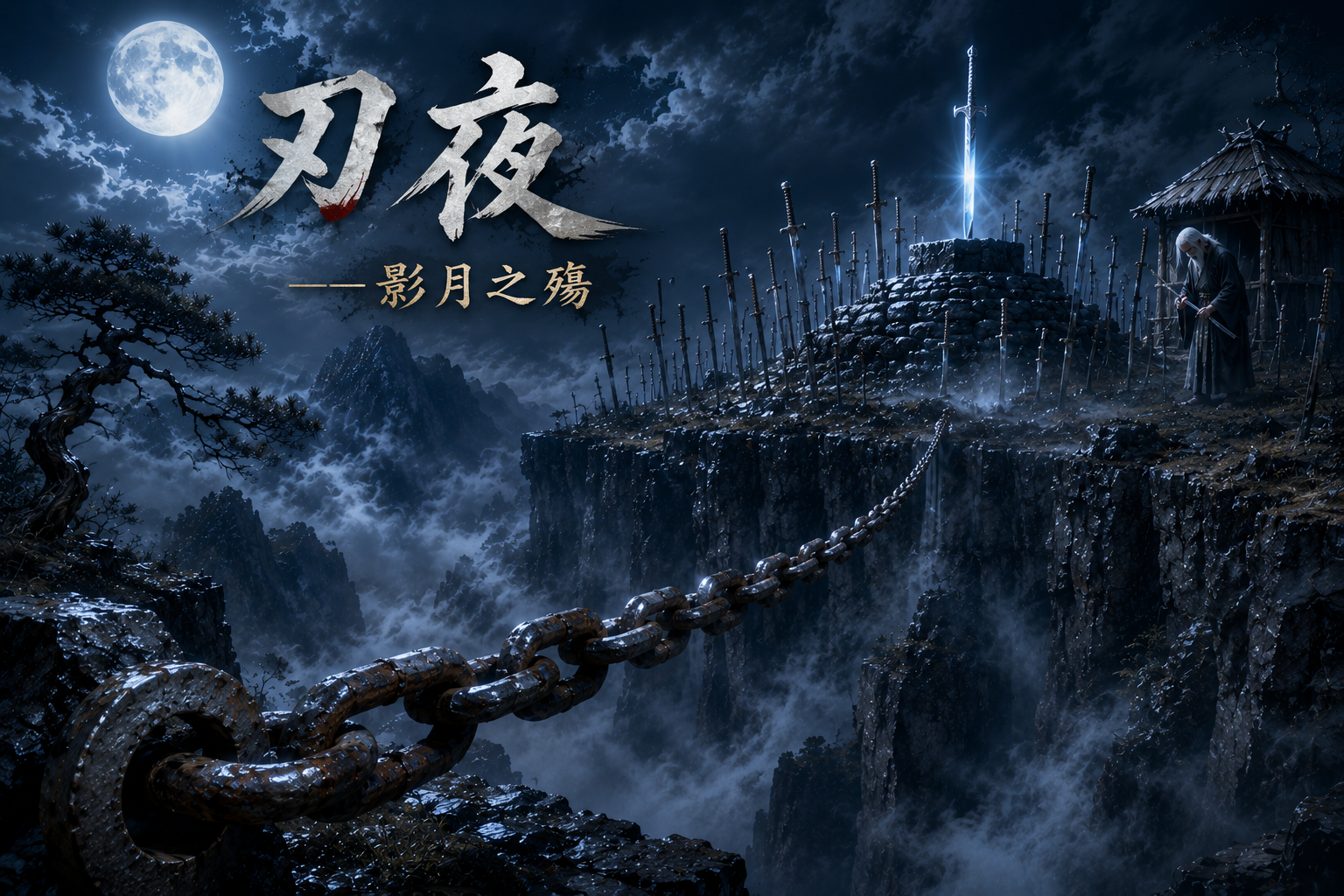
Night of Blades: The Tragedy of Kagemoon
— The Kagemoon Sect and the Origin of the Sword Tomb —
The Moonrise Empire — a realm of the blade.
The Kagemoon Sect — a century-old sword school that sought the Way through the blade.
But on that night, moonlight and blade-light were of one color —
What fell was the head of a traitor,
and also the everlasting sin of the loyal.
After the mountain city was washed in blood, the blades of the dead were heaped into a tomb,
and in that tomb stood a famous blade that no one could ever again draw.
— This is a story from twenty years ago. This is how the Sword Tomb began.
Chapter 1: The Mountain City
In the four hundred and seventy-second year of the Moonrise Empire, deep autumn.
The mist over Kagemoon Mountain City never lifted. This citadel, built upon the mountain's summit, had since ancient times been ground that soldiers fought to hold — wreathed year-round in cloud and fog, easy to defend and hard to assault. The mountain city was itself one vast battle-formation: at once a sacred ground of training and a labyrinth of blades.
But these past few days, the air within the city was heavier than the mist.
The Seventh Master, "the Moon-Cleaver" Saitō Sōgen, sat in the main hall, three secret letters spread before him. The first came from a courtier close to the Emperor, its wording gentle yet edged — "The blade of Kagemoon should serve the imperial house." The second came from a Kaga Clan informant, claiming that someone within the sect was colluding with an outside enemy. The third… had been submitted by the disciple he trusted most, Kuroba Genshin, requesting a full investigation of the "traitor" within the sect.
Sōgen rubbed his brow. He was old; the factional strife within the sect was no longer something he could suppress. The rift between the Loyalists and the Free Blade faction deepened by the day, and he was caught between them — like a blade ground thin on both edges, never knowing when it might snap.
"Master." A voice came from beyond the hall.
Sōgen looked up to see Kuroba Genshin standing at the threshold. He was Sōgen's senior disciple, born of the Loyalist house of Kuroba, exquisite in swordsmanship and — rarer still — utterly devoted to the imperial house. Sōgen had once thought that if the day came for him to step down, Genshin might be a fitting successor.
"Come in," Sōgen said, beckoning.
Genshin stepped into the hall and bowed. "Master, this disciple has uncovered some leads. There is indeed someone in the sect in secret contact with the Kaga Clan — and the evidence points to Hazama Sakyō of the Shadow Assassination Group."
Sōgen's brow twitched sharply.
Hazama Sakyō. The youngest member of the Shadow Assassination Group, and Kirishima Sōgon's sworn younger brother. That silent young man, ever sparing of words — a traitor?
"Is the evidence certain?" Sōgen asked.
"This disciple has intercepted the secret letters that passed between him and the Kaga Clan." Genshin drew several letters from his sleeve and laid them on the table. "The hand, upon comparison, is indeed Sakyō's. The letters speak of… his willingness to trade the Shadow Assassination Group's secrets for the Kaga Clan's protection."
Sōgen opened the letters, his face darkening further.
He did not notice — in Genshin's lowered eyes, a flicker of hesitation, almost imperceptible, passed. Those letters… were indeed in Sakyō's hand. But Genshin himself did not know how they had come to appear on his desk. He was only following orders — the imperial house wanted him to "cleanse" the unstable elements within the sect, and Sakyō was the chosen sacrifice.
"Carry my secret command," Sōgen said at last, his voice hoarse. "Order the captain of the Shadow Assassination Group, Kirishima Sōgon… to cleanse the house."
Chapter 2: Brothers
The quarters of the Shadow Assassination Group lay in the most remote western corner of the mountain city.
There were no carved beams or painted rafters here as in the main hall — only a row of plain wooden huts. The Shadow Assassination Group was the most secret unit of the Kagemoon Sect, charged with the sect's dirtiest work, the kind least fit to be spoken of beyond its walls. Its members rarely appeared before others, and when they did, they kept their heads low, slipping past like shadows.
Kirishima Sōgon sat in his hut, wiping his blade for the third time.
He was a little past thirty, his features resolute, yet his eyes always carried a weariness he could not name. As the last captain the Shadow Assassination Group would ever have, he had seen too much darkness — assassination, betrayal, the silencing of witnesses. Each time he carried out a task, he told himself: this is for the sect. The duty of one who wields the blade is to obey the Master.
Footsteps came from beyond the door, light and steady.
"Big brother." Hazama Sakyō pushed the door open and came in, a jug of wine in his hand. "The moon is fine tonight. Drink with me?"
Sōgon looked at him and said nothing.
Sakyō was five years his junior. Though they shared no blood, they had forged a bond closer than life in the brutal training of the Shadow Assassination Group. On a mission three years before, Sakyō had taken three blades covering Sōgon's retreat, and nearly lost half his life. From then on, Sōgon had regarded him as his own brother.
"What is it?" Seeing him silent, Sakyō set down the wine jug. "You don't look well."
Sōgon was silent a moment, then finally spoke: "The Master has given an order."
Sakyō's smile stiffened slightly.
"He orders me… to cleanse the house." Sōgon's voice was very soft, soft as a passing wind. "The target is you."
The room was quiet enough to hear the candle flame burn.
Sakyō did not panic, did not deny it. He only looked quietly at Sōgon. After a long while, he suddenly gave a small laugh — and in that laugh was something hard to name, like relief, and like sorrow.
"Big brother, do you believe me?"
Sōgon did not answer.
Sakyō drew from his robe a charred half-fragment of a secret dispatch and laid it on the table. "I've found out a few things. About the Kaga Clan, about the imperial house, about… that evidence."
Sōgon's gaze fell on the fragment, and did not move.
"What evidence?"
"The evidence against me." Sakyō's voice was low. "Don't you think… it came too conveniently? The day after I found the trail of the Kaga Clan planting informants in the sect, those letters appeared on Genshin's desk. Big brother, do you think there are such convenient coincidences in this world?"
Sōgon's hand trembled, just slightly.
"What are you trying to say?"
"I have no proof that it's false," Sakyō said quietly, "but I have no proof that it's true either. I only… feel that something is wrong. Someone is laying out a board, big brother. What they want isn't me — it's the whole Kagemoon Sect."
Sōgon's hand tightened on his blade.
"The Master has given an order." He said it again. The voice was still soft, but Sakyō heard the tremor in it.
Sakyō looked at him, and suddenly stopped speaking. He only stood there quietly, like a blade already drawn that no longer meant to return to its sheath.
"Big brother," he said at last, "do as you're told."
Beyond the window, the moonlight was veiled by cloud for a moment, and the whole mountain city sank into a deeper shadow. Sōgon's hand shook on the blade — but his blade was already drawn.
"Why won't you explain?" His voice was hoarse. "Why won't you tell me that the evidence might be false?"
Sakyō turned his head and looked at him. That look was calm, calm enough to make Sōgon feel his heart seized in someone's grip.
"I just told you," Sakyō said softly. "Did you believe it?"
Sōgon could not answer.
Because he knew — he had not. The Master had ordered it; the evidence lay before him. He was a captain of the Shadow Assassination Group; his duty was to obey, not to question. Sakyō was right. He had not believed.
"Then… one day, in the days to come," Sakyō closed his eyes, "you will know the truth. When that day comes… do not hate yourself."
Sōgon's blade fell.
Blood spattered the window lattice, spattered the moonlight, spattered Sōgon's face. Sakyō's body slowly toppled, the charred fragment of the dispatch still clutched in his hand. To his death he did not open his eyes again; to his death he offered no defense.
Sōgon knelt on the ground, the blade slipping from his hand.
Beyond the window, the moonlight brightened again. Beside Sakyō's hand he saw, on the fragment of the dispatch, a few faint characters — the words Sakyō had never finished saying.
At that same moment, cries of alarm and the ring of blades suddenly rose across the whole mountain city.
In the distance, fire leapt toward the sky — at the far end of the mountain city, the Loyalists and the Free Blade faction had split, thunderously, into two; blade-light and battle-cries burst out together, like an invisible fissure cleaving the century-old sword school in half.
The Night of Blades had begun.
Chapter 3: The Night of Blades
That night would be known in history as "the Night of Blades."
The fire started from the scripture pavilion in the eastern wing and spread to the training ground on the west. No one knew who set the first fire, but everyone knew — tonight, the blade told no friend from foe.
Sōgon knelt beside Sakyō's body, the cries of killing beyond the door drawing nearer. He could not hear those sounds. He could hear nothing at all. He could see only Sakyō's eyes — those eyes that had not closed even in death, his own face reflected within them.
It took him a long time to recognize what was written on that face: fear.
Not Sakyō's fear. His own.
"— Found them! The Shadow Assassination Group is in here!" A coarse voice came from beyond the door.
Sōgon's head jerked up. With his left hand he took up Sakyō's blade, with his right he gripped his own, the two blades crossed before him. The instant the door was kicked open, he saw three unfamiliar faces — Loyalists, Free Blade men, or Kaga Clan in disguise; he could no longer tell.
He did not ask, did not confirm. He drew.
Two blades swept out together, two arcs traced beneath the moon. When those three men fell, he had not even seen their faces clearly.
He was not killing enemies. He was killing "anyone who dared to come in."
Sōgon kept watch in Sakyō's hut through the night, and no one dared approach that door again. The fighting outside went on all night — the clash of blades, the screaming, the embers — while inside he sat like a stone statue, guarding a corpse he had cut down with his own hand.
And at the other end of the mountain city, before the main hall, the Seventh Master, Saitō Sōgen, stood upon the steps, trying to halt this mutual slaughter.
"Stop! You are all disciples of Kagemoon —!"
His voice, amid the ring of blades and the light of fire, sounded especially aged. Blade in hand, he walked step by step toward the center of the melee, meaning to press down this revolt with the authority of the Master.
But he did not finish the walk.
Three dark-red figures dropped soundlessly from the shadows of the rooftop — Kaga Clan jōnin, two wielding short blades, one holding back in the rear. They bore no marks, no banners, but that pervasive reek of blood and those strange ninja tools — Sōgen knew their origin at a glance.
"Kaga…!" A cold light flashed in his eyes.
The lead ninja wasted no words; the three struck at once!
Sōgen's blade left its sheath.
It was the drawing technique passed down through the generations of the Kagemoon Sect — the one-stroke instant kill. The blade-light traced out like the arc of the moon, faster than its own shadow could follow. Before the first ninja's short blade so much as touched the hem of his robe, a line of blood burst from his throat, and his body pitched forward to the ground. The second ninja, caught in his shock, could not check his momentum; Sōgen's backhand stroke severed the arm that held the blade, and he tumbled screaming off the steps.
Two strokes, two men. Front to back, no more than a single breath.
But the drawing technique had one fatal flaw — once the stroke was loosed, its momentum spent, there came an instant, exceedingly brief, before the guard could be recovered. Even a single instant, to one who knew the Kagemoon sword well, was enough to kill.
The third ninja holding the rear — the Kaga Clan jōnin — had been waiting for this very moment. He knew Sōgen's drawing technique well, knew that single instant of opening, and knew his chance would come only once.
He moved.
His figure swept out low along the ground like a wraith; his left hand flung three short blades to cut off Sōgen's retreat, his right hand drove a ninja blade straight for Sōgen's heart. Sōgen's blade was still extended, too late to draw back — he could only block with the hilt, but with a clang the blade was caught by the flat of the ninja blade and snapped clean through. The broken blade spun away and buried itself in the flagstones, humming without end.
Sōgen's guard was wide open.
The jōnin did not hesitate; the short blade sank into Sōgen's chest, clean through to his back.
Sōgen's body shuddered violently. He lowered his head, looked at the blade thrust into his heart, then slowly raised it and looked into the eyes behind that mask.
He smiled.
Blood welled from the corner of his mouth, but his left hand — at some unknown moment — had closed upon the jōnin's collar.
"Let us go together."
Dragging the jōnin with him, he toppled from the steps, and the two of them plunged into the deep ravine before the main hall. The falling figures were swallowed by the firelight, vanishing into the dark. No one heard the final sound — only a broken blade left standing in the flagstones, its hilt trembling faintly, like an eye that would not close.
No one saw this. Both sides of the melee were too busy with slaughter; no one noticed that their Master was already dead.
After the Night of Blades, the official account was that "the Master fell fighting valiantly in the chaos of battle." No one pressed for details — because those who pressed were dead as well.
When dawn came, Sōgon at last pushed open the door and walked out.
The whole mountain city lay in ruin. The pine forest was stained with blood, the covered bridges broken, the air thick with the smell of blood and burnt smoke. Treading over a ground full of blade-scars and corpses, he walked step by step toward the main hall.
He saw that broken blade — the Master's blade, standing in the flagstones. He knew the pattern on the hilt; it was Sōgen's blade. Only half the blade remained, the break clean, as if cut through in a single stroke by something exceedingly sharp.
He did not go to draw that blade. He only went around it and walked on into the hall.
The infighting between the Loyalists and the Free Blade faction lasted the whole night, and only at daybreak did it gradually subside. The Kaga Clan ninja, their task complete, withdrew in silence — their purpose accomplished: to kill the men of Kagemoon with the blades of Kagemoon; behind every fire that rose, every scream that sounded, lay their hand. And Kuroba Genshin, the pawn the imperial house had chosen, died too among the chaos of blades. The Kaga Clan broke faith and never meant to let him live to succeed; the imperial house's scheming, together with the puppet they had propped up, was buried alike in the Night of Blades.
In the end it was Tenba Jirō — who would not submit, who turned back the tide — who took up the sect and became the Eighth Master.
Sōgon took no part in the fighting.
He shut himself in Sakyō's hut and stayed three more days. No one dared disturb him — the captain of the Shadow Assassination Group had just cut down his own sworn brother with his own hand, and no one knew what to say to him.
On the fourth day, he pushed open the door and walked out.
There were no tears in his eyes, no redness, only a hollow calm. He went to Sakyō's effects and dug out the charred half-fragment of the secret dispatch.
The characters on the fragment had blurred, but he still made out a few — "imperial house," "Kaga," "frame." Piece by piece he fitted them together, as if fitting together a self already shattered.
The truth, like a blunt blade, cut open his innards inch by inch.
Sakyō was no traitor. He had died on the road to exposing the truth. The one who framed him was the snare laid jointly by the Kaga Clan and the imperial house. And he, Kirishima Sōgon — the one Sakyō trusted most, the one he had called "big brother" for ten years — had taken up the blade with his own hand and cut off his head.
Sōgon knelt on the ground and did not weep.
He only quietly gathered the fragments and hid them against his chest, inside his robe. Then he stood, walked out of the hut, walked through the devastated mountain city, and walked toward the back mountain.
Chapter 4: The Sword Tomb
The mist on the back mountain was thicker than in the city.
Sōgon walked a long while, passing through a stretch of scorched pine forest, following the mountain path downward, until he came before a valley so deep its bottom could not be seen. Cloud and mist churned within it, the far side hidden from view. Wind blew up from the valley floor, carrying a desolate, keening sound, as if a thousand people were weeping at once.
On the far side stood a sheer cliff. On the cliff face, faintly, could be seen a tomb heaped of black stone.
And the only thing joining the two banks was a single iron chain.
That chain was thick as a child's arm, its two ends fixed to great boulders on the cliffs of either side, swaying faintly in the wind. It was mottled with rust, yet still sound — forged decades ago by the smiths of the Kagemoon Sect from hundred-times-tempered steel, meant originally to serve as part of a secret path on the back mountain in time of war. Later, when the fighting ceased and the secret path fell into disuse, only this chain remained, the sole passage to the far side.
But almost no one ever crossed. On the cliff beyond there was nothing but rock and withered trees. What was more, to cross this chain over a valley tens of fathoms deep — a single slip, for anyone whose lightness-skill was less than sure, meant a fall into a bottomless abyss. As the years passed, the back-mountain valley became a forbidden ground of the Kagemoon Sect; disciples passing by would only glance at it from afar, and never try to cross.
Sōgon stood before the chain and lowered his head to look at his own hands.
On those hands was Sakyō's blood. He drew a deep breath and stepped onto the chain.
The chain swayed beneath his feet, the wind pouring up from the valley floor, setting his robes snapping. He did not hold on, did not look down; he only fixed his mind and walked forward, step by step. The chain underfoot was slick, and each step was like walking on a blade's edge.
He walked a long while.
When he reached the far side, his brow was beaded with cold sweat. He looked back the way he had come — the mountain city was already lost in the mist on the other bank, only a blurred outline left.
Here there was nothing. Only rock, withered grass, the sound of wind, and that tomb heaped of black stone.
Sōgon walked toward the Sword Tomb.
Tenba Jirō's order had been to "gather the blades of all who fell in the Night of Blades and lay them on the back mountain." But how had they been carried across this chain? Sōgon did not understand — until he drew near the tomb and saw, beside the stone base, several woven rattan crates. The blades had been carried over in crates, one crate at a time, slung along the chain and slid across the valley. Arriving here, they had been driven one by one into the black-stone tomb.
Sōgon walked a circle around the Sword Tomb.
The black stones were heaped into a round mound half a man's height, its top level, and into it were driven nearly a hundred blades — short blades, long blades, tachi, wakizashi — each one stained with blood, each one bearing the story of a death that would not close its eyes. There was no inscription, no censer, only these blades, standing soundless in the wind, as if waiting for something.
Sōgon recognized several of them.
Sakyō's blade — he knew the black cord knotted on its hilt, for he had tied it himself. Kuroba Genshin's blade — the Kuroba crest carved on the scabbard, sharp as new, without a trace of blood, yet now a thing without a master. The Master Sōgen's broken blade — only half remaining, the pattern on the hilt still clear, the break at the edge clean, as if cut through in a single stroke by something exceedingly swift.
And many more blades whose names he could not call. Some belonged to faces he had known, some to fellow disciples he had seen but never spoken with. They had once been the blades of Kagemoon; now only this cold iron was left, driven into a cliff that no one came to.
Sōgon knelt before the Sword Tomb.
"I'm sorry," he said. His voice was soft, scattered by the wind.
The blades gave him no answer.
He knelt a long while, until his knees were numb against the rock, until the sun broke a corner through the clouds and lit the rust and the bloodstains upon the tomb.
Then he rose and walked to the deepest part of the Sword Tomb.
There stood a stone dais.
The dais was not tall, about waist-height, wrought wholly of black granite polished smooth as a mirror. In its center stood a blade — the guardian blade of the Kagemoon Sect, Tsukikagemaru, the Moonshadow Blade.
Sōgon had never seen Tsukikagemaru drawn, but he had seen its sheath. It was a blade all silver-white, faintly giving off a pale-blue cold light, its hilt wrapped in white sharkskin, the guard carved with the pattern of a crescent moon. The whole blade was set into the stone dais, sunk perhaps three inches into the stone, standing firm there as if it had grown out of the rock itself.
It was said that Tsukikagemaru had a spirit. It could tell the righteousness or evil of a man's heart, and only one it acknowledged could draw it from the stone. Before the Night of Blades, it had left its sheath several times, each time accompanying the most glorious moments of the Kagemoon Sect — master after master had used this blade to cut down powerful foes and widen the sect's domain. But after the Night of Blades, no one again could make Tsukikagemaru leave its sheath.
Sōgon reached out and grasped the hilt.
He felt a cold force come through the hilt — a force not like the cold of iron, but like an unseen hand refusing him, pushing him away. He gave a hard pull. It did not stir.
He pulled again. Still it did not move.
He let go, stepped back, and looked quietly at the blade.
"You are judging me," he said softly.
The blade did not answer. But that cold feeling lingered in his palm, as if branded into the skin.
Sōgon lowered his head and looked at his hands. He understood.
Tsukikagemaru did not acknowledge him. Because on his hands was the blood of the innocent.
He sat down beside the stone dais, leaned against the edge of the Sword Tomb, and closed his eyes. The wind blew up from the valley, passing through the blades driven into the earth, and sounded a low ringing — like someone weeping, and like someone murmuring.
He did not rise to leave.
Because this was now the only place he could go.
Sōgon raised a thatched shelter beside the Sword Tomb. The shelter was crude, a few withered branches propping up a torn cloth, barely able to keep off wind and rain. He had brought only two things out of the mountain city — Sakyō's blade, and that half-fragment of the secret dispatch.
From that day on, Kirishima Sōgon never again left this cliff.
Chapter 5: The Tomb-Keeper
In the first few months after Sōgon settled beside the Sword Tomb, nearly every day passed like a year.
Each morning when he woke, the first thing he did was wipe Sakyō's blade. He wiped that blade until it shone like new, without a speck of rust, the edge gleaming cold in the morning light — just as it had when Sakyō was alive. He would set the blade back in its appointed place in the Sword Tomb, then turn to carry water, split wood, light a fire — the chores a tomb-keeper ought to do.
By evening, he would sit beside Tsukikagemaru, facing the blade set in the stone, and sit still. He did not speak, did not meditate; he only sat quietly, like a forgotten stone statue.
The only one who stayed and lived at the Sword Tomb was him.
In the first months, a few of his sect-brothers had come to see him. They stood on the far bank of the chain and called his name from afar, asking whether he would come back. Sōgon gave no answer. He only sat by the Sword Tomb, head bowed, like a stone that could not speak.
Later, Tenba Jirō came as well. The new Master crossed the chain himself, stood before Sōgon, looked into his eyes, and said, "Sōgon, come back. The Shadow Assassination Group needs you. The Kagemoon Sect needs you."
Sōgon raised his head and looked at Tenba Jirō. That look was calm, calm enough that Tenba Jirō felt his heart pricked by something.
"Master," Sōgon said softly, "my hands can no longer hold a blade."
Tenba Jirō was silent a long while, and pressed him no further. He turned and left, and never came again. Before going, he stood a moment at this end of the chain, looked back once at the thatched shelter and the Sword Tomb, and murmured a single line. Sōgon did not catch it, but he thought it was, most likely, a farewell.
From then on, no one came again — until Tsukihime appeared.
Tsukihime was Tenba Jirō's younger sister, ten years his junior. In the year of the Night of Blades she was still a child of thirteen, hidden in a concealed compartment of the scripture pavilion, watching through a crack the blade-light and fire of that night. She did not cry, did not call out; she only quietly committed to memory every face of the intruders — those faces that looked just like Kagemoon disciples, yet raised their blades against them.
When she grew up, she became one of the few in the mountain city who dared to keep asking after "the truth of the Night of Blades." Unlike Tenba Jirō — whose investigation was conducted in secret, cautious as if treading on thin ice — Tsukihime's inquiries were more direct, more daring. She had slipped into the outskirts of the Kaga Clan's Valley of Shadows and brought back a list of informants; she had disguised herself as a traveling merchant and drawn out an imperial courtier's words in a capital tavern. Her leads were, at times, more crucial than the secret reports in Tenba Jirō's hands.
And the place she went most often was the end of that iron chain on the back mountain.
The first time she came, Sōgon scarcely recognized her. That little girl who had hidden in the compartment of the scripture pavilion had grown into a sharp-eyed young woman with a short blade at her waist. She stood at the chain's end, the tip of her foot just touching the rock of the far bank, and called toward the thatched shelter: "Uncle Sōgon."
Sōgon stared a long while. It had been so long since anyone called him that.
"You are…"
"Tsukihime." She came over, crouched at the door of the shelter, and drew from her robe a packet of rice balls wrapped in lotus leaves, setting it on the ground. "My brother says you won't come back. I thought, maybe you're just… hungry."
Sōgon looked down at the packet of rice balls and said nothing. Tsukihime did not linger either; she set the things down and left. Crossing the chain, her steps were a little quicker than when she had come, as if she feared she would weep if she stayed a second longer.
After that she came every so often. Sometimes she brought rice balls, sometimes a pot of hot tea, sometimes nothing at all — only sat beside the Sword Tomb and kept him company through an afternoon in silence.
At first Sōgon did not speak. Later, he began to listen to her talk. Tsukihime would tell him of things in the mountain city — who had been promoted to instructor, who had hurt a hand at blade practice, which disciple had sneaked down the mountain to drink at the tavern and been hauled back. Trivial things, all of them, yet they let Sōgon feel that the world outside was still turning, that life went on.
Sometimes Tsukihime spoke of serious matters too.
"Uncle Sōgon, I've found out a few things." Her voice dropped low. "Before the Night of Blades, the Kaga Clan met with imperial courtiers in the capital. Someone saw them enter the Chrysanthemum Pavilion — the Emperor's villa."
Sōgon's hand paused, just slightly.
"And?"
"And then there's… the hand in those letters." Tsukihime's tone grew careful. "I had it compared. Uncle Sakyō's writing was indeed imitated. Imitated very closely — but the finish of some strokes is different. When Uncle Sakyō wrote the character for 'blade,' the last falling stroke would curl up slightly; but in those letters the falling stroke is flat."
Sōgon closed his eyes.
"You're certain?"
"I found three different handwriting masters, all the most expert in the mountain city." Tsukihime's voice was soft. "Every one of them said it was forged."
Sōgon was silent a very long time. When he opened his eyes again, their rims were a little red, but he did not weep.
"…Thank you."
Tsukihime looked at him and said nothing. She rose, brushed the dust from her robe, and made ready to leave as always.
"Uncle Sōgon," she said, turning back suddenly when she reached the chain, "you don't have to bear it all alone. Those blade-souls… what they're waiting for isn't only the truth. They're waiting for you too — waiting for you to get better."
Sōgon did not answer. But her words, like a warm wind, blew across a heart that had been frozen too long.
To Sōgon, Tsukihime was not only a helper in seeking the truth. She was his only comfort. Sōgon had no family, no children. After the Night of Blades he had lost everything — fellows, brother, faith. Only Tsukihime, like a thread of faint light, shone into the darkness of his Sword Tomb.
Sometimes she would ask him about the ancient secrets of the assassins' footwork.
"Uncle Sōgon, the Shadow Assassination Group's 'Shadowless Step' — how is it different from what the instructors teach now?"
Sōgon would be silent a moment, then slowly rise, walk out of the shelter, and demonstrate a step under the moonlight — the angle of the toe as it touched down, the timing of the shift in balance, the matching of breath to stride. Tsukihime would watch intently, then try it once herself.
"No," Sōgon would say softly, with an elder's patience. "Your weight leans to the left. The key to the Shadowless Step is 'soundlessness' — when the sole touches down it must be like a leaf settling on water, leaving no trace."
Tsukihime would try again. On the third attempt, her steps finally fell light as a breath of wind.
"That's it," Sōgon said. The corner of his mouth moved, just slightly — the first time in twenty years he had come close to a smile.
Tsukihime would break into a brilliant smile, as if she had won some great reward. That smile made Sōgon remember — he had once had a brother, had once had something worth protecting. Though all of it was gone now, Tsukihime's presence made him feel he was still a "person," and not merely a breathing shell.
He had grown used to the lonely days of penance, alone. And at some point — he no longer knew when — he ceased to fear the loneliness. He began to talk to the blades.
"Sakyō, Tsukihime came today." He would wipe that blade, his tone gentler than before. "She brought rice balls — said they were the kind you used to love best, with shiso and pickled plum."
"Sakyō, Tsukihime found out the hand was forged. Did you hear? You didn't die for nothing."
"Sakyō… that child has grown up. When she asked me about the Shadowless Step, I almost believed I could still teach someone something."
He was like a madman talking to himself, speaking to a blade that would never answer. But he did not care. Because Tsukihime made him feel that those words — someone was hearing them for him.
Year after year, his hair whitened, his back stooped, the lines on his face cut deeper. The people of the mountain city slowly forgot his name, forgot who he was. Now and then disciples of the sect, coming to the Sword Tomb to pay respects to the elders of their school, would glimpse from afar the thatched shelter on the cliff and that bent figure, and murmur, "Who is that?"
"The tomb-keeper," someone would answer. "Don't ask, don't go near. He's gone mad."
They did not know that the "madman" did the same things every day — wiping Sakyō's blade, sitting before Tsukikagemaru, listening to the blade-souls murmur in the night. But Tsukihime knew. Each time she came, she carried away a little of his silence, and left behind a little warmth.
Little by little, Sōgon began to make out more in the murmuring of the blade-souls. He heard that those souls were not only reenacting the slaughter — they were waiting. Waiting for an answer, waiting for a vindication.
And the answer lay in that half-fragment of the secret dispatch against his chest. And Tsukihime was piecing it together — for him, and for the blade-souls — fragment by fragment, into a whole.
Chapter 6: Unavenged
Within the main hall of the mountain city, the Eighth Master, Tenba Jirō, sat before his desk, a scroll of secret reports spread before him.
He had come to this seat treading over the bones of his own brethren, beneath a cloud of suspicion that could never be washed clean. After the Night of Blades, the Loyalists were gravely weakened and the Free Blade faction had lost more than half its number; he had been pushed up onto the ruins where both sides had crippled each other. No one dared say "congratulations," no one dared smile. The reek of blood from that melee lingered among the beams and pillars of the main hall to this day.
In the open, he was deferential to the court, sending tribute on schedule, answering every show of imperial "concern" with respect. In secret, he was investigating. Investigating the truth of the Night of Blades, how many Kaga Clan ninja had slipped into the mountain city that night, what role the imperial house had truly played in the upheaval.
He had already uncovered many leads. But he could not make them public. For once the truth was revealed, the Kagemoon Sect could not bear a second civil war.
"Master." An attendant reported from beyond the door. "Kuroba Sōji requests an audience."
Tenba Jirō's brow stirred faintly.
Kuroba Sōji, an elder of the Loyalist faction, the father of Kuroba Genshin. In the Night of Blades he had lost his only son, and laid all his blood-hatred upon the Kaga Clan. He did not know — and would not believe — the imperial house's hand in it. How could a man loyal to the throne admit that the chrysanthemum crest he served was the very hand that moved the pieces?
"Let him in."
Kuroba Sōji stepped into the hall, his temples already white, his gaze still keen as a blade. He wore a plain black kimono, a tachi at his waist — the blade Genshin had used in life, reclaimed after the Night of Blades and never since parted from his side.
"Master," he said, coming straight to the point without a word of greeting. "The Kaga Clan is massing forces in the Valley of Shadows — by report led by a jōnin, at least two hundred strong. They seem to be preparing a fresh assault on us. I ask leave to lead a company out and strike, to avenge my son Genshin."
Tenba Jirō was silent a moment.
"Elder," he said slowly, "do you know why the Kaga Clan strikes at us?"
"Because they are our sworn enemies."
"Sworn enemies." Tenba Jirō repeated the words, a trace of bitterness in his tone too faint to catch. "Do you think the Kaga Clan, before the Night of Blades, had the strength on their own to set that civil war in motion?"
Kuroba Sōji's gaze narrowed. "Master means to say…"
"The Kaga Clan is strong, but they alone were not enough to shatter Kagemoon's century-old foundation in a single night." Tenba Jirō's voice was low, as if probing something. "Someone helped them from the shadows. Someone else."
Kuroba Sōji's hand tightened on his hilt.
"Who?"
Tenba Jirō did not answer. He only took up the scroll of reports from the desk, tucked it into his sleeve, and said mildly, "The time is not yet. Wait a while longer."
Kuroba Sōji's face shifted through several changes, but in the end he bowed and withdrew from the hall.
Tenba Jirō watched his retreating back and let out a soft sigh. He knew that Kuroba Sōji's hatred was a coal not yet burned out, waiting only for a wind. And that wind — if one day it truly blew — Tenba Jirō was not certain he could hold it back.
He rose and walked to the window, gazing toward the distant back mountain. In the mist, faintly, a small black dot could be seen on the far bank of the cliff — the thatched shelter, the dwelling of the tomb-keeper.
"Tsukihime has gone there again," he murmured to himself. His sister went at least two or three times a month, each time carrying some food, some news, some warmth that Sōgon perhaps did not know how to ask for.
"It's just as well…" Tenba Jirō said softly. "At least there, he still has someone willing to listen to him."
He had no answer. But he knew that what the tomb-keeper guarded was not only those blades. What he guarded was the truth — a truth no one yet dared to speak aloud. And Tsukihime was carrying it, little by little, into the light for him.
Chapter 7: Twenty Years Later
Twenty years passed.
Moss grew over the black stones of the Sword Tomb, the characters on the plain marker had blurred, but those blades driven into the earth still stood, one by one, like soldiers who had never fallen.
The censer was added later. In the autumn of the third year, Sōgon picked up a piece of bluestone from the valley, chiseled a shallow hollow, and made it serve as a censer. He had no incense, so he twisted withered grass into thin cords and lit those; the smoke rose curling, passing through the gaps between the hilts, and scattered into the wind. Every Kagemoon disciple who passed on the far bank could see that smoke — some said the tomb-keeper was making offering to the dead, some said he was talking with the dead.
But no one dared cross to look.
The iron chain to the Sword Tomb still hung there, untrodden for twenty years. Those whose lightness-skill was wanting could not cross; those whose skill sufficed… had no reason to. Over there were only a madman and a heap of masterless blades.
Sōgon had grown old.
His hair had gone wholly white, like winter snow. His back was bent, his steps dragging as he walked, no longer light as the captain of the Shadow Assassination Group he had once been. But his eyes were clear still — like two pools of icy water, cold and limpid. Every day he did the same things: wiped Sakyō's blade, sat before Tsukikagemaru, listened to the blade-souls murmur in the night.
His thatched shelter had been rebuilt several times, the original torn cloth replaced with hides and planks, barely a dwelling that could keep off wind and rain. Inside were only a straw mat, an earthen bowl, a single blade — and that half-fragment of the secret dispatch hidden against his chest.
One day, a young man came to the cliff's edge on the far bank.
It was Tenba Jirō's only son, a youth of sixteen, his bearing upright, his eyes carrying the same keenness as his father's. He stood at the cliff's edge, gazing toward the Sword Tomb on the far side, and looked a long while.
Then he stepped onto the chain.
By the time Sōgon noticed him, the youth had already reached the middle of the chain. The wind was strong, the chain swaying, yet the youth's steps were steady — like a young hawk learning how to fly across an abyss.
The youth crossed to the far side, stood before the Sword Tomb, and looked quietly a while. His gaze swept over the blades driven into the earth, over the bluestone censer, and came to rest at last on Tsukikagemaru upon the stone dais.
"Are you the tomb-keeper?" the youth asked.
Sōgon did not answer, only looked at him.
The youth did not mind. He walked straight to Tsukikagemaru, reached out, and grasped the hilt.
He gave a hard pull. It did not stir.
He pulled again. Still it did not move.
The youth frowned, let go, and stepped back.
"What is it waiting for?" he asked, turning to Sōgon.
Sōgon was silent a long while before he spoke. "For a person."
"What person?"
"One who can bear the truth." Sōgon's voice was soft, like the wind keening through the Sword Tomb. "One whose hands are unstained by the blood of the innocent, whose heart holds no guilt."
The youth looked thoughtfully at the blade, then let go of the hilt.
"I'll come back," he said.
Sōgon watched his retreating back and suddenly remembered himself, twenty years before — he too had once grasped this blade, and been refused by it. But the youth was unlike him. The youth's hands bore no blood yet, his heart no guilt yet.
Perhaps one day, he truly would be able to draw that blade.
Chapter 8: Beneath the Moonshadow
The night had deepened again.
Sōgon sat before the thatched shelter, moonlight spilling over his shoulders like a layer of silver-white frost. He drew from his chest that charred half-fragment of the secret dispatch and studied it under the moon.
Twenty years. He had long since committed every character on it to memory — characters that recorded a conspiracy, a conspiracy that had buried the century-old foundation of the Kagemoon Sect. The Kaga Clan and the imperial house in collusion, forging evidence, planting false guilt, killing with a borrowed blade. This half-fragment in his hand was the proof Sakyō had bought back with his life.
But he had never spoken it.
Not that he dared not, but that he could not. Tenba Jirō was investigating, Kuroba Sōji was hating, and the truth… the truth was a double-edged blade, able to cut down the conspiracy, and able to cut down this already-tottering sect. If it were made public now, the Kagemoon Sect would split again. Those who had survived — those who had lost fellows, masters, brothers in the Night of Blades — would they believe the truth, or choose to go on hating?
"Sakyō," he murmured to the moonlight, "what should I do?"
The wind passed over the Sword Tomb, and the blades driven into the earth gave a faint keening. He heard among them the voice of one blade, very soft, very familiar —
"Big brother, do as you're told."
It was Sakyō's voice. The last words of twenty years ago, now come to him from among the blade-souls, still calm, still carrying that relief he could not name.
Sōgon closed his eyes.
He knew Sakyō had never hated him. Even though he had taken up the blade with his own hand, even though he had chosen obedience over trust — Sakyō still regarded him as his big brother.
And that was precisely the reason he could never forgive himself.
He tucked the fragment back into his robe and raised his eyes to the night sky. The moon was round again. Another night of the full moon, and the murmuring of the blade-souls would rise again. And he, as on more than seven thousand nights before, would quietly listen, quietly keep watch.
The wind slowly stilled, and the murmuring of the blade-souls faded with it. Sōgon did not rise to return to the shelter; he only sat where he was, until the east grew pale.
Day broke.
He stood, and as always walked into the Sword Tomb to wipe Sakyō's blade. For twenty years he had wiped that blade bright as new, without a speck of rust. The edge gleamed cold in the morning light, just as it had when Sakyō was alive.
He set the blade back in its place, then walked to Tsukikagemaru and stood quietly a while.
The morning light came from the eastern face of the cliff and fell upon Tsukikagemaru, the silver-white blade giving off a pale-blue cold light. He looked at that light and suddenly thought — this blade had stood here twenty years now. It had seen wind, seen snow, seen the turning of spring, summer, autumn, and winter. It had seen him kneel here, sit here, lie here, sleep here. It had seen him speak to it, fall silent before it, weep before it.
It had never answered anything.
But Sōgon knew it was listening.
"I know what you're waiting for," he said softly. "You're waiting for someone — to win back the innocence of the dead."
He reached out and grasped the hilt one last time.
This time, he did not pull hard. He only held it quietly, feeling the cold and the silence that came through the blade. That familiar force of refusal was there still, but this time, he no longer felt it to be judgment.
"I cannot do it," he said, his voice soft. "There is blood on my hands. But I will wait. Until the one who can draw you appears, until the day the truth comes to light."
He let go, turned, and walked out of the Sword Tomb.
Behind him, Tsukikagemaru gave off a faint cold light in the morning sun, like an eye that would not close, gazing quietly at this man imprisoned twenty years by guilt and by truth.
The incense of the Sword Tomb still rose, curling, into the air.
And the blade-souls, on every night of the full moon, still reenacted that slaughter without end — waiting for the day when someone, at last, would win back their innocence.
The Night of Blades has passed; the blade-souls are not yet at peace.
Beneath the Moonshadow Blade, sin and truth alike await.
Thank you for reading this far.
This site has no ads and no paywall — if what you found here meant something, ☕ buying me a coffee is the best encouragement to keep writing.