Fantasy World Short Stories
Dragon Hidden in the Abyss
—— The Founding Emperor of Shuntian's Escape from Wuxiang Temple ——
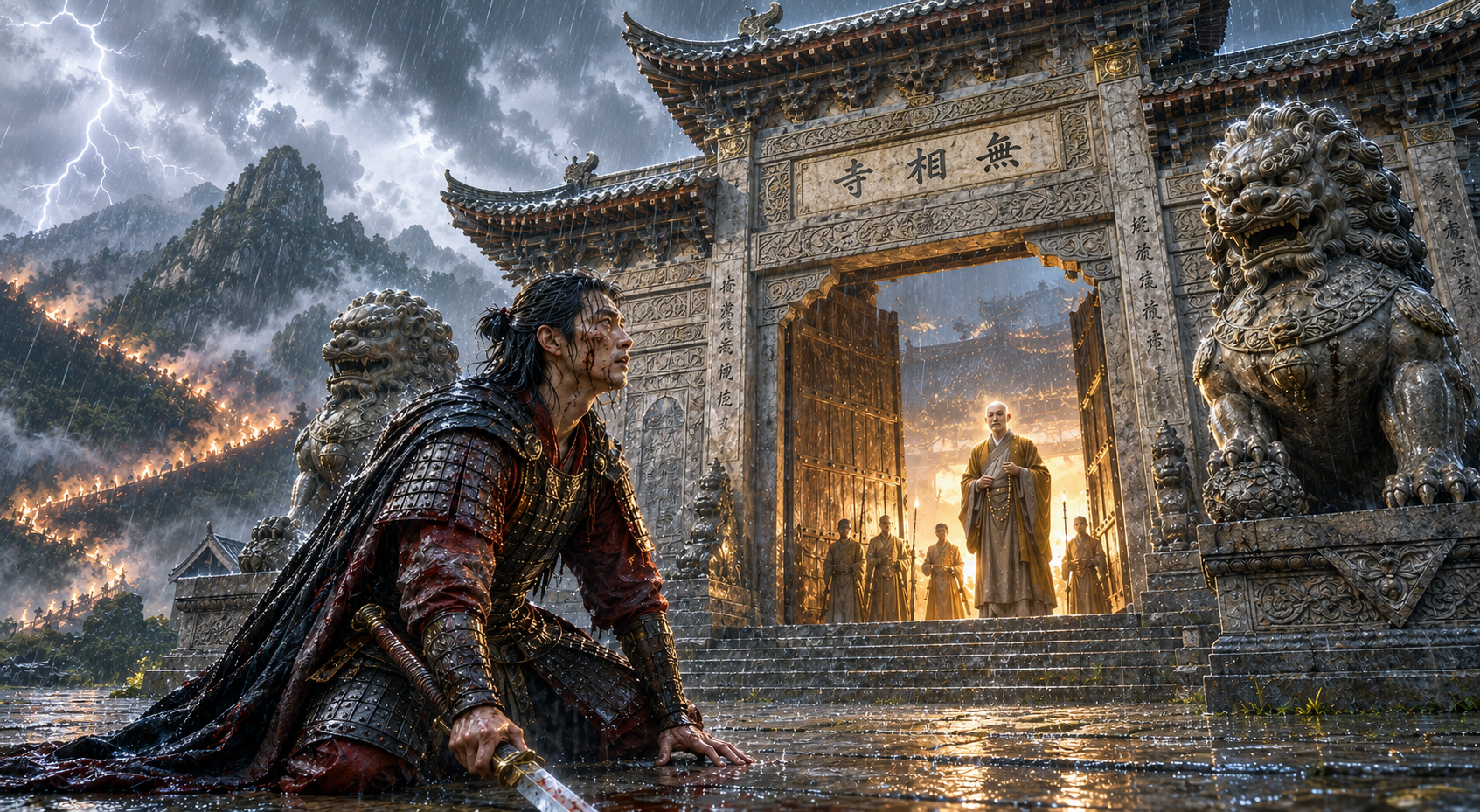
In the waning years of the Warring States, warlords stood shoulder to shoulder, and the fighting never ceased.
The people were scattered, bleached bones lay exposed in the wilds, and all under heaven had long suffered the wars.
A young lord, his army shattered, fled into an ancient temple on Mount Shaoshi.
The monks of that temple, with compassion in their hearts and valor for a blade,
held back his pursuers—and, for all the realm, held open the way to a new dynasty.
—This is a tale of eighty years ago. This is how the Shuntian Dynasty began.
Volume One — A Crushing Defeat
Prologue
In the waning years of the Warring States, the realm was riven into four and split into five.
Along the western coast lay Qin, possessed of fine harbors where merchant ships gathered thick, its profits from fish and salt unmatched in all the world. On the northern steppe rose Shuo, supreme in its iron cavalry, with bowmen numbering in the hundreds of thousands. Among the eastern ranges stood Qi, a kingdom built into the mountains, rich in ore, its crossbows the finest under heaven. In the southwestern basin sat Shu, sealed off and self-reliant, with fertile fields stretching a thousand li. And in the southern heartland were the lords of Jing, Tang, Yue and others, each holding his own ground where the rivers crossed.
Yet beyond these lords of the open stage, there lurked in the shadows of the warring age a force more hidden and more terrible still—the Blood God Sect. This heretical order, worshippers of the "Blood Demon," cultivated their evil arts through human sacrifice, taking slaughter for practice and fresh blood for power. They belonged to no single state, yet covertly infiltrated the courts and armies of all, manipulating men's hearts and swaying the tides of war with their arts of blood-malice.
And in the south there was a young lord struggling to survive in the cracks between them all—Li Chongyan.
He was but twenty-eight, yet already a valiant general whose name shook the realm. His father, Li Zhao, had once been a renowned general of Tang, but slander brought him low, and he moved his household to the southern frontier to set up on his own, ennobled as Earl Shun. After Li Zhao's death, Li Chongyan inherited the title, found his footing in a world of chaos, and held a single city with several thousand troops—not strong, perhaps, but famed for skill in battle.
Eighty years before the first year of Hongwu—when there was as yet no "Hongwu" era name, and the realm reckoned the years each by its own lord's count—Li Chongyan led eight thousand picked troops east, meaning to take the strategic town of Jiangling and seize control of the south's network of land and water. But an ally turned his blade on him, his plans were leaked, and the enemy closed in from every side.
He broke free under the escort of his guards, bearing three sword wounds; of thirty riders, only seven remained.
Behind him, pursuers blanketed the hills and fields—three thousand crack soldiers led by Cao Meng, the great general of Jing. But within Cao Meng's host lurked a deadlier menace still: three elites of the Blood God Sect's Assassination Hall, ordered to hide among the troops and seize, at the first opening, Li Chongyan's life and his life-blood—for the Blood God Sect had long coveted this young general's "heaven-doom" destiny. Their aim was not merely to kill him, but to refine his very soul through the art of blood sacrifice.
Chapter One — Flight in the Rain
The autumn rain fell like a cataract, and a vast grey pall lay over heaven and earth.
Li Chongyan lay slumped over his horse's back, rainwater mixed with blood seeping through the seams of his armor and dripping along the horse's belly onto the muddy mountain road. His left shoulder had taken a blade; the flesh was peeled back, and white bone showed faintly through. His right side had been run through by a spear—it had missed the organs, yet every breath felt like fire.
"My lord! Mount Shaoshi is just ahead!" His deputy, Zhao Hu, reined in and looked back, his face full of alarm. "The pursuers are less than ten li behind us!"
Li Chongyan forced his head up; the rain blurred his vision. Dimly, he saw ahead a towering peak rising into the clouds, its slopes wreathed in mist, the eaves of halls and pavilions just visible halfway up.
Mount Shaoshi stood in the Song range of the south, its main summit, Lotus Peak, piercing straight into the clouds. The terrain was steep and the forests dense; it was the highest peak for a hundred li around. And the Wuxiang Temple upon its slope was a famed ancient monastery of the south—three hundred years before, the eminent monk Bodhidharma had crossed from the western land of Tianzhu and come east, faced the wall for nine years atop this mountain, and there awakened to the singular method of "governing the martial through Chan," founding this temple. All its martial arts took Chan as their root and the martial as their use, holding that "to cultivate Chan is to cultivate the martial, and to perfect one's skill is itself spiritual practice"—Chan and the martial, neither to be neglected. More important still, the Brahma-sound mantras of Wuxiang Temple—suppressing evil with the power of the Eight Mantras—were among the few forces in the world able to stand against the blood-malice of the Blood God Sect.
"Wuxiang Temple is up on the mountain," Li Chongyan murmured.
"My lord!" cried another guard, Chen Bao, anxiously. "Wuxiang Temple is a pure ground of the Buddhist faith. If we bring weapons and soldiers up there, I fear—"
"Fear what?" Li Chongyan coughed and spat a mouthful of bloody foam. "Fear they'll hand us over? Or fear they'll watch us die and do nothing?"
He straightened up; gravely wounded as he was, his back stayed straight as a spear.
"In all I do, I, Li Chongyan, have always kept a clear conscience. Master Daoyan, abbot of Wuxiang Temple, has long been called a 'Sage Monk.' I do not believe he would watch a man die and refuse to help."
"But my lord—"
"There is no 'but.'" Li Chongyan jerked the reins. "Up the mountain!"
The seven riders wheeled and galloped toward Mount Shaoshi.
Not far behind, dust rose along the mountain road—the torches of the Jing army flickering in the rain, like ghost-fires come to claim their lives. And among those torches, three dark-crimson figures could dimly be seen; wherever they passed, the very rain seemed to take on a faint sheen of blood.
Chapter Two — Knocking at the Mountain Gate
Wuxiang Temple rose tier upon tier along the mountainside. The mountain gate stood halfway up Mount Shaoshi: a stone archway five zhang tall loomed there, and the stone lions flanking it stood over three zhang high, baring a savage aspect under the lashing rain, as if to warn all who came—this is no place of the common world.
Above the lintel was an empty rectangular recess—a space reserved for an imperially bestowed plaque yet to come.
Li Chongyan reined in before the mountain gate, dismounted, and staggered, nearly falling.
Zhao Hu hurried to steady him. "My lord!"
"It's nothing." Li Chongyan pushed his hand away and climbed the hundred stone steps one at a time. With every step the wounds tore a little further, and the rain-washed blood left a faint red trail down the stairs.
At last he came before the great wooden doors.
The bronze rings upon them were mottled with rust, yet carried the weight of long-endured years. Li Chongyan reached out, grasped a ring, and knocked three times.
"Who knocks?" came a steady voice from within.
"Earl Shun, Li Chongyan." His voice was not loud, yet every word was clear. "A defeated general, seeking an audience with the abbot."
Silence.
After a long while, the wooden door creaked open a crack. A middle-aged guest-receiving monk poked his head out and looked the blood-soaked young lord up and down.
"Please wait a moment, General. This humble monk will announce you."
The door closed again.
Li Chongyan stood in the rain, unmoving.
Behind him, his guards watched anxiously as the torches below drew ever nearer. Zhao Hu said in a low voice, "My lord, the pursuers have reached the foot of the mountain..."
Li Chongyan said nothing; he only stood quietly, the rain running down his cheeks, so that none could tell rain from sweat.
Chapter Three — The Abbot's Choice
Within the abbot's meditation chamber, Master Daoyan sat in meditation.
An oil lamp glowed dim as a bean, lighting his lean face. His brows were snow-white, drooping to the corners of his eyes, yet his gaze was deep as an ancient well, as though it could see through every illusion of the world. Sandalwood incense curled through the room; on the wall hung a painting of Patriarch Bodhidharma facing the wall, beside it the words "To cultivate Chan is to cultivate the martial; to perfect one's skill is itself spiritual practice"—the temple's ancestral precept of three hundred years: Chan and the martial, neither to be neglected.
"Abbot, thousands of soldiers have come to the foot of the mountain and surrounded the whole of Mount Shaoshi!" The guest-monk's voice trembled. "They have come for that General Li! They say it is the army of Jing—the great general Cao Meng, pursuing General Li on the king's order!"
Daoyan opened his eyes. "Where is General Li now?"
"Still waiting in the rain. He is wounded, and has lost much blood..."
Daoyan was silent a moment, then rose slowly. "Open the gate. Invite him in."
"Abbot!" the guest-monk cried in alarm. "Jing is powerful; if we shelter him, their army will surely storm the mountain! The foundation Wuxiang Temple has held for centuries—"
"The gate of the Buddha stands open; it turns away no one who comes." Daoyan's tone was calm, yet beyond dispute. "Besides, a man who in utter desperation neither abandons his subordinates nor loses his composure has something rare in him. Go and invite him in."
"But—"
"Xingkong," Daoyan called.
Outside the chamber, a young warrior-monk answered and entered. He was about twenty, lean and powerfully built, his eyes like lightning—the finest disciple of this generation in the Hall of Arhats. He had entered the temple as a child, first studying the scriptures, then the martial arts; he had already passed the trials of the Wooden-Men Lane's three gauntlets—Threshold, Subduing, and Sweeping—and was now attempting the Seizing gauntlet. In the Arhat Demon-Subduing Staff, none of his peers could match him.
"This disciple is here."
"Take a few men and go out to the mountain gate to receive General Li. He is wounded—he likely cannot walk."
"Yes!"
At last the mountain gate opened.
The moment Li Chongyan stepped through, he was soaked to the bone, his face pale as paper. His armor was covered in cracks; the wound on his left shoulder had already clotted into a black scab, and the armor over his right ribs had been pierced through, so the rain fell straight onto the wound.
Daoyan himself stood waiting on the steps before the Mahavira Hall. The Mahavira Hall was grand and imposing, its eaves sweeping upward, the golden body of Shakyamuni enshrined within, the arhat statues to either side solemn and grave. Seeing Li Chongyan enter, Daoyan pressed his palms together in greeting.
"General Li, please."
Li Chongyan cupped his hands, the rainwater dripping from his armor onto the ground. "A defeated general dares not trouble the abbot to receive him in person."
Daoyan smiled faintly. "A general who keeps his composure even in defeat—it is no waste for this old monk to welcome him. Please, come with me."
That night, Li Chongyan was settled in a secluded side room. Xingkong tended his wounds himself—cleansing, stitching, applying medicine—his technique practiced, clearly not for the first time.
"You know medicine as well, Master?" Li Chongyan asked, enduring the pain.
Xingkong did not look up. "Wounds taken on the battlefield are no different from blade-wounds of the martial world. The warrior-monks of Wuxiang Temple go down the mountain every year to practice medicine and treat the common folk."
"And you... do not fear bringing trouble on yourselves?"
Xingkong glanced up at him, his gaze calm. "To save a single life is worth more than raising a seven-storied pagoda. This is the duty of the Buddhist order. What is there to fear?"
Li Chongyan was silent a while, then suddenly laughed. "Well said—'the duty of the Buddhist order.' This kindness of today, should the chance ever come, Li Chongyan will repay a hundredfold."
Xingkong did not answer; he only finished binding the last wound in silence, then rose and left.
And outside Wuxiang Temple, the tents of the Jing army had already ringed the foot of the mountain. In the deepest part of that camp, three dark-crimson tents gave off a faint, intermittent reek of blood; the grass and trees around them had withered and died, as if some unseen force had drained the life from them.
Volume Two — Turmoil at the Temple Gate
Chapter Four — A Dilemma
At dawn the next day, the temple's senior monks gathered in the abbot's chamber.
The Head Seat, Master Mingjue, wore a grave expression. He was past fifty, burly and powerfully built, with a resolute face—the strictest keeper of the precepts in the temple, and held in the highest regard among the monks.
"Abbot, that General Cao at the foot of the mountain has sent a letter. He gives us three days to hand over Li Chongyan, or he will storm the mountain on the charge of 'harboring an enemy general.'"
"How many men does Jing have?" asked the Prior, Huicheng.
"Three thousand at least. And more troops are said to be on the way."
"Three thousand..." Huicheng drew a sharp breath. "All of Wuxiang Temple numbers little more than two hundred souls, and fewer than a hundred warrior-monks fit to fight. How are we to withstand them?"
"And so we should hand over Li Chongyan," Huicheng said heavily. "To place the whole monastery under the blade for the sake of an outsider is not worth it."
"The Prior is mistaken." Mingjue's voice was cold. "General Li came to our temple gravely wounded. To hand him over would be no different from killing him with our own hands. A monk holds compassion in his heart—how can he watch a man die and not save him?"
"Brother Head Seat, this is recklessness! The lives of hundreds in this monastery—how can you set them in peril for the sake of one man?"
"This is the duty of the Buddhist order. The gate of the Buddha stands open and turns away no one who comes. If we abandon a man out of fear of the powerful, how do we differ from those worldly weathervanes who bend whichever way the wind blows?"
They argued long, and reached no conclusion.
"There is one more thing," the Prior Huicheng said suddenly, lowering his voice, his face graver still. "Yesterday, while the guest-monk was patrolling outside the mountain gate, he caught a reek of blood. In the woods at the foot of the mountain he found several corpses—as though some evil art had drained them of their life-blood, their whole bodies withered dry as kindling. They wore the uniforms of the Jing army, but the killing wounds... were not made by blade or sword."
Daoyan's gaze sank slightly.
"The Blood God Sect." He uttered the three words slowly; though his voice was soft, it changed the color of every monk's face in the room.
"Abbot, do you mean... there are Blood God Sect men among the Jing army?" Mingjue's brow knotted tight.
"It is only a surmise." Daoyan rose and walked to the window, gazing at the unbroken line of tents below, his eyes settling on the three dark-crimson tents in the deepest part of the camp—last night he had not been certain, but now he could feel that faint, intermittent aura of blood-malice, which, even across several li of mountain road, still chilled the heart.
"The Blood God Sect has always excelled at lurking and infiltration; they covertly manipulate the powers of every state, achieving their ends through the art of blood sacrifice. If they have set their eyes on General Li, then this is no longer so simple a matter as a war between two states."
"Abbot, all the more reason we should not wade into these muddy waters!" Huicheng said anxiously.
Daoyan turned, his gaze calm as still water. "On the contrary. The Blood God Sect cultivates its evil arts through human sacrifice, and sees life itself as a resource. Should General Li fall into their hands, his end would be a hundred times more wretched than death on the battlefield—his life-blood and his soul would be refined down into fodder for the Blood Demon."
He paused, his tone firm. "The Brahma-sound mantras of Wuxiang Temple are among the few forces in the world that can suppress the aura of blood-malice. If we yield today, tomorrow the Blood God Sect will only push further. This is not merely saving one man—this is a stand of the Buddhist order against the heretical path."
In the end every gaze fell upon Daoyan, and no one objected any longer.
"This old monk will go down the mountain himself, and have a word with that General Cao."
Chapter Five — A War of Words
That afternoon, Daoyan went down the mountain alone.
When Li Chongyan heard of it, he forced his wounded body to the mountain gate. "Master! This matter began with me; by rights I should be the one to face them!"
Daoyan shook his head. "Your wounds have not healed, General, and it is your head that General Cao wants—if you go, you play right into his hands. This old monk is a man of the cloth; however brutish he may be, he will not dare openly mistreat a monk. Please, rest at ease in the temple and recover."
With that, he pressed his palms together in farewell, turned, and departed.
At the foot of the mountain, the Jing tents stretched for several li. In the central command tent, Cao Meng sat high in the seat of honor, a dozen armored guards standing to either side, blades and spears bristling, the air thick with killing intent.
Daoyan stepped into the tent, his manner composed, and pressed his palms together. "This humble monk, Daoyan, greets General Cao."
Cao Meng was a renowned fierce general of Jing, built like a tiger and a bear, his face full of brutish flesh. He looked the old monk up and down and sneered. "You've got nerve, Master. You harbor an enemy general, and then deliver yourself to my door?"
Daoyan smiled faintly. "This humble monk would ask the General—what crime has General Li committed?"
Cao Meng was taken aback.
"When two armies clash, victory and defeat are the common lot of soldiers," Daoyan went on. "General Li fought your state each serving his own lord—where is the 'crime' in that? Moreover, has the King of Jing issued any warrant for General Li? Has he sent word to the states proclaiming his guilt?"
Cao Meng's expression shifted.
Daoyan continued. "When General Li came to our temple, he was gravely wounded, all but senseless. Had this humble monk turned him away at the gate and left him to live or die on his own, how would that differ from killing him by my own hand? A monk holds compassion in his heart—to see the wounded and not save them, is that the way of a disciple of the Buddha?"
"You—" Cao Meng was choked into silence.
Daoyan's tone shifted, and his gaze turned suddenly sharp. "And another thing—the General seems to have some rather unusual 'guests' among his ranks. On my way down the mountain today, I saw in the woods at the foot several corpses drained of their life-blood—corpses wearing the uniforms of the Jing army. Does the General know what manner of thing has slipped in among his troops?"
Cao Meng's face changed utterly.
Of course he knew. Those three Blood God Sect masters had been "arranged" into his army by the King of Jing himself, supposedly to "assist" him in completing his task. He had not dared refuse, yet he had never truly trusted them. The cruelty of their methods when they killed chilled even him, a veteran of many campaigns.
Daoyan took in every shift of his expression and pressed his palms together. "If the General will grant this humble monk three days, then in three days—whether General Li stays or goes—this monk will give the General his answer. After that, to attack or to besiege shall be entirely as the General wishes. But if the General insists on storming the mountain—"
He paused, his tone mild yet carrying a force not to be slighted. "Wuxiang Temple does not meddle in war, but neither is it a place to be trampled at will. Hundreds of warrior-monks, five hundred stone statues in the Hall of Arhats, an ancient monastery of a thousand years—should the General destroy them, how will the realm regard the King of Jing? And what is more—those few 'guests' in the General's army—what they want is surely more than just General Li's head, is it not?"
Cao Meng ground his teeth and was silent a long while.
At last he slammed the table. "Fine! It shall be as the Master says—three days! In three days, if Li Chongyan is not handed over, do not blame my blade for showing no mercy!"
Daoyan pressed his palms together. "Amitābha. My thanks to the General."
As he turned to leave, his gaze passed, as if by chance, over the shadows in the corner of the tent. There stood a figure draped in a dark-crimson cloak, its face indistinct; one could only faintly sense a nauseating reek of blood about it.
That figure, it seemed, was watching him too.
Chapter Six — The Stratagem
At dusk, Daoyan returned to the temple.
Li Chongyan had long been waiting outside the chamber. Seeing Daoyan return, he hurried to cup his hands. "Master, what did the enemy general say?"
"He has given us three days." Daoyan pushed open the chamber door. "Please come in, General."
The two sat facing each other. Daoyan poured the tea himself.
"What does the General think we should do, three days from now?"
Li Chongyan was silent a moment, then said gravely, "In three days, with no reinforcements, I am certain to die. So I must leave within those three days."
"And how will you leave?"
"Break through the encirclement." Li Chongyan looked at Daoyan. "I need the Master's help."
Daoyan said neither yes nor no; he only watched him quietly.
"Does the General know that there are Blood God Sect men among the pursuers?"
Li Chongyan's hand trembled slightly, and a few drops of tea splashed out.
"The Blood God Sect?" His voice sank. "Why would they be here?"
"This old monk does not know the details either. But the Blood God Sect has always cultivated its evil arts through human sacrifice; that they have fixed on the General is, I fear, about more than mere military merit." Daoyan's tone was calm. "The General's destiny is singular—to them, you are a superb sacrifice."
Li Chongyan was silent a moment, then gave a cold laugh. "So my enemies now include yet another cult of evil."
Daoyan did not reply; he only watched him quietly.
Li Chongyan drew a deep breath and composed himself again. "Whatever the case, I must leave. Does the Master have a plan?"
Daoyan nodded slightly. "Well said, General. Cao Meng has valor to spare but little cunning, and he is greedy for glory. If we can find a way to make him divide his forces, or to sow confusion, you can seize the moment and slip away by the rear of the mountain. But the Blood God Sect men are another matter—they are not bound by military orders, nor do they care what Cao Meng thinks. To deceive them is harder than deceiving Cao Meng."
"Then what is to be done?"
Daoyan was silent a while, then said slowly, "This old monk has a plan, but it will need the General's cooperation."
"Please speak, Master."
"The blood-malice of the Blood God Sect has a natural dread of the Buddhist Brahma-sound mantras. When the General departs, this old monk can give cover with the mantras, suppressing their blood-malice senses for a time. But this can buy only a brief moment—within that moment, the General must break out of the encirclement."
Li Chongyan nodded gravely. "I understand."
The two deliberated a while longer, and at last settled on the complete plan—
First: the strategist skilled in painting would forge a Jing royal banner and document, the message reading, "The western frontier is in peril; the Qin navy stirs; return at once to its defense."
Second: Zhao Hu would slip into the Jing camp by night and place the false document in Cao Meng's tent.
Third: Daoyan, in his capacity as abbot, would go down the mountain once more to persuade Cao Meng to withdraw to his face.
Fourth: once Cao Meng's main force had pulled back, a small garrison would surely remain on the mountain. Then the warrior-monks would escort Li Chongyan out through the secret rear-mountain passage, clearing the way with the Arhat Demon-Subduing Staff Formation—while Daoyan, in the Mahavira Hall, would chant the Brahma-sound mantras, using the power of the Dharma to suppress the Blood God Sect's blood-malice senses.
When Li Chongyan had heard it all, he marveled, "The Master's foresight and depth of planning—Chongyan is in awe!"
Daoyan said mildly, "What the General does not know is this: though Wuxiang Temple stays apart from worldly affairs, it studies the arts of war, trains in the martial, and cultivates the Brahma-sound—solely to guard a corner of peace in a world of chaos. Over the years, the monks of this temple have traveled north and south. What kind of man have we not seen? What kind of matter have we not lived through?"
He paused and looked at Li Chongyan. "This old monk is not helping the General. This old monk is helping the people of the realm. If the General can quell the chaos and restore peace to the common folk, then what Wuxiang Temple gives today will not have been given in vain. And what is more—to stand against the Blood God Sect is, from the first, the duty of the Buddhist order."
Li Chongyan rose and bowed solemnly. "The Master's life-saving grace—Li Chongyan will not forget it as long as he lives."
Chapter Seven — The Eighteen Arhats and the Brahma-Sound
Two days later, the plan was carried out smoothly.
The forged order of transfer was "accidentally found" by a Jing scout and delivered to Cao Meng's desk. Cao Meng, half-believing, sent men back to the capital to learn the truth. And just then, Daoyan came down the mountain again to persuade Cao Meng to withdraw to his face.
"General, since the King of Jing has issued an order, to disobey it is to defy the king. Better to pull back to its defense first; once the western frontier is secured, there will be time enough to deal with General Li."
Cao Meng wavered, undecided.
Daoyan continued, "Besides, Li Chongyan is gravely wounded and cannot flee far in a short time. Seal the key passes around Mount Shaoshi, and he cannot sprout wings to escape. Once the General has finished his military business and returns to take him—would that not be the best of both?"
In the end, Cao Meng was persuaded.
At dawn the next day, the Jing army struck camp; the main force departed in haste, leaving only three hundred men to guard the foot of the mountain.
Yet the three dark-crimson tents did not move.
The three masters of the Blood God Sect had stayed behind.
A heaven-sent chance—yet one with hidden killing intent: three hundred Jing soldiers plus three Blood God Sect elites were still a force not to be underestimated.
Daoyan led Li Chongyan to the Hall of Arhats.
The Hall of Arhats was a vast, circular training ground, ringed by five hundred stone arhat statues, each in a different posture—the might of the Dragon-Subduing Arhat, the ferocity of the Tiger-Taming Arhat, the steadiness of the Long-Browed Arhat—each the opening form of a set of Arhat Fist. These statues were said to have been carved by warrior-monks of past generations after the forms of living men; they were at once the temple's guardians and its instructors in the martial arts.
Eighteen warrior-monks stood ranged on either side, brow-height staves in hand, their presence commanding. At their head was Xingkong; the seventeen monks behind him had all passed the trials of at least three gauntlets of the Wooden-Men Lane—the temple's elite.
Daoyan said, "General Li, these eighteen warrior-monks are masters of the Arhat Demon-Subduing Staff, the strongest guardian elite our temple has had in decades. This old monk has entrusted them to Xingkong; tonight, at the hour of zi, they will escort the General out through the secret rear-mountain passage."
He turned to Xingkong and drew from his sleeve a string of ancient prayer beads, dark crimson in body, with a faint golden light coursing through them.
"Xingkong, these beads hold the Brahma-sound blessing of the patriarchs of every generation. Should you meet the Blood God Sect on the way, drive the beads with the mantra and you can suppress the blood-malice for a time. Remember—of the Eight Mantras of the Brahma-sound, the 'Great Brightness Mantra' and the 'Vajra Mantra' are the most effective against blood-malice. When you chant, the heart must be settled and the breath steady; there must not be the slightest wavering."
Xingkong received the beads in both hands, his expression solemn. "This disciple will remember."
Li Chongyan was aghast. "Master, if the Blood God Sect learns of this, great calamity will fall upon Wuxiang Temple!"
Daoyan smiled faintly. "The General need not worry. This old monk has arranged everything—after you leave tonight, the temple will set fire to a few side halls and announce to the world that there was a blaze. Xingkong and the others were already due to go down the mountain to 'beg alms'; no one will suspect a connection to the General. As for the Blood God Sect..."
He paused, his tone calm yet carrying a force beyond dispute. "This old monk will sit in the Mahavira Hall and chant the Brahma-sound mantras through the night. Where the Brahma-sound reaches, blood-malice retreats. They will not be able to sense your presence, and so will have no way to track you."
"But—"
"General," Daoyan cut him off, his gaze deep as the sea, "these old eyes have seen far too much slaughter of living souls. A hundred years of warring states, and the people suffer beyond telling. If the General can pacify the realm and restore an age of peace to the common folk, then what Wuxiang Temple gives today will not have been given in vain. And what is more—"
He gazed into the distance, his voice dropping low. "The Blood God Sect has plagued the realm too long; between the Buddhist order and the heretical path, a reckoning must come at last. If we do not retreat today, we will have to retreat tomorrow; if we do not fight today, tomorrow we will have no strength left to fight."
Li Chongyan was silent a long while, then suddenly bowed deeply.
Volume Three — Flight by Night
Chapter Eight — Discourse in the Wuxiang Pavilion
That night, a bright moon hung high, flooding the temple courtyard with light.
Unable to sleep, Li Chongyan wandered out of his room. The cold, clear moonlight fell on the flagstone path, wrapping the whole monastery in a silvery glow. From afar came the sound of chanting, low and far-off, as though it drifted in from another world.
As he walked, he came before the Sutra Library.
Wuxiang Temple's Sutra Library was called the "Wuxiang Pavilion," after the line from the Diamond Sutra, "All things with form are illusory." This seven-storied book-tower stood under the moonlight like a pagoda, the wind-chimes at its eaves ringing clear in the night breeze. Within were stored ten thousand scrolls of scripture, and the martial treatises annotated by the patriarchs of each generation—the very foundation of Wuxiang Temple.
He was about to turn away when he heard, from inside, the sound of pages turning—soft, as if someone were turning the leaves of a sutra with the greatest care.
Peering through the gap in the door, he saw a small, frail old monk bent over a desk, copying out scripture. He wore a grey monastic robe, his face plain and unadorned, his fingers bent and deformed from years of holding the brush, the nails yellowed—yet still he wrote, stroke by stroke, so absorbed he seemed to have forgotten the whole world.
This old monk had no dharma name; everyone in the temple simply called him the "Sweeping Monk." He had swept the Wuxiang Pavilion for decades, quiet by nature, never quarreling with anyone; no one knew how old he was, or where he had come from.
Li Chongyan knocked softly. The old monk raised his head, and a glint crossed his clouded eyes.
"The General does not sleep so late at night?"
"Nor does the Master."
The Sweeping Monk smiled faintly. "This old monk copies scripture day and night; I am long used to it. If the General does not mind, will you come in and sit?"
Li Chongyan pushed open the door and entered.
The Sweeping Monk poured a bowl of plain tea and said mildly, "The General's journey here is hardly so simple a thing as taking refuge, I think?"
Li Chongyan took a sip of tea; it was bitter beyond measure, yet left a lingering sweetness.
"The Master's eyes are keen indeed." He set down the bowl, his gaze earnest. "My coming here—is in truth to seek counsel on the great currents of the realm."
The Sweeping Monk did not answer at once, but asked in return, "Who, does the General think, can unite the realm as it stands today?"
Li Chongyan was silent a moment, then set out his own thoughts: Qin in the west had the profits of sea trade, but its nobles were extravagant and its armaments slack; Shuo's iron cavalry in the north was strong, but it lacked provisions and could not sustain a long war; Qi in the east was built into the mountains, its crossbows excellent, but it kept to its own corner with no will to advance; the southern states each went their own way and could not join their strength. His own power, though small, held the southern heartland, with land and water both within reach; if he could unite the strength of the south and then ally with the western sea-merchants' wealth, the chance was not beyond him. And yet—
"There is one more hidden peril," Li Chongyan said with a frown. "The Blood God Sect. They secretly infiltrate every state, manipulating men's hearts with their evil arts. If this scourge is not rooted out, then even should I win the realm, it will be hard to hold it in lasting peace."
The Sweeping Monk listened quietly, then nodded slowly. "That the General can see this far shows no common vision. The Blood God Sect is indeed a great scourge upon the realm; they worship the Blood Demon and take slaughter for their practice. But does the General know what the Blood God Sect fears most?"
Li Chongyan shook his head.
The Sweeping Monk drew from beneath the desk a yellowed scroll of scripture, its cover inscribed in plain, antique strokes: "The Sinew-Transforming, Marrow-Cleansing Classic."
"Patriarch Bodhidharma faced the wall for nine years and awakened to the method of 'governing the martial through Chan.' This Sinew-Transforming, Marrow-Cleansing Classic seems a manual of martial arts, but is in truth a method for cultivating the heart—to break the attachment to self, to dispel wrath, to still the mind. When the mind is settled the qi is upright; when the qi is upright, evil cannot invade. What the blood-malice of the Blood God Sect fears most is precisely the great righteous spirit and the true mantras of the Dharma."
He opened the scroll and pointed to a passage. "This speaks of 'breaking the attachment to self'—let go of obsession, and only then can you see the truth clearly. In contending for the realm, if the General is not fixed upon his own gain and loss but sets his eyes on all the living, then he may go far and steadily. And if, in days to come, he can press down evil with righteousness and quell blood-malice with the Dharma, only then will the realm find true peace."
Li Chongyan understood in a flash.
At the last, the Sweeping Monk said, "If the General can hold fast, on his way, to what he has grasped tonight, then the pacifying of the realm may be looked for. And the dynasty to come—if it takes the people as its root and presses down evil with righteousness, that is the plan that endures."
Li Chongyan rose and bowed deeply. "The Master's words today—Chongyan will not forget them as long as he lives."
Chapter Nine — Breaking Through
The hour of zi, the rear of Wuxiang Temple.
The moon was dark and the wind high as the eighteen warrior-monks, brow-height staves in hand, escorted Li Chongyan and his party down the mountain by the secret passage.
The passage was narrow and damp, wide enough for only one at a time. It was said to have been dug when Wuxiang Temple was first built, to protect the scriptures and statues in times of war. For centuries it had never been opened to outsiders.
Meanwhile, within the Mahavira Hall, Master Daoyan sat cross-legged before the Buddha's image, prayer beads in hand, his eyes half-closed. He drew a deep breath and slowly began—the first note of the Brahma-sound issued from his mouth, low and far-reaching, like an echo welling up from the depths of the earth.
"Om—"
The sound pierced through the halls, passed over the walls, and spread out across the whole of Mount Shaoshi. It was as though some unseen force in the air had been awakened; a golden Buddha-light flickered faint in the night, wrapping the entire monastery within it.
Below the mountain, within the three dark-crimson tents, three figures opened their eyes at once.
"The Brahma-sound..." one of them murmured, his voice hoarse as sandpaper scraping. "So the old bald donkey of Wuxiang Temple really is shielding that boy."
"Shall we move?" another asked.
The leading Blood God Sect master was silent a moment, then slowly shook his head. "The Brahma-sound is at its height; to climb the mountain now would see our blood-malice suppressed. Wait—wait for them to come out on their own."
He looked toward the rear of the mountain, a savage smile curling at his lips. "There is only one secret passage. They will have to come out sooner or later."
Meanwhile, Li Chongyan and his party emerged from a hidden cave-mouth on the mountainside, and before them lay a dense bamboo grove.
Moonlight spilled down through the gaps in the bamboo leaves, casting dappled shadows on the ground. The night wind passed through, and the leaves rustled, as though someone were whispering.
Xingkong said in a low voice, "General, the rendezvous we arranged is three li ahead. General Zhao Hu is already waiting there with his men. Once we reach it, the Jing army will not be able to follow."
Li Chongyan nodded and was about to step forward—
"Whoosh—!"
An arrow shot out from deep within the bamboo, grazing past Li Chongyan's ear and lodging in the bamboo behind him, its tail quivering without cease.
"An ambush!"
Xingkong gave a great shout, and in an instant the eighteen monks formed up, shielding Li Chongyan in their midst. The Arhat Demon-Subduing Staff Formation—built upon the three stances of "Dragon-Subduing," "Tiger-Taming," and "Long-Browed," its hundred and eight staff-forms interlocking layer upon layer, airtight and impenetrable.
Deep in the bamboo, torches flared, and hundreds of Jing soldiers surged out of the dark to surround them on every side.
Cao Meng rode out from the firelight, sneering as he looked them over. "The Master foretold it like a god, knowing General Li would break out this way! A pity—I, Cao Meng, am no fool either. I guessed long ago you would take the rear of the mountain!"
Yet what truly made Xingkong's heart sink was not Cao Meng, but the three dark-crimson figures behind him.
They stood silently in the shadows, neither speaking nor moving. But a nauseating reek of blood pervaded the air, and the bamboo leaves around them swiftly withered and curled as they drew near, as if some unseen force were draining the life from them.
Xingkong gripped the prayer beads in his hand and said in a low voice to Li Chongyan, "General, those three are the Blood God Sect. Whatever happens in a moment, just run for the rendezvous and do not look back."
Li Chongyan drew the sword at his waist. "And you?"
"This humble monk will hold them back." Xingkong's voice was calm, yet carried an unshakable resolve.
"Kill—!"
The melee erupted!
Xingkong led the eighteen monks, meeting the hundreds of Jing soldiers with the Arhat Demon-Subduing Staff Formation. Staff-shadows whirled like a gale sweeping fallen leaves, and several of the enemy dropped at once. But the enemy was many, surging up wave on wave to surround them.
Cao Meng took the field himself, blade in hand, its edge bright as snow, and crossed weapons with Xingkong.
And at that moment, the three dark-crimson figures moved.
The leading Blood God Sect master's form flickered, and he was suddenly before Li Chongyan. His palm glowed with an eerie blood-light; even three feet away, Li Chongyan felt a scorching, bloody reek rush at his face—the opening form of the Blood-Malice Palm.
"Li Chongyan—your life-blood, I'll be taking it!"
His palm struck out!
Xingkong whipped around, raised the prayer beads high, and chanted the Brahma-sound mantra—
"Om mani padme hum—!"
The beads burst into a dazzling golden light, and a great righteous spirit spread outward with Xingkong at its center! The Blood God Sect master's palm-stroke faltered slightly; the blood-light, as if meeting some unseen barrier, dispersed for the most part in midair.
"Damned bald donkey!" the Blood God Sect master roared, and lunged at Xingkong instead!
Xingkong met him with his staff, unleashing the Arhat Demon-Subduing Staff with all his strength—the Dragon-Subduing stance, the Tiger-Taming stance, the Long-Browed stance, the hundred and eight forms layered tight and impenetrable. Yet the master's Blood-Malice Palm was weird and unfathomable, each strike carrying an evil force enough to drive the meridians into reverse.
At the same time, the other two Blood God Sect masters moved as well. One struck at Li Chongyan; the other circled from the flank toward the weak point of the monks' formation.
The bloody fight raged for a full watch.
The eighteen monks held back the assault of the Jing army and the Blood God Sect with the Arhat Demon-Subduing Staff Formation, but the enemy was simply too many, and the Blood God Sect's methods too uncanny; the monks grew gradually unable to hold.
Xingkong took the leading master's palm full in the chest; with a stifled grunt he staggered back several steps, blood seeping from the corner of his mouth. But the golden light of the beads in his hand did not go out, and the Brahma-sound did not cease.
"Go, General!" Xingkong cried hoarsely, his robe soaked through with blood, yet still standing unbowed as a vajra.
Li Chongyan glanced back and saw Xingkong locked with the Blood God Sect master, staff-shadow and blood-light woven together, neither gaining the upper hand.
He gritted his teeth, turned, and plunged into the night with his three remaining guards.
"After him!" The Blood God Sect master made to give chase, but Xingkong's staff barred his way.
"Your opponent—is me!"
Xingkong chanted the Brahma-sound mantra once more, and the golden light of the beads suddenly surged, forcing the Blood God Sect master back several steps.
Li Chongyan looked back no more and ran on toward the appointed place. Dimly, the sound of Xingkong's chanting reached his ears, piercing the bamboo grove and the night, like a lamp in the darkness lighting the road ahead.
That night, the eighteen arhats, with flesh-and-blood bodies, held back by main force both the pursuers and the heretical path.
At daybreak, Li Chongyan reached the rendezvous at last and joined Zhao Hu.
Word came from behind: of the eighteen warrior-monks, three had died in battle, seven were gravely wounded, eight lightly wounded—and not one had surrendered. And the three masters of the Blood God Sect, suppressed by the full force of Xingkong's Brahma-sound mantra, had not been able to cross that line by a single step.
Chapter Ten — Deliverance
Some days later, reinforcements arrived.
Li Chongyan's general Zhang Yi led three thousand crack troops from their base and, in a single stroke, crushed the remnant Jing forces at the foot of the mountain. Seeing all was lost, Cao Meng fled with his survivors back to the Jing capital. The three Blood God Sect masters, too, vanished in the chaos of battle—they never clung to a fight; once their quarry escaped, they would melt at once into the shadows to await the next chance.
Li Chongyan led his troops in person and returned to Mount Shaoshi.
The enemy had long withdrawn, leaving only ruin behind. The scorch-marks on the temple's side halls, the shocking bloodstains on the mountain road, the wounds of the monks who had taken blades for him—every one of them was there before his eyes.
Xingkong lay unconscious for three days and three nights. His left arm, struck by the Blood-Malice Palm, was charred black flesh that could heal only once the lingering blood-malice had been purified by the Dharma; his chest had been kicked, breaking two ribs. But he had lived.
When he woke, the first thing he asked was, "Is General Li safe?"
Daoyan nodded. Xingkong pressed his palms together, said "Amitābha," and fainted away again.
When Li Chongyan entered the temple, Daoyan led the monks to receive him at the mountain gate.
Li Chongyan dismounted, strode forward, and gripped Daoyan's hands tightly. "Master, Chongyan has come too late!"
Daoyan smiled faintly. "There is no need for this, General. Xingkong is out of danger, and the brothers who fell have been laid to rest. By the Buddha's mercy, they have passed on to the Pure Land."
Li Chongyan gazed at the three new graves, silent a long while, then suddenly knelt and bowed his head to the ground.
"General Li, you must not—" Daoyan hurried to raise him.
"Master," Li Chongyan lifted his head, tears in his eyes, "these three bows: the first for Master Daoyan's life-saving grace; the second for Master Xingkong's taking the blade in my stead; the third for the eighteen arhats who gave their lives to see me through. Should the day ever come when I, Li Chongyan, hold the realm, the kindness of Wuxiang Temple I will repay a hundredfold!"
Daoyan raised him to his feet. "The General speaks too gravely."
That evening, the setting sun dyed the peaks of Mount Shaoshi red.
Li Chongyan stood before the mountain gate and looked back at the ancient temple that had saved his life. The afterglow of the sun fell on the temple's golden roof, wrapping the whole monastery in a solemn, sacred light.
He looked at the blank recess above the lintel, and made a silent vow in his heart—that one day, he would inscribe four characters with his own hand to fill that emptiness.
He mounted his horse, took one last look at the ancient temple, then turned and rode down the mountain.
Behind him, Master Daoyan stood still before the mountain gate, the prayer beads in his hand glowing faint gold in the setting sun. His gaze passed over the peaks to the far distance—he knew the Blood God Sect would not let the matter rest. But at least for this moment, the Brahma-sound of the Buddhist order had warded off a catastrophe for this young lord.
And this karmic bond of goodness, eighty years on, would at last become the cornerstone of a dynasty.
Epilogue
Li Chongyan did indeed, in the end, sweep away all rivals and settle the realm.
The lords were made one, the Warring States came to an end, and the realm entered a new era. Li Chongyan ascended the throne and took the imperial title, naming his dynasty "Shuntian"—he was Taizu, the Founding Emperor of Shuntian.
On the day of his enthronement, he inscribed with his own hand the four great characters "Nation-Guarding Chan Temple," had them made into a gilded plaque, and sent men to bear it to Wuxiang Temple.
Sent with it was an imperial decree: investing Wuxiang Temple as a "State Temple," granting its abbots through the generations the right to forgo the kneeling bow before the sovereign, exempting the temple and its lands from tax and corvée for all generations, and granting it the inviolable privilege of taking in disciples of its own choosing, never to be revoked.
Furthermore, Taizu bestowed forty qing of fine farmland, and built stupas on the rear mountain of Wuxiang Temple for the three warrior-monks who had died in battle. Xingkong was ennobled as "Nation-Guarding General-Monk"; though he never returned to lay life, he enjoyed the salary and honors of a general.
As for the Blood God Sect—the very first secret edict Taizu issued after taking the throne commanded the Shushan Sect and Wuxiang Temple to join forces and root out the Blood God Sect's strongholds across the land. That edict opened with the words: "Until the heretical path is rooted out, the realm cannot know peace."
For the eighty years that followed, every emperor kept faithfully to Taizu's testament and treated Wuxiang Temple with the highest honor. The Brahma-sound mantras of Wuxiang Temple became, too, a vital force for suppressing blood-malice, named together with the Sword Immortals of the Shushan Sect as the "Twin Pillars of Buddha and Sword."
Yet the bright moon and the cries of slaughter of eighty years ago became, in the end, a few light strokes of ink in the histories. No one knows of that night's killing in the bamboo grove; no one remembers the long discourse through the night in the Wuxiang Pavilion; and fewer still know that—behind that seemingly ordinary hunt for a fugitive lord lay the earth-shaking conspiracy of the Blood God Sect to refine a sovereign-to-be through blood sacrifice.
Only the gilded "Nation-Guarding Chan Temple" plaque hung high above the mountain gate, and the three silent stupas on the rear mountain, still tell, without a sound—
that on that rainy night, a weary general once stepped into this ancient temple, his body covered in wounds;
and that this ancient temple, with its compassion and its valor, its Dharma and its mantras, kindled the spark of an age.
The Warring States ended; Shuntian arose.
A single vow of the Buddhist order bought peace for all the realm.
(The End)
Thank you for reading this far.
This site has no ads and no paywall — if what you found here meant something, ☕ buying me a coffee is the best encouragement to keep writing.