Fantasy World Short Stories
Joraku: The Moonshadow Pact
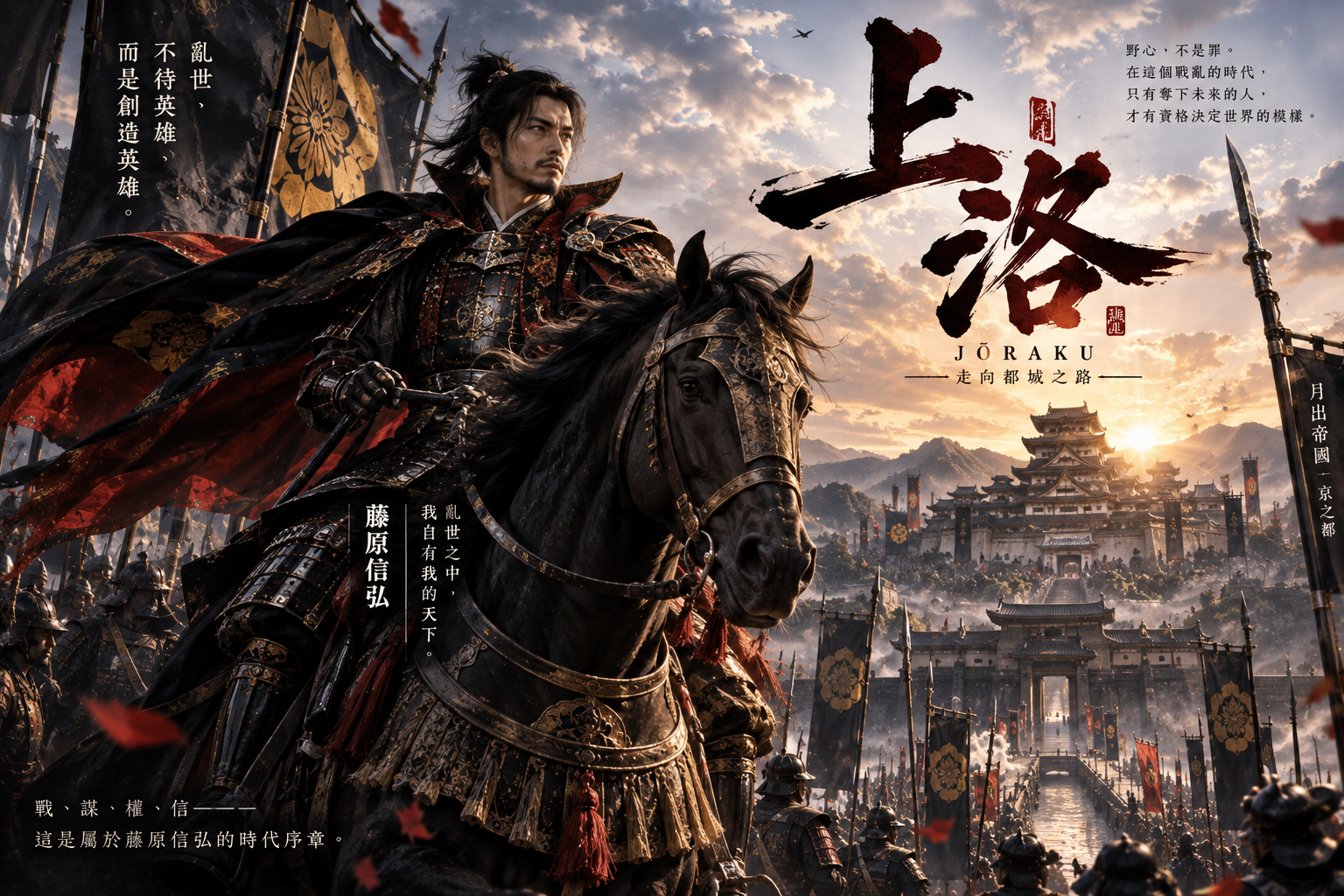
— The Joraku of Fujiwara Nobuhiro, Daimyo of Echizen —
The Moonrise Empire: a realm ruled by the descendants of the great god Tsukuyomi.
Yet for three hundred years the Emperor has reigned in name only, while all true power has rested with the Shogunate.
Within the Imperial Palace of the Moon Capital, the Son of Heaven is a living god — and a caged bird.
Within the Shogunate at Edo, the shogun holds the reins of the realm, yet lives in constant dread of being replaced.
And on the southern frontier, a young daimyo spurs his horse westward —
he means to travel a long road curved like a crescent moon,
around mountains and straits, to the thousand-year-old capital in the north.
He wants more than land. He means to change the very foundations of the nation.
Chapter One: Autumn Wind
The wind of Echizen blew in from the south, carrying the tang of salt water and the smell of withered grass. Yellowed pampas grass swayed in the setting sun like a golden sea. The distant mountains already wore their first snow, and where white met black ran the sharpest line between heaven and earth.
Echizen Province was one of the southernmost domains of the Moonrise Empire. It had none of the splendor of the north, none of the bustle of the Moon Capital — only unbroken mountain ranges and a long, long coastline. The people of Echizen lived by fishing, hunting, and farming. They were a hardy, fierce folk, and a poor one.
Fujiwara Nobuhiro sat his horse atop a seaside cliff, looking down at the churning sea below.
He was twenty-five this year, and had been head of the Fujiwara house for barely three years. Three years ago his father, Fujiwara Nobuhide, had been gravely wounded in a war with the neighboring Saeki clan and never recovered. On his deathbed he had gripped his son's hand and said only this: "Go north."
Go north. It had taken Nobuhiro three years to truly understand what those words meant. Echizen lay at the southern tip of the Moonrise Empire. Farther south there was only the boundless sea, and to the east, endless ocean as well — the whole southern peninsula was bounded by water on three sides, with a single narrow passage leading north by land. The empire's centers of power all lay in the north — the Moon Capital, Osaka, Edo. But no straight road ran north. To reach the Moon Capital from Echizen, one first had to sail west along the coast, round the great strait, then turn inland and follow the Southern Tsukitsu Road all the way north. The whole route curved like a new moon — first west, then north, winding and roundabout — and took a full two months to travel.
His father had told him to go north not to send him to his death, but so that he would make the joraku — the march on the capital.
"My lord." A voice came from behind him.
Nobuhiro did not turn around. He knew it was his chief retainer, Sasaki Sadayoshi — a forty-year-old warrior with three sword scars on his face, each one the proof of a fight to the death.
"Sasaki, tell me — what is the Moon Capital like these days?"
Sasaki Sadayoshi urged his horse forward and stopped beside Nobuhiro. He was silent for a while before he spoke. "I went there once, ten years ago. The shogun then was still Takahashi Yoshiteru, and the Emperor was Emperor Eiko. The Moon Capital was lively, but also… chaotic."
"Chaotic?"
"The streets were packed with envoys from the Shogunate and from the daimyo of every province, and everywhere there was spying and plotting." Sasaki's tone was flat. "I stayed in the Moon Capital less than a month, and in that time I ran into three assassination attempts."
Nobuhiro nodded, his gaze still fixed on the north, where sea met sky.
"And now? The shogun has changed, and so has the Emperor. Is the Moon Capital… still as chaotic?"
Sasaki did not answer. The answer went without saying.
Fujiwara Nobuhiro turned his head and looked at his retainer. There was something in those young eyes that reminded Sasaki Sadayoshi of a man he had known twenty years before — Sasaki had been young himself then, and that man's eyes had been exactly like Nobuhiro's. Later that man had died, died in a struggle for power he should never have been part of.
"My lord," Sasaki Sadayoshi said, his voice dropping a little, "do you truly mean to go to the Moon Capital?"
"I have already decided."
"The waters of the Moon Capital run deep. The shogun, the court nobles, the daimyo of every province, and all those sects and gangs hiding in the shadows… every one of them will want either your life or your sword."
Nobuhiro smiled. There was no fear in that smile — only a kind of certainty Sasaki Sadayoshi could not understand.
"Then let them come and take it."
He wheeled his horse around and rode down the hill.
"Inform the whole army — tomorrow at dawn, we break camp. I'll take only fifty of my personal guard by sea, round the Southern Sea Strait, land on the west coast, and go north along the Southern Tsukitsu Road. The rest of the troops stay behind to hold Echizen."
"My lord, only fifty men—"
"This journey isn't to make war." Nobuhiro cut him off. "I'm going to offer tribute to the Emperor, pay the annual levy to the Shogunate, and while I'm at it, ask the Shogunate to formally recognize my succession as daimyo. Bring too many soldiers and people will get the wrong idea."
Sasaki Sadayoshi was silent for a moment, then nodded.
"I understand."
Behind them, the banners bearing the Fujiwara crest snapped in the evening light. As Nobuhiro rode down the hill, he turned over in his mind the true purpose of this journey — tribute and taxes were only the pretext. What he really wanted was to see with his own eyes the Emperor imprisoned in the Imperial Palace, to hear with his own ears the voice of the shogun, to feel with his own hand the pulse of this city of power.
Joraku. The word pressed like a boulder on the chest of every frontier daimyo. But Nobuhiro knew that his aim on this journey reached further than a mere "joraku."
Chapter Two: The Sea Route
For the next twenty days, Nobuhiro and his fifty guards traveled west along the coast.
The fleet was only two ships, carrying the fifty men and the gifts meant as tribute — Echizen lacquerware, textiles from Higashitsu, swords from Nishitsu, and several chests of gold and silver for the annual levy. Nobuhiro stood at the prow, watching the sea ahead.
"My lord, the Southern Sea Strait lies just ahead." Sasaki Sadayoshi came to stand beside him.
Nobuhiro nodded.
"Sasaki, how do you think the Saeki house will view this joraku of mine?"
Sasaki Sadayoshi was silent for a while.
"Saeki Nobukage is a cautious man. He'll wait and watch first, and only then decide whether we're friend or foe."
"And if he chooses to be our enemy?"
"Then we'll find a way in the Moon Capital." Sasaki's tone was calm. "My lord isn't going to the Moon Capital just to deliver tribute, is he?"
Nobuhiro glanced at his retainer, a faint smile rising at the corner of his mouth.
"Sasaki, how long have you served me?"
"Twenty years, my lord. Since the year you turned five."
"Twenty years… Did you know my father?"
Something flickered in Sasaki Sadayoshi's eyes.
"I did. The late lord was a… very decisive man."
"Then do you think I'm like my father?"
Sasaki Sadayoshi looked at him for a long, long time.
"My lord, I think — there is someone you resemble even more than the late lord."
Nobuhiro was taken aback for a moment, then laughed.
"Is that praise, or an insult?"
Sasaki did not answer. But in his eyes Nobuhiro saw something he could not name — something like gratification, and something like worry.
The ships sailed on westward.
Chapter Three: The Moon Capital and the Secret Edict
Two months later: the Moon Capital.
The heart of the Moonrise Empire, the thousand-year-old capital, the seat of the Emperor.
Nobuhiro reached the Moon Capital at dusk on a rainy day. The rain was light, falling fine and dense on the bluestone streets and wrapping the whole city in a hazy gray veil. Most of the houses along the streets were low, with paper lanterns hanging beneath the eaves; their flames flickered in the rain, casting blurred shadows.
His fifty guards were quartered at a post station outside the city. Nobuhiro entered the city with only Sasaki Sadayoshi and two attendants.
"My lord, whom should we call on first?" Sasaki Sadayoshi asked quietly.
Nobuhiro did not answer at once. He rode through the streets of the Moon Capital, his gaze sweeping over the houses, the passersby, the eyes peering out through gaps in the windows. The Moon Capital was quieter than he had imagined. There were few people in the streets; now and then a few commoners in plain kimono hurried past, heads down, not daring to meet his eyes. The houses on either side were orderly enough, yet there was an indefinable heaviness about them — as if the whole city were holding its breath, waiting for something.
"The Imperial Palace first," Nobuhiro said.
"The Imperial Palace? My lord, by protocol we ought to call on the Shogunate first—"
"I know." Nobuhiro cut him off. "But I want to see this 'living god' first."
Sasaki Sadayoshi's expression shifted, but he said nothing more.
The Imperial Palace stood at the center of the city, encircled by high earthen walls and a moat. By the time Nobuhiro arrived, night had fully fallen. The palace gates were shut tight, and only a handful of guards stood at the entrance, in shabby old armor, their eyes listless.
Nobuhiro dismounted and walked up to the gate.
"Who goes there?" A guard stepped forward to block his way, his voice wary.
"Fujiwara Nobuhiro, daimyo of Echizen Province. I bring tribute and request an audience with His Majesty the Emperor."
The guard's expression changed. He looked Nobuhiro up and down, then glanced at the two attendants behind him. After a moment's hesitation he said, "Please wait here, my lord, while I announce you."
Nobuhiro waited outside the gate for a long time.
The rain grew heavier, drumming dully on his cloak. He did not move; he simply stood there, still.
At last, the gate opened a crack.
An old man in black ceremonial robes stepped out — about sixty, lean of face, but with the shrewd eyes of one long versed in the ways of the world. At his waist hung a short sword whose scabbard was carved with a chrysanthemum crest — the mark of a court noble.
"Lord Fujiwara, I am Tachibana Tadafusa, Grand Chamberlain of the court." The old man bowed slightly. "His Majesty will see you."
Nobuhiro nodded and followed Tachibana Tadafusa into the Imperial Palace.
Inside, the palace was far more spacious than it looked from without. The pines and cypresses in the gardens were neatly trimmed, and the stone lanterns glistened wetly in the rain. The wooden floors of the long corridors were polished to a shine, and every step drew a faint creak. But Nobuhiro noticed that the paper doors of many rooms were worn and tattered; in places the wooden frames even showed through. The Imperial Palace was polished on the surface, but decaying within.
Tachibana Tadafusa led him through several long corridors and stopped before a paper door.
"His Majesty awaits you within," Tachibana Tadafusa said softly, and stepped aside.
Nobuhiro drew a deep breath and slid the door open.
The room was not large, perhaps ten tatami mats. In its center sat a man of about thirty, dressed in white imperial robes and wearing a tall black court cap. His features were delicate and his skin pale, as if he had never seen the sun. But what caught Nobuhiro's attention were his eyes — they were very quiet, far too quiet for a man who had spent half his life a prisoner.
The eighty-third Emperor of the Moonrise Empire: Emperor Eiwa.
Nobuhiro knelt outside the threshold and touched his forehead to the floor.
"Your servant Fujiwara Nobuhiro, daimyo of Echizen Province, pays his respects to Your Majesty. I bring tribute from Echizen, and humbly offer it to Your Majesty."
The room was silent for a long time.
Then he heard a voice, low and gentle, as if it came from very far away.
"Fujiwara… Nobuhiro. I have heard your name."
Nobuhiro raised his head and saw Emperor Eiwa looking at him. Those eyes were still quiet, but in them Nobuhiro caught something very faint — something like curiosity, or perhaps… hope.
"You have come from Echizen?"
"Yes, Your Majesty."
"A long road."
"I traveled two months, Your Majesty — first west along the coast and around the Southern Sea Strait, then ashore on the west coast and north along the Southern Tsukitsu Road."
Emperor Eiwa nodded slightly, then made a small gesture. An attendant at his side brought over a tray bearing a cup of tea.
"Drink. The Moon Capital is cold on a rainy day."
Nobuhiro took the cup and drank. The tea was warm, with a faint bitterness.
"Fujiwara Nobuhiro," Emperor Eiwa said, his voice still calm, "you have not come to see me merely to offer tribute, have you?"
Nobuhiro set down the cup and looked the Emperor straight in the eye.
"I wish to know what Your Majesty wishes to do."
For an instant the air in the room seemed to freeze. The attendant went pale, and outside the door Tachibana Tadafusa let out a stifled gasp.
But Emperor Eiwa's expression did not change. He only looked at Nobuhiro quietly, for a long time.
Then he smiled. It was a light smile, light as a passing breeze.
"I wish to be a true Son of Heaven. I wish the people of this land to know that their Son of Heaven is more than an ornament kept in a palace. I wish the daimyo to understand that their loyalty belongs not to the Shogunate, but to the descendants of the great god Tsukuyomi."
Nobuhiro remained kneeling where he was, motionless.
"Your Majesty, I understand."
Emperor Eiwa looked at him, and the light of hope in his eyes grew a little brighter.
"What is it you understand?"
"I will help Your Majesty win it." Nobuhiro rose and bowed. "With your leave, I withdraw."
He turned and left the room.
He was nearly at the palace gate when hurried footsteps sounded behind him. Nobuhiro turned to see Tachibana Tadafusa hurrying after him, out of breath.
"Lord Fujiwara… please, wait!" Tachibana Tadafusa drew a very slender scroll of silk from his sleeve and handed it to Nobuhiro with great care. "This… His Majesty asked this old servant to give it to you."
Nobuhiro took the silk scroll but did not unroll it right away.
"This is…"
"A secret edict." Tachibana Tadafusa lowered his voice. "His Majesty says that should the realm be thrown into upheaval, you may take up arms at his command in defense of the throne. But—" he paused, "—the time has not yet come."
Nobuhiro tucked the secret edict away against his body and bowed to Tachibana Tadafusa.
"Thank you."
He turned, walked out of the Imperial Palace, and swung up onto his horse.
The rain was still falling, but his heart felt a little brighter than when he had come.
Chapter Four: The Crescent Moon Teahouse
After leaving the Imperial Palace, Nobuhiro did not go straight to the Shogunate.
He wandered the streets of the Moon Capital, taking in every corner of the city. The rain eased, and more people appeared in the streets. Several samurai with long swords at their hips passed him by, different family crests on their armor — envoys from the daimyo of every province.
"My lord, where to now?" Sasaki Sadayoshi asked.
"Let's find somewhere to rest first." Nobuhiro's eyes swept the street. "I hear there's a teahouse in the Moon Capital called the 'Crescent Moon Teahouse' that's quite famous."
"The Crescent Moon Teahouse?" Sasaki Sadayoshi's brow furrowed. "I've heard of the place. They say it's where information brokers and men of the martial world of every stripe gather. The Shogunate turns a blind eye to it, because it needs to buy information there too."
A faint smile rose at the corner of Nobuhiro's mouth.
"All the more interesting, then. Lead the way."
The Crescent Moon Teahouse stood in a quiet lane in the eastern quarter of the Moon Capital. From outside it was just an ordinary teahouse — a two-story wooden building with a faded cloth curtain hanging at the door, painted with a waning crescent moon. But the moment he stepped inside, Nobuhiro felt the difference.
Inside, the teahouse was far larger than it looked from outside. A dozen or more low tables were set out in the main hall, each screened off from the next by bamboo blinds. The air was filled with the scent of tea and a faint smell of rust — the smell of blades.
Nobuhiro sat down at a table in the corner and ordered tea and sweets.
"My lord," Sasaki Sadayoshi said quietly, "there are a few people here watching us."
"I know. Let them watch."
His gaze swept the hall and quickly settled on a few suspicious figures: a swordsman in a bamboo hat in the corner, cradling a cup of tea he never drank; a middle-aged man in merchant's clothes by the counter, the bulge at his waist plainly the shape of a hidden short blade.
Nobuhiro set down his cup and was about to rise and leave when a voice spoke up beside him.
"Lord Fujiwara, drinking tea alone is no fun at all. Why not let me join you for a cup?"
Nobuhiro turned his head and saw that a young man had, at some point, taken the seat across from him. He was perhaps twenty-five or twenty-six, with fine features and a careless, devil-may-care smile at the corners of his mouth. He wore a plain kimono; a tachi hung at his left hip, and a short fire-tube was tucked at his right — the "blade-and-gun two-sword style" unique to the Reform Blade Alliance.
"Who are you?" Nobuhiro's voice was calm; his right hand had already come to rest, unobtrusively, on his sword hilt.
"Just a traveler passing through." The young man smiled. "I heard Lord Fujiwara had come up from the south, so I thought I'd pay my respects."
"How do you know who I am?"
"The whole Moon Capital is talking about you. A young daimyo arrives from the south and, on his very first day in the city, goes to the Imperial Palace — half the city is gossiping about it."
Nobuhiro said nothing. His fingers tapped lightly on the hilt of his sword.
"Since you take such an interest in my movements, perhaps you'll tell me — whose man are you?"
The young man's smile did not change.
"I am…"
He never finished. For in that instant his left hand moved — so fast it was nearly invisible — and the tachi sprang from his hip, its point driving straight for Nobuhiro's throat!
Nobuhiro was faster. His blade left its sheath.
It was the iaijutsu he had honed since childhood — one stroke, instant death. Quick as a lightning flash, his blade traced an arc and caught the edge of the tachi precisely.
Clang!
The ring of steel on steel echoed through the teahouse, sparks flying.
But the young man's assault did not stop. In the instant his blade was caught, his right hand had already drawn the short fire-tube from his hip.
Bang!
A burst of smoke and flame erupted from the muzzle. Scorching iron shot grazed past Nobuhiro's ear and blasted a charred hole the size of a fist in the wooden wall behind him.
Nobuhiro's pupils narrowed slightly.
Tachi and short fire-tube together — near and far in turn, feint and strike impossible to read. The young man's attack came in wave after wave, the tachi in his left hand slashing again and again, the fire-tube in his right seeking its chance in every gap between exchanges. After three moves, Nobuhiro had been driven back two steps. The robe at his left shoulder had been grazed by iron shot, leaving a scorch mark.
But Nobuhiro's breathing stayed even. The Ibuki breathing method flowed through his body, making every movement precise and sparing of strength.
On the fourth move, the young man's tachi swept across once more. Nobuhiro sidestepped and in the same motion flicked his blade upward, straight for his opponent's wrist. The young man was forced to pull back his blade and retreat — but even as he fell back, the fire-tube in his right hand swung up to aim at Nobuhiro's face again.
Nobuhiro did not retreat. In the very instant the muzzle found him, he stepped forward instead. His body slid low along the floor, his blade gliding down the length of the young man's blade, straight at his fingers.
The young man had no choice but to let go of his sword. He rolled backward and came up on one knee, his left hand closing once more on the tachi.
Both men stopped at the same moment.
Nobuhiro's blade pointed at an angle toward the floor, its tip trembling faintly — the sign of the Ibuki breathing method at work.
The young man looked at him, the amusement in his eyes fading a little, replaced by a hint of seriousness.
"Iaijutsu… Ibuki breathing… and the nerve to advance rather than retreat under the constant threat of a fire-tube." His voice dropped. "Lord Fujiwara, your swordsmanship is better than I imagined."
He slowly rose, returned the tachi to his left hip, cleared the spent charge from the fire-tube and hung it back at his right hip, then bowed slightly to Nobuhiro.
"I am Murakami Ryoma — Captain of the First Unit of the Reform Blade Alliance."
Nobuhiro's eyebrow lifted slightly.
"The Reform Blade Alliance? I've heard of you. You're a band of rebels bent on overthrowing the Shogunate."
Murakami Ryoma laughed.
"Lord Fujiwara, you misunderstand. It isn't the Emperor we want to overthrow — it's the Shogunate."
He came back to the table and sat down again across from Nobuhiro, unbuckling his tachi and fire-tube and laying them on the table.
"The Reform Blade Alliance holds that the Emperor should not be used as the Shogunate's puppet. What we mean to build is a united government in which the daimyo of every province rule together — a federation governed by a council of lords. Every daimyo would have a voice, and this country would no longer be decided by one man alone."
Nobuhiro was silent for a moment, then slowly sheathed his blade and sat back down.
"Who leads your alliance?"
"Sakakibara Genshin."
"I've never heard the name."
"He was once a Shogunate general serving a certain daimyo, and was exiled for advocating a united government. During his exile he sought out patriots across the land, and in the end he founded the Blade Alliance. His creed is: 'The blade is swung to protect the future, not to cut in loyalty to the past.'"
Nobuhiro's fingers tapped lightly on the tabletop.
"What do you want from me?"
"We want you to support our revolution." Murakami Ryoma looked Nobuhiro straight in the eye. "You're an ambitious daimyo — you want to change this country. So do we. We can fight side by side, each on our own ground."
"And if I refuse?"
"You won't. Because you're just like us — you believe this country needs to change, too."
He took a small bronze token from inside his robe and set it on the table. On it was engraved a waning crescent moon crossed by a blade.
"This is the Blade Alliance's token. If you ever need help, take it to any 'Crescent Moon Teahouse' — someone will be there to meet you."
Nobuhiro picked up the token and weighed it in his hand.
"And if I need help right now?"
"What do you need?"
"Information." Nobuhiro set the token down. "I need to know everything about the inner workings of the Shogunate — its factions, its rivalries, its weaknesses."
Murakami Ryoma was silent for a moment.
"That kind of information doesn't come cheap. The price is a promise — that once your great work is done, you will support the ideals of the Blade Alliance."
Nobuhiro looked at him for a long time. Then he held out his hand.
"Done."
Murakami Ryoma clasped it.
Chapter Five: The Shogunate
Early the next morning, Nobuhiro went to the Shogunate to pay the annual levy.
The Shogunate's seat in the Moon Capital lay three li west of the Imperial Palace. Unlike the dilapidated palace, the Shogunate compound was grand and imposing, its walls high and thick. A row of fully armed guards stood before its gate, their armor gleaming, their scabbards carved with the three-leaf hollyhock crest.
Nobuhiro dismounted before the gate. Sasaki Sadayoshi and the two attendants followed behind him, shouldering the chests that held the annual levy.
"Fujiwara Nobuhiro, daimyo of Echizen Province, come to pay the annual levy and to request an audience with the Lord Shogun."
A guard went in to announce him and was soon back.
"The shogun will see you."
As Nobuhiro entered the Shogunate compound, he felt at once how different it was from the Imperial Palace. The corridors here were wider and higher, and the floors made no sound underfoot. Sword racks hung on the walls, every blade wiped spotlessly clean. Everything here told the visitor: this is where power lives.
But Nobuhiro also noticed some unusual details. From the shadows where the long corridors turned came the faintest sound of breathing — someone was watching from the dark.
"Sasaki," Nobuhiro said quietly.
"Here, my lord."
"Be careful. Something isn't right here."
Sasaki Sadayoshi's hand moved, unobtrusively, to the hilt of his sword.
The reception hall was vast, large enough to hold dozens. In the seat of honor at its center sat a man of about fifty, powerfully built, with a stern and commanding face. His temples had gone gray, but his eyes were still as keen as a hawk's. He wore black ceremonial robes, and at his waist hung a tachi whose scabbard bore the three-leaf hollyhock crest. This was the eighth shogun of the Moonrise Empire, Takahashi Hidetada.
"Fujiwara Nobuhiro." Takahashi Hidetada's voice was deep and forceful. "You're younger than I imagined."
"The Lord Shogun flatters me." Nobuhiro bowed, and signaled his attendants to carry the chests forward. "Echizen Province's annual levy for this year, for the Lord Shogun's acceptance."
Takahashi Hidetada glanced at the chests and said nothing.
"This joraku of yours — is it only to pay the levy?"
"I also wish to ask one thing of the Lord Shogun."
"Speak."
"I ask that the Shogunate formally recognize the Fujiwara house's right to rule Echizen Province, and confirm my succession as daimyo."
Takahashi Hidetada picked up his teacup, took a sip, and slowly set it down again.
"Your father died three years ago. And only now you come asking for recognition?"
"I needed time to prepare the tribute — and time to understand the Moon Capital."
The faintest trace of a smile rose at the corner of Takahashi Hidetada's mouth.
"Understand the Moon Capital? And what have you come to understand?"
Nobuhiro looked the shogun straight in the eye.
"I have come to understand that the Moon Capital is a most interesting city. Every person here wears more than one face, and every word carries more than one meaning."
Takahashi Hidetada was silent for a moment.
"Fujiwara Nobuhiro, I can recognize your title. But first I need to be sure of one thing — whether you have what it takes to hold Echizen."
Nobuhiro's eyebrow twitched.
"The Lord Shogun means—"
He did not finish. For in that instant, from the roof of the hall came a faint cracking sound — the sound of a roof tile breaking underfoot.
Sasaki Sadayoshi moved.
His blade cleared its sheath faster than sound. He turned in midair, his blade tracing an arc as it hewed at the dark figure crashing down through the broken tiles. The instant the figure landed, it had already drawn a short blade from its back and met Sasaki Sadayoshi's sword head-on.
Clang!
Sparks flew.
Sasaki Sadayoshi fell back half a step, steadied himself, and fixed his eyes on the intruder. The man wore dark red night garb, his face masked in black cloth — a ninja of the Kaga Clan.
"The Kaga Clan—!" Sasaki Sadayoshi growled, shifting his stance from a horizontal cut to a straight thrust.
The two traded several moves. Sasaki Sadayoshi's swordsmanship was known for its raw power, every blow carrying the weight of a thousand pounds. But the Kaga ninja's footwork was uncanny in the extreme — his steps followed a rhythm that darted now left, now right; one moment he was on the left, the next he had shifted into the blind spot on the right. It was the Kaga Clan's "Ember Shadow Step."
And at that very moment, the paper door at the side of the hall burst apart — a second dark figure lunged out, straight at Nobuhiro!
Nobuhiro's blade left its sheath. Its light swept out like the arc of the moon, sealing off the attacker's path. But even as the ninja was forced back, his left hand flung three jet-black paper talismans from his sleeve — Exploding Talismans. They burst in midair, turning into three searing fireballs!
Nobuhiro threw himself backward, dodging the first fireball. He braced his blade against the floor and, using it for leverage, flipped sideways; the second fireball skimmed past his back. The third flew straight at his face — and Sasaki Sadayoshi cut in between them, batting the fireball aside with the back of his own blade by sheer force, sparks scattering.
"My lord, get back!" Sasaki Sadayoshi growled.
Nobuhiro did not get back. He steadied himself and leveled his blade at the ninja once more. The Ibuki breathing method flowed through his body, quickly calming his breath.
Nobuhiro's gaze swept toward Takahashi Hidetada. The shogun had not moved from his seat. He sat with his hands folded on his knees, his face calm to the point of coldness. He was watching — watching how Nobuhiro reacted, watching Sasaki Sadayoshi's swordsmanship, weighing exactly how much this young daimyo from the south was worth.
"Sasaki, fall back to my side," Nobuhiro said quietly.
Sasaki Sadayoshi stepped back and drew his blade in, standing guard before Nobuhiro. Seeing this, the two Kaga ninja stopped as well.
Nobuhiro turned to Takahashi Hidetada and looked the shogun straight in the eye.
"Lord Shogun, is this… a test?"
Takahashi Hidetada's eyebrows moved slightly. Then he smiled.
"Fujiwara Nobuhiro, you're clever."
He made a gesture. At once the two Kaga ninja put away their blades, withdrew into the shadows in the corners of the room, and vanished.
"The Kaga Clan's men were my doing. I wanted to know whether you and your man truly deserve to stand here."
Nobuhiro was silent for a moment.
"And does the Lord Shogun think I do?"
Takahashi Hidetada looked at him for a long time.
"Your retainer's swordsmanship is not bad. To hold out for several moves against a surprise attack by a Kaga jonin without showing any sign of defeat — even in the Moon Capital, that makes him a fine hand. As for you — you never once lost your composure, from start to finish. Even with Exploding Talismans cutting off your retreat, you never lost your judgment."
He picked up his teacup and took a sip.
"I can recognize your rule over Echizen Province. But remember this — I grant it because I believe you have what it takes to hold it. If you can't hold it — I can take it back at any time."
Nobuhiro bowed.
"I will — keep the Lord Shogun's teaching in mind."
He turned and walked out of the reception hall, Sasaki Sadayoshi close behind him. As they passed out through the gate of the Shogunate compound, Sasaki Sadayoshi could hold back no longer.
"My lord! Those Kaga ninja—"
"The shogun arranged them." Nobuhiro's voice was quiet. "He must have been testing us."
"Testing? And what if we'd actually been killed?"
Nobuhiro gave a short laugh and swung up onto his horse.
"Heh — then we might have died heroes, 'protecting the shogun.' Perhaps the shogun would even have rewarded my house by granting it a new head to succeed me. But we weren't killed, and weren't even badly hurt — so now he knows whether we're worth his recognizing Echizen, doesn't he?"
He rode on, Sasaki Sadayoshi following behind.
"My lord, you grasped and learned all of that in so short a time?"
Sasaki Sadayoshi fell silent for a while.
"My lord, more and more I feel — you are better suited to the Moon Capital than I ever imagined."
Nobuhiro did not answer. He simply rode on through the streets of the Moon Capital, into the distance.
Chapter Six: Undercurrents and Clashes
Nobuhiro stayed in the Moon Capital for twenty days.
In those twenty days he called on more than a dozen court nobles, the envoys of three regional daimyo, and five senior ministers of the Shogunate. Every visit, he brought gifts — but what he truly carried away was information.
He learned of the factional strife within the Shogunate: though Takahashi Hidetada sat firmly in the shogun's seat, the Elders and the Junior Elders were riven with conflict. He learned how the provincial daimyo regarded the Shogunate: some loyal, some waiting to see, some itching to move. He learned the Emperor's true situation: the Shogunate had cut the Imperial Palace's allowance until it could barely keep going, and the Emperor even had to sell his calligraphy and paintings to make ends meet.
On the fifteenth day, on his way back to his lodgings, Nobuhiro passed a quiet lane. It was narrow, its walls on either side overgrown with withered vines. He was about to ride past when he heard a stifled scream from deep inside the lane.
Nobuhiro reined in his horse and listened. Several more dull thuds followed — the sound of fists striking flesh — along with muttered curses.
He dismounted and walked into the lane alone.
Deep in the lane, five or six monks in plain robes had surrounded a young man curled up on the ground. The young man's clothes were in rags, his face already black and blue, blood seeping from the corner of his mouth. The monks carried no weapons, but between their fists and palms flowed a faint golden sheen — the "Wheel-Light Guardian Seal" unique to the Gessho Sect.
"Still want to talk back?" The lead monk crouched and patted the young man's cheek. "Are the rules of the Gessho Sect something for the likes of you to question?"
The young man struggled to lift his head, defiance in his eyes. "You… you say you'll save all living beings — so why… why do you take our village's grain and money by force, and call it 'offerings'?"
"Offerings?" The monk laughed. "That's what you give to the Buddha. The Buddha will bless you. And if you don't give—" he opened his palm, and a pale golden light swirled across it, "—the Buddha will punish you, too."
Nobuhiro's brows drew together. He strode toward them.
"Stop."
His voice was not loud, yet it carried an authority that brooked no argument. The six monks turned as one, sizing up this uninvited guest warily. The lead monk recognized the Fujiwara crest on Nobuhiro's robes — the mark of a daimyo.
"And you are?"
"Fujiwara Nobuhiro, daimyo of Echizen Province."
Something flickered in the monk's eyes.
"Lord Fujiwara, this is an internal matter of the Gessho Sect. It has nothing to do with you."
"Beating a commoner in the open street — you call that an internal matter?"
The monk smiled.
"Lord Fujiwara, perhaps you're not familiar with the rules of the Gessho Sect. This man—" he pointed at the young man on the ground, "—refused to pay his offerings, and openly slandered our sect. By the laws of the Buddha Realm, he must be disciplined to atone for his sins."
"The laws of the Buddha Realm?" Nobuhiro's voice turned cold. "This is the Moon Capital, not your Buddha Realm."
The monk's smile faded a little.
"Lord Fujiwara, you must be aware of the relationship between the Gessho Sect and the Shogunate. What we do here — we do with tacit approval."
Nobuhiro was silent for a moment.
Then he did two things. First, he took a step forward. Second, he drew his blade.
His blade's light swept out like the arc of the moon — aimed not at the monks, but at the pale golden light in the lead monk's palm. The point of the blade struck the light precisely.
Clang!
There was a crisp, ringing sound, like metal striking metal. Pierced by the blade's point, the monk's "Wheel-Light Guardian Seal" — that pale golden shield of qi — caved inward for an instant, then sprang back. The monk's face went white, and he stumbled back several steps.
"Lord Fujiwara—!"
"I didn't hurt you." Nobuhiro sheathed his blade, his voice calm. "I only wanted you to know — if I truly meant to strike, that 'Wheel-Light Guardian Seal' of yours would not stop me."
The monk's face changed color several times. He looked down at his palm — the pale golden light had dissipated, leaving a tiny red mark.
He was silent for a long time, then made a gesture. The other monks let go of the young man on the ground and stepped aside.
"Lord Fujiwara, I will report today's events truthfully."
"As you please. And while you're at it, tell your sect master — the Gessho Sect is not welcome in the southern domains."
The monk gave him a long, hard look, then turned and left.
Nobuhiro crouched down and helped the young man to his feet.
"Go home. And from now on, keep your distance from the Gessho Sect."
The young man thanked him a thousand times over and went on his way.
Nobuhiro stood and looked in the direction the monks had gone. The Gessho Sect's power reached deeper into the Moon Capital than he had imagined. Their relationship with the Shogunate was likely not as simple as mere "tacit approval." But Nobuhiro had also noticed that, for all their arrogance, these monks were probably nothing more than the lowest-ranking monk-soldiers the Gessho Sect sent out into the world. The sect's true leadership — the leaders of the Buddha Realm, who held that "the Buddha's palm shields the people and asks nothing of divine blood" — would not necessarily approve of such extortion.
"My lord," came Sasaki Sadayoshi's voice from behind him, "that stroke of yours just now—"
"I was only trying out their 'Wheel-Light Guardian Seal.' It's just as the records describe — inner force condensed into a shield of qi that can stop blades and can also do harm. But the shield has a weakness: when it's struck, it stalls for an instant. Strike fast enough, and you can break through."
Sasaki Sadayoshi was silent for a while.
"My lord, were you testing the Gessho Sect?"
"I'm testing every power in this country. The Gessho Sect, the Shogunate, the Emperor, the Blade Alliance, the Kagemoon… every one of them has its own designs. I need to know where each of them draws the line."
He swung up onto his horse and rode on.
"Come. There's still much to do."
Chapter Seven: The Kagemoon Invitation
A few days later, a secret letter was quietly delivered to Nobuhiro's lodgings.
It bore no signature and no salutation — only a single line: "Tonight, at the hour of the Rat, the Crescent Moon Teahouse, the Heaven Chamber. Someone wishes to see you."
Nobuhiro looked at the letter and pondered it for a long time.
He arrived at the Crescent Moon Teahouse with Sasaki Sadayoshi a quarter hour before midnight. The teahouse had already closed for the night, but a side door stood ajar. He pushed it open and went in, following a dim corridor to the innermost room — the Heaven Chamber.
Someone was sitting in the room.
It was a woman of perhaps twenty-eight or twenty-nine, in a plain kimono of deep blue. At her waist hung a short sword whose scabbard was carved with the pattern of a new moon — the emblem of the Kagemoon. Her features were fine, but her eyes held a composure beyond her years. She sat cross-legged on the tatami, and on the low table before her stood a pot of tea gone completely cold.
"Lord Fujiwara," she said, her voice calm and cool, "forgive me for summoning you so presumptuously."
Nobuhiro sat down across from her. Sasaki Sadayoshi stood guard outside the door, his wary gaze sweeping both ends of the corridor.
"And you are…"
"Tsukihime." She smiled faintly. "Temba Jiro is my elder brother."
Nobuhiro's eyebrow twitched. He had heard the name — Temba Jiro's younger sister, one of the few in the Kagemoon who could move freely among all its factions.
"Lady Tsukihime," Nobuhiro said calmly, "I look forward to your guidance. I have long admired Sect Leader Temba of the Kagemoon."
Tsukihime did not answer at once. She poured a cup of tea and pushed it toward Nobuhiro.
"In truth, when my brother learned of you, Lord Nobuhiro, he hoped to come and meet you himself." Her voice dropped a little. "But the Shogunate has planted at least three informants in Kagemoon Castle. Every time he leaves the castle, someone reports it to Takahashi Hidetada. So — he could only send me."
Nobuhiro picked up the cup but did not drink.
"Lady Tsukihime," he said, setting the cup down, "you didn't come here only to express goodwill, did you?"
The faintest smile rose at the corner of Tsukihime's lips.
"Lord Fujiwara is indeed a clever man."
She took a roll of something from inside her robe and laid it on the table. It was a map — a detailed map of the many castles and districts around the Moon Capital, marked with the sentry posts and weak points of the Shogunate's and other daimyo's garrisons, and much more besides. But Nobuhiro noticed that several key areas on the map were conspicuously blank, as if part of it had been deliberately painted over.
"What is this?" Nobuhiro asked.
"A survey of the lands around the Moon Capital, drawn by the Kagemoon over several decades." Tsukihime's voice grew serious. "But this isn't the complete version. My brother says — he needs to see your good faith first."
"What kind of good faith?"
"There is a merchant from the south, an old friend of the Kagemoon, whom the Shogunate is holding in the Moon Capital's prison on a charge of 'collaborating with the enemy.' If you can get him out — or at least spare him from execution — my brother will be satisfied that you're worth working with."
Nobuhiro was silent for a moment.
"The merchant's name?"
"Hayashi Mototada. What he knows is very important to the Kagemoon."
Nobuhiro held her gaze for a moment, then nodded.
"I'll find a way."
Tsukihime inclined her head slightly and pushed the map toward Nobuhiro.
"This half of the map — is yours for now. The rest will follow once the thing is done."
Nobuhiro put the map away, rose, and left.
As he stepped out of the Crescent Moon Teahouse, the night wind met him head-on, carrying the chill of late autumn.
There was one thing he had to accomplish first — before the complete map could be his.
Chapter Eight: Northward
Nine months later: Higashitsu Province, Senjo Castle, seat of the Saeki clan.
Snow fell thick and heavy, burying the whole castle in white. Saeki Nobukage stood atop the keep, looking out at the Fujiwara army's tents beyond the walls, his face ashen.
"Fujiwara Nobuhiro… he's really come."
"My lord," a retainer said quietly behind him, "the Fujiwara army has five thousand men. We have only three thousand. And—"
"And what?"
"And the Shogunate has already recognized the Fujiwara house's right to rule. Now we… we have no legitimate ground left to stand on."
Saeki Nobukage's hand tightened on the railing.
But he knew full well that what truly gave Fujiwara Nobuhiro his pretext for war was something else. Twenty years ago, the two provinces of Higashitsu and Nishitsu had been Fujiwara lands. When the Fujiwara house had fallen into decline, the Saeki house had seized its chance and taken them, and the Shogunate's stance had stayed vague ever since — neither recognizing the Saeki occupation as lawful nor backing the Fujiwara in reclaiming them.
And Fujiwara Nobuhiro very likely held a secret edict from the Emperor. With that edict, his campaign was not an "invasion" but "the recovery of former lands."
"Saddle my horse. I'm going to see Fujiwara Nobuhiro."
An hour later, on the snowfield between the two armies, two riders faced each other.
Saeki Nobukage looked at the young daimyo across from him, a tangle of emotions welling up inside him. He had seen Fujiwara Nobuhiro before — some months ago, at a banquet in the Moon Capital. Back then Nobuhiro had been just a young man newly come into the headship of his house, head bowed, saying little.
And now this young man had his army at the gates.
"Fujiwara Nobuhiro, must you really do this?"
Nobuhiro looked at him, his eyes calm.
"Lord Saeki, I have no wish to be your enemy. But Higashitsu and Nishitsu — those I must reclaim."
"Reclaim?" There was a note of bitterness in Saeki Nobukage's voice. "You're saying they're the old lands of your Fujiwara house?"
"Twenty years ago, these two provinces were indeed Fujiwara domains. When my father was defeated and my house declined, the Saeki house seized the chance to take them. I have come today — to take back what belongs to the Fujiwara."
Saeki Nobukage fell silent.
The wind and snow howled between them. Nobuhiro looked at him, and his tone softened a little.
"Lord Saeki," he said, his voice lowering, "my father's death… had something to do with you."
Saeki Nobukage stiffened slightly.
"That was a matter of the battlefield," he said at last. "I bear responsibility for your father's death. But that war — I was not the one who started it."
"I know." Nobuhiro's voice was calm. "Border skirmishes, fights over resources, probing each other… both sides were at fault. But my father died in that war. That is a fact."
Saeki Nobukage was silent for a long time.
"Fujiwara Nobuhiro," he said at last, his voice low, "what if I were willing to — become your vassal?"
Nobuhiro's eyebrow twitched.
"My vassal?"
"I would hand over suzerainty over Higashitsu and Nishitsu, along with the right to levy troops, the right to conduct diplomacy, and part of the right to tax. I would acknowledge you as my overlord, and acknowledge the Fujiwara house's supreme authority over these two provinces. In return — you guarantee the survival of the Saeki house. I keep the administration of my lands and my body of retainers, and step down from 'independent daimyo' to 'vassal lord under the Fujiwara house.'"
He paused and looked Nobuhiro straight in the eye.
"From this day on, I am your vassal daimyo. The Saeki house is no longer an independent power."
Nobuhiro was silent for a moment.
"Lord Saeki, do you understand what this means?"
"I do. It means the Saeki house loses its independence from this day forward. But compared with being wiped out—" he smiled bitterly, "—I would rather choose to be a vassal."
Nobuhiro looked at him for a long time. Snow settled on both men's shoulders, as if time itself had frozen in that moment.
"Lord Saeki," Nobuhiro said at last, "I accept your vassalage. The Fujiwara house will guarantee the Saeki house's administration of its lands and the survival of its retainers."
He turned his horse and looked toward Senjo Castle.
"In three days, I will send men to take over the castle."
Saeki Nobukage inclined his head slightly.
"Thank you."
He rode away, his figure growing smaller and smaller in the snow.
Nobuhiro watched him go and was silent for a long time. Then he said something under his breath.
"Lord Saeki, I will remember this day."
He turned and rode back to camp.
Behind him the snow kept falling, covering every footprint, as if nothing had happened at all.
In the command tent, Sasaki Sadayoshi was waiting. When Nobuhiro returned, he rose, but did not ask how it had gone — he had already read the answer in Nobuhiro's face.
"My lord, Higashitsu and Nishitsu — they're ours?"
"They're ours. Saeki Nobukage chose vassalage."
A flicker of surprise crossed Sasaki Sadayoshi's eyes.
"Vassalage? He was actually willing to…"
"He's a clever man." Nobuhiro's tone was calm. "He knows resistance would only destroy the Saeki house. As a vassal — at least he can preserve the family name."
Sasaki Sadayoshi was silent for a moment.
"What does my lord intend to do next?"
Nobuhiro walked to the entrance of the tent and lifted the flap. Outside, the snow was still falling, and all between heaven and earth lay silent. In the distance, Senjo Castle crouched behind the curtain of snow like a silent beast, quietly waiting for the handover three days hence.
"Go back to Echizen," Nobuhiro said calmly. "And then wait."
"Wait for what?"
"For the Moon Capital's response. For the daimyo still sitting on the fence to make their choices. For—" he paused, his gaze turning north, toward the Moon Capital, "—the day I am ready."
Sasaki Sadayoshi said nothing. He came up behind Nobuhiro and stood shoulder to shoulder with him.
"My lord, may I ask you something?"
"Ask."
"Do you truly believe — this country can change?"
Nobuhiro was silent for a long time. The wind stirred his cloak, and snow settled on his shoulders.
"I don't know," he said at last, very quietly. "But I do know that if no one tries, it will never change."
He turned and went back into the tent, and picked up the half-map from the table — the half Tsukihime had given him. He studied it for a long time, then carefully rolled it up and tucked it inside his robe.
"Come. On the road home, there's still much to do."
Chapter Nine (The Future): Joraku
Ten years later: the Southern Tsukitsu Road.
A late-autumn wind blew in from the south. The Fujiwara banners snapped in the wind as thirty thousand crack troops marched north along the highway.
Nobuhiro sat his horse at the head of the column, gazing at the distant horizon.
Ten years.
From twenty-five to thirty-five, he had gone from a weak daimyo making his joraku with fifty men to an overlord who controlled six provinces, led an alliance of seven daimyo, and held thirty thousand crack troops in his hand. But what had truly decided him to march was not the thirty thousand men. It was a string of secret reports from the Moon Capital:
- 🔹 Succession strife within the Shogunate: Takahashi Hidetada's eldest and second sons were fighting over the succession, the Elders and the Junior Elders had each chosen sides, and the Shogunate's decision-making had ground to a halt. Though Hidetada himself still held his seat, he could no longer keep his own retainers in check.
- 🔹 The Blade Alliance's infiltration: Murakami Ryoma's people had succeeded in turning two daimyo directly beholden to the Shogunate, who had promised to switch sides at the decisive moment. The Reform Blade Alliance's underground network spread throughout the Moon Capital; they knew every back alley, and the hour every sentry post changed its watch.
- 🔹 The Kagemoon's silence: Citing "disagreement within the sect," Temba Jiro had refused the Shogunate's order for the Kagemoon to send troops. Tsukihime then sent word to Nobuhiro in secret: within the Kagemoon, the Loyalist faction and the Free Swordsmen had reached a quiet understanding — neither was willing to fight for the Shogunate.
- 🔹 The Emperor's secret edict: Emperor Eiwa had secretly sent letters to several daimyo, hinting at reforms to come — and one of those secret edicts was meant for Nobuhiro. Late one night, Tachibana Tadafusa carried the letter from the Imperial Palace to the Crescent Moon Teahouse, and from there the Blade Alliance's hidden agents passed it into Nobuhiro's hands.
- 🔹 The southern levy cut off: Not a single coin of this year's annual levy from the six southern provinces had reached the Moon Capital. Takahashi Hidetada had sent envoys to demand payment; Nobuhiro replied citing "poor harvests" and "rampant banditry," and the envoys went home empty-handed.
- 🔹 The Gessho Sect's pressure: The Gessho Sect's "Roka Legion" had clashed with the Shogunate's border garrison in the northeast, forcing Takahashi Hidetada to send his last strategic reserves to the northeast.
Riding along, Nobuhiro ran through all of it in his mind once more. Ten years of lying low, ten years of building, ten years of waiting — this information was the true weapon of his joraku.
"Sasaki," he said quietly, "when we reach the Moon Capital, we won't need to storm it."
"What does my lord mean?"
"Takahashi Hidetada's army is still there, but his allies are gone. His Elders are at each other's throats. The Kagemoon won't send troops. The Emperor has turned. The south no longer pays its taxes. The Blade Alliance controls the underground intelligence. Even his heirs are fighting for power. Our thirty thousand men are just the last card, laid on the table at the very end."
Sasaki Sadayoshi was silent for a long time.
"My lord, these ten years… you've been waiting for this day all along."
Nobuhiro did not answer. He only gazed at the northern sky — toward the Moon Capital.
Ten years ago, the first time he had set foot on this road, he had been only a young daimyo seeking the Shogunate's recognition. Back then he had brought fifty men, a load of tribute, and an anxious heart.
Ten years later, he had brought thirty thousand crack troops, six provinces, an alliance of seven southern daimyo, the Emperor's secret edict, and every piece of intelligence and every connection he had built up over a decade.
"Sasaki, do you remember the first time we traveled this road, ten years ago?"
"I remember. My lord had only fifty men then."
Nobuhiro laughed.
"And are you sure now that I'll come back alive?"
Sasaki Sadayoshi looked at him, and in his eyes was something hard to name — something like trust, and something like resolve.
"I am sure now — my lord will come back alive."
Three weeks later, the Fujiwara army had passed the midpoint of the Southern Tsukitsu Road and broken through five barrier stations in a row. Each time, the commander chose to surrender — not out of fear of death, but because word had already reached them: the Shogunate's authority was crumbling, and the power of the south could no longer be stopped.
In the fourth week, the Fujiwara army reached the outskirts of the Moon Capital.
Thirty thousand men drew up in battle order outside the city, banners snapping, blades and spears thick as a forest. Nobuhiro sat his horse before the lines, gazing at the thousand-year-old capital he had first entered ten years before.
On the walls, the Shogunate's banners streamed in the wind. The archers were in position, the musketeers waiting behind the battlements. But Nobuhiro noticed the tension on the faces of the soldiers on the walls — in their eyes was hesitation, wavering, none of the firm fighting spirit of ten years before.
They knew this city was cut off, with no help coming. They also knew the thirty thousand men outside the walls had not come to negotiate.
Nobuhiro did not order an attack. He simply stood there, quietly.
He was waiting.
He waited an hour.
Suddenly there was movement on the walls. A white flag rose above the ramparts and slowly unfurled in the wind — the Shogunate army's flag of truce, signaling a willingness to parley.
The city gate slowly opened a crack. A mounted figure rode out through the gap, dressed in black ceremonial robes and bearing a document. It was an envoy of the Shogunate.
The faintest smile rose at the corner of Nobuhiro's mouth.
"Here it comes."
The envoy rode up to Nobuhiro, dismounted, and bowed.
"Lord Fujiwara, the Lord Shogun invites you in. He asks that you enter the city alone."
Sasaki Sadayoshi's face changed.
"My lord—"
Nobuhiro raised a hand to stop him.
"Understood."
He dismounted and handed the reins to Sasaki Sadayoshi.
"Wait for me here."
"My lord, if this is a trap—"
"If this is a trap," Nobuhiro said, looking at his retainer, "you know what to do."
He turned and walked toward the open gate.
Thirty thousand men stood silent behind him. The archers on the walls were watching him. The wind blew, and the banners snapped. He walked across the open ground between the gate and the army's lines — one man, one sword, one stretch of ground to cross on foot.
Nobuhiro walked into the Moon Capital.
The streets were empty. Every commoner had been evacuated, every shop shut. Only the wind moved through the deserted streets, stirring a few fallen leaves. He passed familiar street corners — the curtain of the Crescent Moon Teahouse swaying in the wind; he walked the long road to the Shogunate compound — where, ten years before, he had been attacked by the ninja of the Kaga Clan.
The gates of the Shogunate compound stood open. Two rows of guards stood inside, their armor gleaming, their knuckles white on their sword hilts.
Nobuhiro walked through the gate, down the long corridor, and into that same reception hall.
Takahashi Hidetada sat in the seat of honor, in the same place and the same posture as ten years before. His hair was whiter than it had been then, the lines on his face deeper, but his eyes were as keen as ever. Before him lay an open document, its ink not yet dry.
"Fujiwara Nobuhiro," Takahashi Hidetada said, his voice as deep as ever. "You've come."
"I have come." Nobuhiro bowed.
Takahashi Hidetada looked at him for a long time.
"Do you know why I had you come in alone?"
"I do. The Lord Shogun wished to know whether I would come alone."
"You came alone."
"I came alone."
"Why?"
Nobuhiro looked the shogun straight in the eye.
"Because I wanted the Lord Shogun to know — I have not come to declare war. I have come to negotiate terms."
Takahashi Hidetada was silent for a moment.
"My army is still here."
"But the Lord Shogun's allies are already gone."
"I still have my Elders and Junior Elders."
"They are fighting among themselves. The Lord Shogun's eldest and second sons have each drawn a faction to their side. They no longer heed your commands."
Takahashi Hidetada's fingers paused for an instant.
"I still have the Kagemoon."
"The Kagemoon has refused to send troops. Temba Jiro's sister, Tsukihime, began working with me ten years ago."
Takahashi Hidetada's fingers tapped lightly on the table.
"The Emperor…"
"The Emperor has already issued a secret edict. A month ago, Emperor Eiwa wrote in secret to the seven daimyo of the south, declaring his willingness to support reform."
Takahashi Hidetada was silent for a long time.
Then he smiled — a smile with bitterness in it, and with something Nobuhiro had never seen in him before, something like relief.
"Fujiwara Nobuhiro, when you came ten years ago, I took you for just another young man eager to climb. Now I know better — you never wanted to climb. You wanted to replace the ladder. You've set every piece on the board in exactly the right place."
He picked up the document from the table and held it out to Nobuhiro.
"Take it."
Nobuhiro took the document and unrolled it to look. It was a formal decree bearing the great seal of the Shogunate — recognizing Fujiwara Nobuhiro as "Governor-General of the Southern Tsukitsu Road," with authority over the six provinces of Echizen, Higashitsu, Nishitsu, Minamitsu, Kitatsu, and Nakatsu, and recognizing his alliance with the seven daimyo of the south as lawful.
Nobuhiro looked at the document and was silent for a long time.
"Lord Shogun… why?"
Takahashi Hidetada rose and walked to the window.
"Because I have already lost this game." His voice was calm, as if stating a simple fact. "My army is still here, but my political foundation has crumbled. Heirs at war, the Elders divided, allies betraying me, the Emperor turned against me — what I have lost is not only troops, but the whole political board."
He turned and looked at Nobuhiro.
"Rather than let the Moon Capital be reduced to ruins, better to make a decision now. I choose to yield not because I fear you — but because this country truly does need to change."
He walked back to his seat and sat down again.
"Fujiwara Nobuhiro, I have lost. But I want you to know — I do not yield because I am old, or afraid of dying. I yield because I have seen clearly that the game is over, and so I choose to preserve the last shred of the Takahashi house's dignity."
Nobuhiro held the document and bowed.
"I will — keep the Lord Shogun's teaching in mind."
He turned and walked toward the door. At the threshold he stopped.
"Lord Shogun," he said, without turning around, "ten years from now, if I have succeeded — I will give you back a Moon Capital better than the one you have now."
Takahashi Hidetada did not answer. But behind him Nobuhiro heard the faintest of laughs — not mocking, not bitter, but more like a sigh of a burden finally set down.
Nobuhiro walked out of the reception hall. The sunlight struck his face, a little dazzling. Holding the document, he walked down the long corridor, out through the gate, and out of the Shogunate compound.
Sasaki Sadayoshi was waiting for him outside the city gate.
"My lord—"
Nobuhiro said nothing. He only swung up onto his horse and handed the document to Sasaki Sadayoshi.
"Back to camp."
Sasaki Sadayoshi glanced at the document, and the color left his face.
"My lord, this is—"
"From this day on, the six southern provinces are no longer under the Shogunate's direct rule."
Sasaki Sadayoshi was silent for a long time. Then he put the document away and rode after Nobuhiro.
Two riders side by side, they passed out through the gate of the Moon Capital.
Behind them, the gate closed again after they had gone. On the walls, the banner of the three-leaf hollyhock still streamed in the wind. But everything had changed.
In camp, thirty thousand men were waiting. Nobuhiro rode out before the lines and raised the document high.
"My men — from this day on, we are going home."
Cheers erupted like thunder, ringing across the autumn sky.
And atop the walls of the Moon Capital, Takahashi Hidetada stood on a watchtower, gazing from afar at the cheering army.
"Fujiwara Nobuhiro," he murmured, "do not disappoint me."
Behind him, toward the Imperial Palace, Emperor Eiwa too stood at a window. In his hand was a secret letter from Nobuhiro, which ended with a single line: "Your Majesty, your era is about to begin."
At the corner of the Emperor's mouth rose a smile such as had not been seen there in ten years.
And Nobuhiro had already turned his horse south, leading his thirty thousand men on the road home.
The joraku was over. But the true change had only just begun.
The Shogunate had yielded; the Emperor had not yet been restored.
But the door to change had been pushed open.
Joraku — not an ending, but a beginning.
(End)
Thank you for reading this far.
This site has no ads and no paywall — if what you found here meant something, ☕ buying me a coffee is the best encouragement to keep writing.